NEW YORK
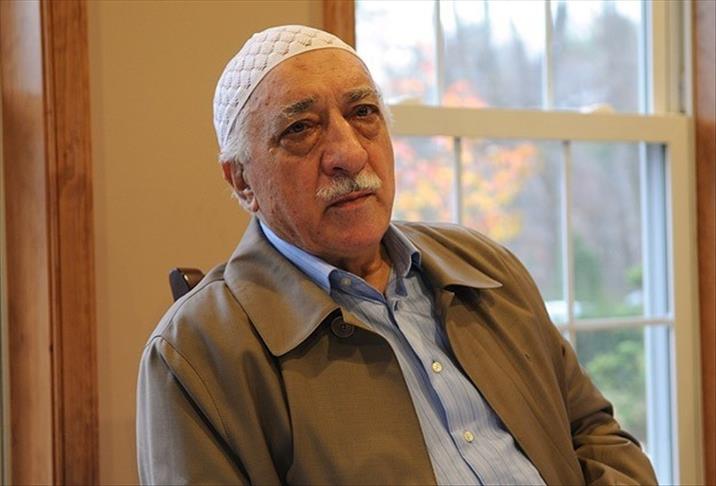
Eyes are on the United States regarding the future status it will give to Fethullah Gulen, the Pennsylvania-based controversial Turkish scholar, as Turkey argues for his extradition.
For a person to be extradited from the U.S., the offence (crime. guilt) he/she is accused for must be considered as offense also by U.S. laws, an international law expert said.
Turkish Foreign Ministry spokesperson said Tuesday that the Turkish government told the U.S. authorities on Jan. 26 that it canceled Gulen’s passport for providing false statement.
Previously, an Istanbul criminal court issued an arrest warrant on Dec. 19, 2015 for Gulen as part of a probe into "parallel state" operation in December 2014.
The Turkish criminal court has said that "the suspects established an illegal organization with a hierarchical structure that is separate from the state's own structure," adding that the accused aimed to "seize influential posts that govern Turkey's social, economic, military and administrative mechanisms."
Prof. Dr. Julian G. Ku, international law expert from Hofstra University in the U.S., told The Anadolu Agency: “Basically, the US Justice Department, in the case of a request, considers if it has the extradition obligation according to the U.S.-Turkey extradition agreement.”
“If the imputed offence (crime, guilt) is considered as offense also according to the American laws than the extradition may be considered,” he said. “However, the US can reject the extradition if it will be convinced that the request has a political aspect.”
Gulen has been in the U.S. since leaving Turkey in 1999 for “medical reasons.” Shortly after his departure, Turkish prosecutors opened a case against him for incitement to attacking the secular state. He was acquitted in 2008.
The current Turkish government accuses the Gulen movement of forming an illegal foreign-linked "state within the state," mainly within the police and the judiciary, which eavesdropped on thousands of people and sought to target the government.
US's bilateral extradition agreements
The United States currently has bilateral extradition agreements with more than 100 countries, including Turkey, according to the U.S. Justice Department.
A document published in Federal Criminal Code and Rules webpage, says that U.S. has a bilateral extradition agreement with Turkey since June 7, 1979.
The U.S. Justice Department says that extradition involves four basic steps: contacting the Office of International Affairs; making a preliminary determination of extraditability; deciding whether to ask for provisional arrest; and submitting the required documents in support of the formal request for extradition.
The law departments of the Office of the International Affairs consider the documentation and, when found reasonable, send it to the Justice Department.
Once the Justice Department accepts the documentations, it informs the regional prosecutor’s office where the person is resident in order to issue an arrest warrant.
The court then decides whether to extradite the required person after hearing their arguments.
Turkish national extradited by U.S.
The U.S. has extradited many people accused on different crimes, including murder, fraud, political crimes, terrorism etc.
Among those extradited is also a Turkish national accused of spying.
Huseyin Yildirim emigrated from Turkey to Germany where was implicated in spying in 1987.
He was arrested in 1988 and accused of transferring U.S. military information to the Eastern Block countries during the cold war, and sentenced to life imprisonment in U.S.
In Dec. 2003, Yildirim was released from a U.S prison and extradited to Turkey, where was sentenced to 15 years in prison on charges of spying. But, Yildirim's sentence was reduced to one day in prison after taking into consideration his prison years in the U.S.