By Betul Yuruk
GENEVA
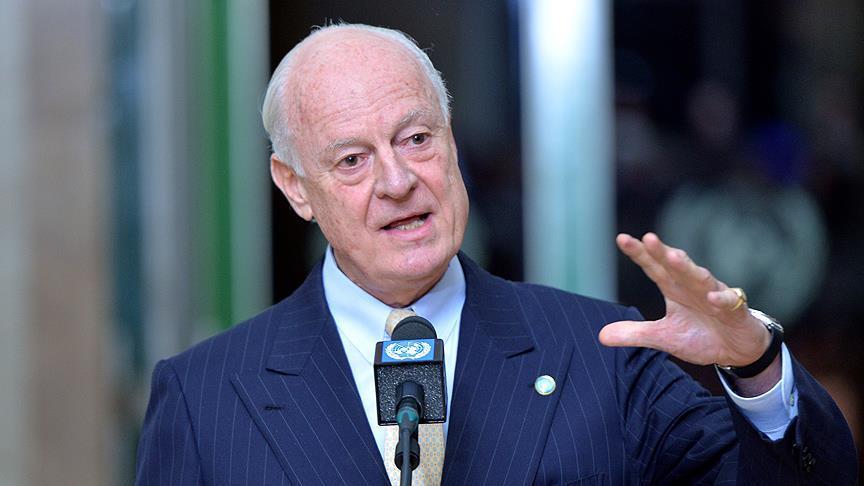
The UN’s special envoy for Syria has welcomed the “legitimate” demand by the opposition for the release of prisoners held by the regime.
More than 65,000 people, mostly civilians, have been forcibly abducted in Syria since the conflict began in March 2011, according to the Syrian Network for Human Rights. The vast majority of abductees were seized by the government.
The opposition High Negotiations Committee has called for the release of detainees, especially women and children, held by the Syrian government and has submitted a list of more than 170 political prisoners.
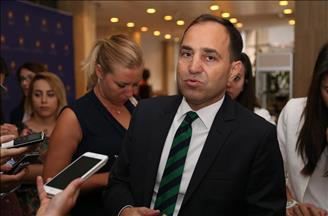
“Those demands are legitimate,” Staffan de Mistura said in an interview with Anadolu Agency at the UN's offices in Geneva on Thursday. “There are thousands of people who are, according to opposition records, prisoners and [have been] prisoners for a long time, including women and children.”
De Mistura, who was appointed in July 2014 to find a resolution to the civil war, said he had raised the prisoner issue several times with the Syrian government.
“We have the list of them,” he said, adding that the release of prisoners would be “very much an important point” in UN-brokered talks between opposition and regime delegates due to resume on Monday.
Turning to another central issue - the provision of humanitarian aid to besieged towns and villages - de Mistura said the UN failed to reach any besieged areas last year but since the cessation of hostilities came into force on Feb. 27, 10 of the 18 besieged areas had been relieved.
“The cessation of hostilities certainly helped otherwise we would not have reached 135,000 people [and] 10 out of 18 besieged areas have been reached,” he said.
On Wednesday, the UN said more than 500 trucks had delivered aid to 238,485 people.
However, the Italian career diplomat noted that around 200,000 people were still living under siege conditions in Deir al-Zor, eastern Syria. These and other remaining besieged areas would be prioritized for relief once a “substantial” agreement is reached at the Geneva negotiations, he added.
“Of the five years of conflict, some of these areas have been besieged for more than three years… that is why we will continue to pushing for that, because we see that some results have been taking place but it is not enough,” he said.
Elections
Under the road map for Syria, presidential and parliamentary elections are due to be held in 18 months. De Mistura said the talks, which are aimed at political transition, a new constitution and elections, was the best way of finding a solution to the five-year conflict.
More than 250,000 Syrian have lost their lives in the war, which began as anti-government protests as the Arab Spring swept across North Africa and the Middle East. At least 11 million have been forced from their homes, according to UN estimates.
Questioned about a possible alternative to the negotiations, he warned: “If the talks collapse and the cessation of hostilities collapse, and if the humanitarian aid is therefore locked, the alternative is tragic for Syria and for the region. I do not want to even consider that.”
The prospect of holding elections in 18 months when millions of Syrians have been dispersed, many to neighboring countries and further afield, may seem a difficult goal to achieve but de Mistura’s experience in other regional trouble spots has given him reason to be optimistic.
“I have been organizing myself, in my UN role, elections in Iraq and Afghanistan and that was in the worst period of those conflicts,” he said.
“Of course, nothing is as bad as Syrian conflict, I agree on that and we all agree... but we were able to organize the elections and they were more or less credible because they were quite inclusive.
“Now 18 months is ambitious but it is doable if we move on governance and on the new constitution.”
Next week’s talks will see the High Negotiations Committee and the Syrian government attempt to reach accord on the future of Syria. One group that will not be present is the PYD, which is considered a terrorist organization by Turkey but has been supported by the U.S. and Russia.
However, de Mistura stressed the importance of all Syrian communities taking part in the peace process.
“Syrian Kurds are Syrians so I am, of course, very much aware of the importance of including Syrians whoever they are - Christians, Kurds, Sunnis, Shias and every other Syrian... in listening to their opinion but they will not be there on Monday,” he said.
Asked about PYD involvement in future discussion de Mistura said it would depend on the circumstances.
The envoy also praised Turkey for its generosity in hosting around 2.7 million Syrian refugees. “I have been there and seen how they are properly treated by your own people,” he said. “They would love to come back to their own country and be able to be part of the future of Syria as well.”