By Shazia Yousuf
SRINAGAR
A swarm of people buzzed outside the polling station in the remote border hamlet of Malangam in the north of Indian-held Kashmir on Nov. 25.
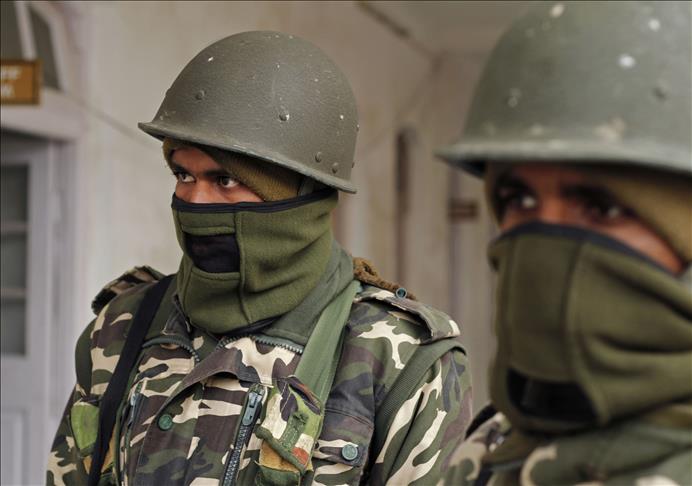
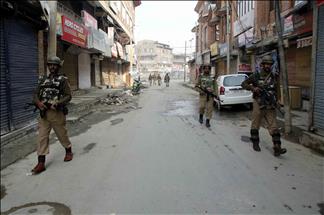
Men stood in long queues and women, their faces covered with the ends of their scarves, stood in another. It was around two in the afternoon and under the supervision of Indian Border Security Force soldiers, almost half of Malangam's votes had been cast.
It was the first phase of state elections in Indian-held Kashmir; the restive region which has for decades sought the elusive Right to Self Determination -- promised by India in the U.N. -- and independence from Indian rule.
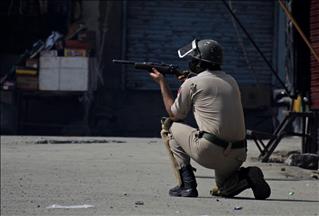
During that time, the region witnessed a popular armed movement against Indian rule that was put down by the Indian state, scores of massive people's rallies supporting independence, months of complete shutdown, and the regular event of young boys throwing stones at gun-toting Indian soldiers.
Malangam is one of the last villages in Kashmir's Bandipore district and across the mountains lies the other half of Kashmir, held by Pakistan. In the 1990s, Malangam became a launch pad for young Kashmiri men crossing to the Pakistani side, known as Azad Kashmir, for arms training. Hundreds of Malangam's own youth joined the militancy and scores were killed in the following years.
“We have more than a hundred martyrs from this village and our graveyard is full of sacrifices,” said Mohammad Shakeel Khan, a voter. “We remember their sacrifices and how brutal the soldiers were to us and we know that we should not take part in these elections but our conditions of poverty and powerlessness force us to vote.”
Choosing to vote, or not, is the issue at the heart of all elections in Indian-held Kashmir. While the pro-Independence resistance leadership calls for boycotts, pro-India Kashmiri politicians contesting them claim that these elections are only for local administration, with no effect on the disputed nature of IHK and are not a substitute to the promised plebiscite. The Indian state has previously used voting in the election to claim the Kashmiri people have sanctioned its 'democratic rule' in the region.
Resistance leaders and activists were imprisoned the same day the elections were announced by the Indian Government, a routine operation. This time however, many in the region have forgotten about them, busying themselves instead with the myriad debates around the elections and in party rivalries and electoral festivities and the churning out of the four high turnout election phases completed so far.
While the first and the second phases saw a turnout of 71 percent, the third saw 58 percent votes being polled and in the fourth phase, there was a 49 percent turnout.
Like Khan, many of the voters felt guilty, even though they said their vote was toward a more accountable local Government and not a vote for India.
“We boycotted the last elections and the elections before that, but what happened? A Government was still formed and the guy who was elected from our constituency told us that he wasn’t responsible for us who didn't vote,” says Ghulam Mohammad Bhat, a 56-year old barber, who cast his first vote since the rigged elections of 1987, which became one of the reasons for the armed movement. “And we bore the brunt of a lot of brutality without anyone whom we could go to for help, so we want to change that and elect a representative.”
Change, in fact, was the buzzword among the voters, though few could explain its meaning.
“We want change and we hope that change will come with our vote,” said a young student in Budgam in Central Kashmir. But what did he mean by change? “Change in everything. Just change,” he replied.
For many of Kashmir's 6 million people, their region has become a vortex of violence and political uncertainty. They live amid more than 600,000 permanently stationed Indian troops, whose actions do not come under the purview of even Indian law. Almost everyone has lost a son, a brother, a friend or a father. Everyone was calling for a change.
Many felt that could be achieved by voting, to remove the National Conference party which has mostly been at the helm for the last 67 years, and also stop the march of India's ruling Hindu nationalist Bharatiya Janata Party, which has been eyeing influence in Kashmir.
“We are grasping at anything like a drowning man grasps at hay straws,” Rehti Begum, an old woman in south Kashmir's Anantnag constituency said after casting her vote.
Rehti's nephew, a militant, was shot dead by Indian soldiers in 1999. Her grandson was disabled in 2010 when Indian soldiers fired on a protest.
“We also need jobs for young people here, we need roads and electricity, we need water. Who will give all that if we don’t vote?” she said, immediately adding: “But the blood of the martyred youth will not go waste either. It will get justice.”
“On the day of judgement,” she says.
- The boycott continues
Between the waves of voting, there were still islands where the boycott held strong. In those areas, many felt a loyalty to those killed in resisting the Indian presence in Kashmir, saying they could not take part as the Indian government uses elections to justify their rule of the region.
In the region's capital, Srinagar, the voting was 28 percent. In Sopore, one of the major towns in north Kashmir, the voting was 30 percent, in Tral, it was 37 percent. There were scores of polling stations where negligible or no votes were polled but almost everywhere, the participation in elections saw an increase from the last time.
“Four of our friends were killed by the Indian soldiers right here in 2010, hundreds of people from this village have been killed in last 25 years, why should we vote?” said Mukhtar Ahmad, a young shopkeeper in north Kashmir's Palhalan village.
Palhalan, one of the biggest villages in Pattan constituency, is one of the few places where there were no election posters or bunting and where no candidate came to campaign for the more than 6,000 votes.
“If we take part in the elections, then how can we claim to reject the Indian rule that we are living under? We must resist this dream of roads and jobs and water and electricity, and our village does resist,” Ahmad said. “People who have to vote can vote, but we won't.”
www.aa.com.tr/en