By Rafiu Ajakaye
ILORIN, Nigeria
The website of Nigeria's independent electoral commission was hacked on Saturday as Nigerians went to the poll to elect a new president and parliament.
The hackers posted cartoons of incumbent President Goodluck Jonathan and his main challenger Muhammadu Buhari on the site.
Kayode Idowu, a spokesman for the commission, said the situation is being addressed.
"No cause for alarm," he told The Anadolu Agency.
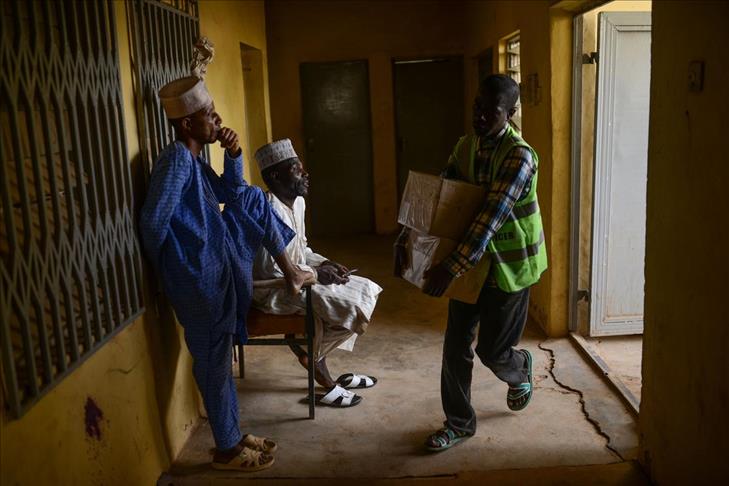
Voting got underway across much of Nigeria, although accreditation has not been concluded in several areas where it started behind schedule owing to issues of late arrival of officials and materials.
Where accreditation is delayed, voting commencement would also be delayed to enable voters on queue to accredit.
Voting is taking place at 119, 973 polling centers across the country and will end after the last accredited voter had cast his/her ballot.
Nigeria has a total of 68,833,476 registered voters, down from 73.5 million four years ago. The reduction has been attributed to the recent elimination of double registration.
Only 56,431,255 eligible voters (some 82 percent of the total) have obtained permanent voter cards (PVCs), without which voters cannot cast ballots.
Fourteen parties are fielding candidates in the presidential poll, all of whom – with one exception – are male. There are, however, four female vice-presidential candidates.
The race is largely between incumbent President Goodluck Jonathan of the People's Democratic Party (PDP), which has ruled the country since 1999, and Muhammadu Buhari, a former military ruler who is running on the ticket of the opposition All Progressives Congress (APC), an amalgam of political interests.
The winner must clinch more than 50 percent of all valid votes plus a mandatory 25 percent in two-thirds of the country's 36 states.
If no candidate is able to win outright, the two frontrunners will compete for a simple majority in a runoff vote.
Nigerians are also electing a new parliament.
A total of 2,537 candidates from Nigeria's 28 registered parties are contesting in the election into the American style two arms of the parliament – 360 House of Representatives seats and 109 Senate slots, three each from the country's 36 states and one for Abuja, the federal capital.
Details from the electoral body say 747, including 126 women, are contesting for the Senate seats while 1,790, including 254 women, are contesting the House of Representatives seats.
Although polling officers are allowed to say how many votes each party won at the polling unit level, tallying will go on through the night and into the next day, when results will be officially announced.
Nigerian law forbids the media and observers – even political parties – to announce any "unofficial" results.
Aggrieved parties have 30 days from the election to legally challenge final poll results.