By Okech Francis
JUBA
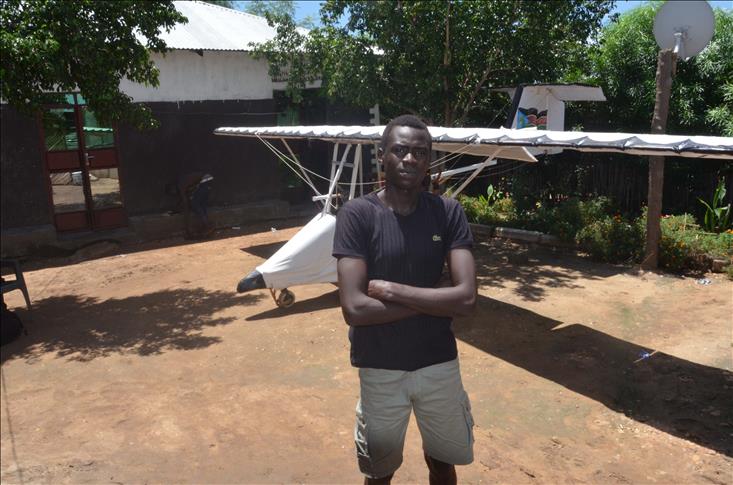
While most South Sudanese are caught up in the year-long political crisis that has engulfed the nascent country, George John Mel, a 23-year-old high school dropout, remains focused on his childhood dream: building airplanes.
Born third in a family of six children, he lives in a small compound roughly 1km from army headquarters in Juba.
The first thing that catches one's eye in the compound is a small airplane powered by two small petrol engines similar to those used in lawnmowers. But it hardly looks like it can fly at high altitudes or for long distances.
"Actually, this ultra-light is meant to fly at low altitude because it is supposed to be covered," Mel told Anadolu Agency during a visit to his small makeshift workshop – which also doubles as his bedroom – in the family's compound.
"I am supposed to put glass. And the pressure change up there is a little bit different from down, so the more you go, the stronger the pressure becomes," he explained. "I designed it to go for low altitude."
"This is not my first project; I have been doing it [amateur aircraft design] for quite a long time," said Mel, who failed to pursue a university education after the death of his father, the family's sole breadwinner, in 2011.
"Since I lost my dad, I didn't proceed with my education," he said. "I didn't join any other [learning] institution… but I was so tick on what I wanted to do because my dream is to make aircraft for South Sudan, not fly them."
"When I look at aircraft, I don't look at flying it or maintaining it, but how to build it," he said.
Mel asserted that his interests went beyond simple aircraft construction to include high-tech aircraft design.
"Actually, my specific interest isn't even aircraft construction; it's mainly unmanned aerial vehicles (UAVs), or drones," he said.
True to his words, the walls of his workshop are plastered with designs – downloaded from the internet – for various drone aircraft and missiles, along with some of his own designs.
"This is what I mainly specialize in," Mel told AA. "For the first drone I designed, I didn't have equipment like GPS-satellite to control it."
"That's why I came up with the idea of building a plane that could carry a person," he added. "My focus is mainly on UAVs."
The young man, who can speak quite knowledgeably about aircraft, always consults the internet when embarking on a new project.
"I do research on my own through the internet sometimes to guide me, because without knowing the principles of flight, you will end up doing things you aren't sure of," said Mel.
Challenges
Mel conceded, however, that – as with any other innovation – there were challenges.
"Meeting requirements, getting resources and materials for putting this work in place is always my major challenge," Mel told AA. "Also, the environment I am in does not favour this work."
"Sometimes you are discouraged by people and told funny things, but I still proceeded with it," he said.
Money, too, remains a major challenge for the budding aviator.
"For the financial part of it, I just get a little money [with which] I buy the engine, the materials, and then do something to proceed with my work," he explained.
"I have a lot of aircraft designs on my mind that I want to release, but the only challenge I have is the [lack of] funds to support it," he said.
Mel has been approached by both the South Sudanese army and air force, both of which have pledged to support him – pledges, he said, that had yet to materialize.
"They came, saw my project, and promised to help me – but you know how the government is," he told AA.
"I asked them to test it, but they told me that, right now, they had seen what I had done but that they didn't want to lose me because they didn't trust the material I used," added Mel. "They told me the engines may not be appropriate for flight testing."
"They prefer that I go for studies so that, in future, they will make something better than this. But me, I trust it; I believe I can take it and it can fly," he insisted.
South Sudanese Air Force Commander Maj. Gen. Pakwany Kur, for one, recognizes the young man's talent.
"He is already with us; we are interested in his project," Kur told AA, adding that discussions over Mel's educational career were already underway.
"I have already asked the Education Ministry undersecretary to write an official letter to us [saying] that the ministry has offered him a scholarship," he said.
"I advised him [Mel] to write a letter of commitment and, so long as there is a letter of commitment, we shall know where to take him," said Kur.
According to Education Ministry Undersecretary Bol Deng, steps are already being taken to further Mel's education.
"We have already informed him to make contacts where aerospace studies are available and he has informed us of a university in Australia," Deng told AA.
"We have also told him to supply us with his documents, which we began processing," he added. "The most important thing is the tuition; we can inform the minister and then the money will be made available."
The undersecretary, however, said the government preferred that Mel studied in a country that has good relations with South Sudan, particularly in terms of education.
"We could possibly send him to India, Pakistan or Egypt," said Deng. "I have asked Air Force Commander Pakwany [Kur] to give us details of study programs in Egypt, where he has been. This is what we are still waiting for."
Mel, for his part, prefers to be given the chance to prove that his aircraft designs actually work.
"I prefer that the government gives me the opportunity to go and test it [my designs]… I am sure of what I have built," he said.
Despite his uncertain future, Mel remains optimistic that he's on the right track.
"My future plan is to see this country produce its own aircraft," Mel told AA. "If I can get more educated, I believe we can do something greater than this."
He added: "This is what I have loved all my life."
englishnews@aa.com.tr
www.aa.com.tr/en