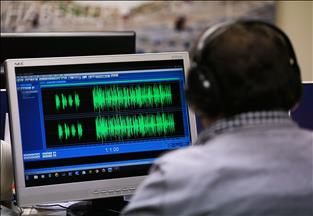
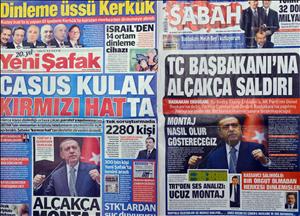
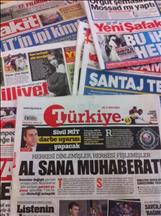
Turkey was rocked Monday by an alleged wiretapping scandal of massive proportions as pro-government local dailies Yenisafak and Star published a list of 3,000 prominent journalists, activists, writers and political party members whose phone calls were monitored by the "parallel government" in Turkey.
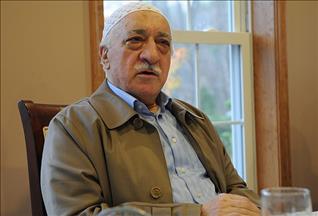
The list was allegedly compiled over a three year period two Istanbul-based prosecutors, Adem Ozcan and Adnan Cimen, both of whom allegedly have links to the Hizmet ("Service") movement, led by U.S.-based Muslim cleric Fethullah Gulen. Both prosecutors have denied ordering the wiretapping activity.
The Hizmet movement allegedly has members within the Turkish police and judiciary, allowing it to control certain parts of the judicial and the law enforcement establishments and the creation of a "parallel government" in Turkey.
Turkish Prime Minister Recep Tayyip Erdogan claimed in late 2013 that the country's democracy was under threat from a group with international links that constitutes a 'state within a state,' referring to the Hizmet movement.
Erdogan and senior government officials have blamed the group for attempting to exude its influence with an anti-graft operation that began on December 17, 2013.
"Some police officers, prosecutors and judges in this country are receiving orders from other places, not from the people," Erdogan has said at a gathering in Istanbul.
The investigations created a rift between the Turkish government and Gulen's movement.
Taha Ozhan -- head of the Ankara-based Turkish think tank SETA -- said, "We will see a real crisis unfold when we know the reason for the wiretapping of all these names."
Mithat Sancar -- a professor of law at the Ankara University and a victim of the wiretapping -- said, "This scandal is not just a routine event... it is a key part of a conspiracy by the parallel state, or whatever you want to call it."
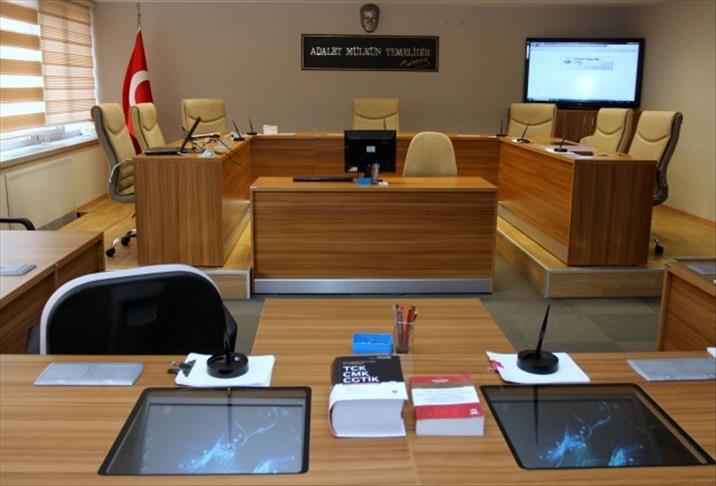
The two prosecutors allegedly ordered the massive wiretapping under a terror probe into a so-called 'Salam' organization. The investigation was run by an Istanbul court under Turkey's controversial counter-terrorism law.
On Monday, Turkish journalist Nihal Bengisu Karaca said in her column, "The list made me think that if the December 17 operations would have succeeded, those names on this list were to be arrested by the parallel state."
Daily Star’s editor-in-chief, Yusuf Ziya Comert, told the Anadolu Agency: "Wiretapping is a judicial scandal because prosecutors linked to the parallel state have created a dossier that includes everyone they wanted to record."
"The wiretapping issue is only propaganda. It's better to wait to hear more before making any comments," said influential Turkish journalist and writer Etyen Mahcupyan.
Opposition parties also called the wiretapping scandal a violation of privacy rights.
Republican People Party (CHP) leader Kemal Kilicdaroglu questioned the government's inability to prevent the scandal, while CHP Deputy Chairmain Akif Hamzacebi said an inquiry should be launched against those responsible for the alleged wiretapping.
Kurdish Peace and Democracy Party (BDP) deputy Hasip Kaplan said they were not surprised with the scandal as "we have been wiretapped for years."
Erdogan called the December 17 operations an attempted coup planned by an organization determined to undermine the national will and democratically elected government.
AK Party Deputy President Yasin Aktay has called the anti-graft investigations a "coup attempt" by the Gulen movement. Aktay has been sued by Gulen’s lawyer for slander.
englishnews@aa.com.tr