WASHINGTON
A possible two-state solution to Israeli-Palestinian conflict would require Israel to return to borders that existed before the 1967 Middle East war, Turkish Prime Minister Recep Tayyip Erdogan said.
In search for a solution to the long-boiling conflict, Erdogan referred to the 'four proposals' of the Middle East Quartet, comprising the United Nations (UN), the United States (US), the European Union (UN) and Russia.
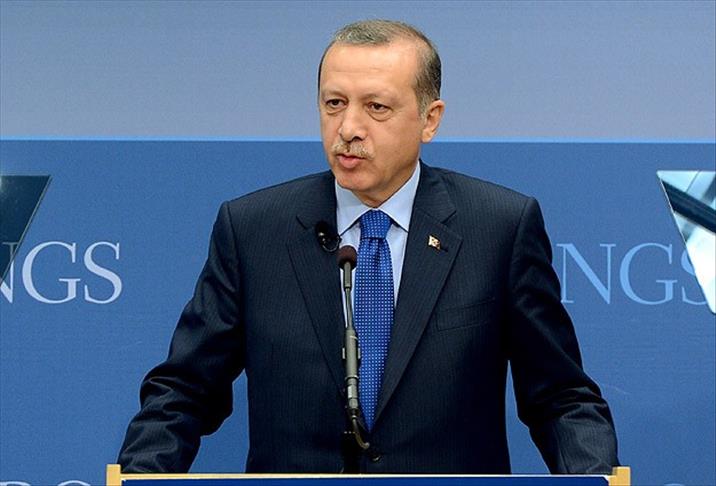
"The most important of those four proposals was the number one, which is the issue of borders," Erdogan told a gathering of press members after his address at Washington-based think tank Brookings Institution. "It is requisite that Israel return to '67 borders."
The establishment of a Palestine state was a necessary condition in order for there to be a peace process, the prime minister said.
"The two-state solution was always at the forefront of discussions regarding the conflict, now we see that some of those who accept the Israeli state cannot say yes to a Palestinian state," Erdogan said. "What to talk about peace unless Israel accepts a Palestinian state first?"
Erdogan said Turkey approached the conflict as if it were a domestic issue.
"I don't say 'it's a domestic issue for us' but we approach it with that sensitivity," he said.
Hamas-Fatah reconciliation
"First and foremost, we need to see a reconciliation between Hamas and Fatah," Erdogan said. "I don't believe a conclusion can be reached in the Israeli-Palestinian peace process unless they agree."
Erdogan said Turkey could do a lot to bring the two Palestinian groups together.
"We're on good terms with both Hamas and Fatah and communicate well with both. As far as we're concerned, there is no difference between them, all are our brothers," he said.
Syrian sufferings 'must be addressed at UN
According to NATO findings, Syria shot 283 rockets and purportedly used a chemical weapon called sarin, Erdogan said.
"All this needs to be brought up at the Security Council and even discussed at UN General Assembly," he said.
No-fly zone
A no-fly zone over Syria would only be enforced by the decision of the Security Council, not through a joint action by the United States and Turkey, Erdogan said, adding the planned peace talks, the second round of the 'Geneva process', would be backed by his country.
The first Geneva process last June brought together major powers under the same roof, only to end in a failure to call for the ouster of embattled Syrian leader Bashar al-Assad, and saw the countries agree instead on a plan for political transition with little practical value. Erdogan had then described the talks as a "vain attempt."