By Andrew Jay Rosenbaum
ANKARA
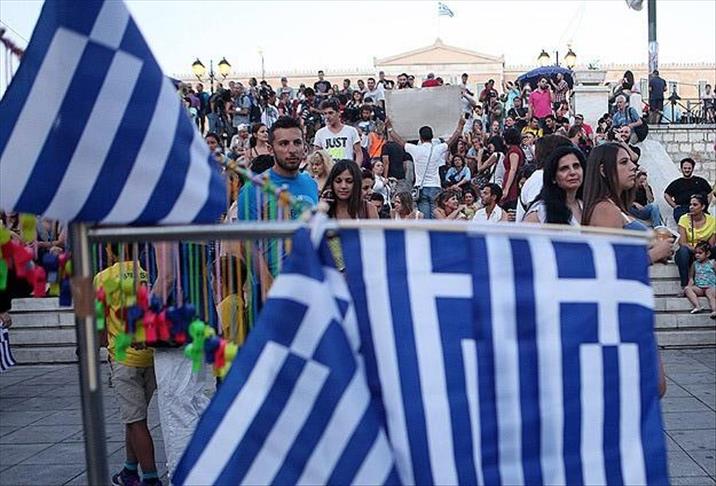
What would a “Grexit” mean to Turkey? Greece has until Sunday to come to agreement with its European credit.
Economists told Anadolu Agency that Turkey is relatively safe from the consequences of a Greek exit from the euro.
"Greece is not a major trading partner," Sinan Ulgen, executive chairman of the EDAM think tank in Istanbul, said. In fact, Turkey may find opportunities in Greece once the crisis is over, Ulgen said. "Once the economy stabilizes, there may be increased interest from the Turkish business community for investment in Greece at lower valuations," he added.
"I think the direct implications for Turkey from 'Grexit' are limited. Trade ties with Greece are small, as are direct financial ties (except the subsidiary of one Greek bank). So long as problems remain contained to Greece, there is unlikely to be much impact on Turkey," William Jackson, emerging markets economist with Capital Economics in London, said.
"This probably helps to explain why Turkish financial markets have performed relatively well in recent weeks," Jackson said.
About 20 Turkish businesses operate in Greece, according to Turkish government statistics. The largest is the state-run, Ziraat Bank, with about $90 million in investments.
Turkish banks do not hold a large amount of Greek assets, and nor is there a large outstanding loan portfolio to companies in the country, according to the Turkish central bank.
But the danger for Turkey would come in a generalized capital flight from emerging markets.
"A ‘Grexit’ scenario could increase risk aversion in financial markets and stem the inflow of funding to emerging markets. As an economy with a yearly borrowing requirement in excess of $200 billion, Turkey would be vulnerable to such changes in investor confidence," Ulgen pointed out.
Jackson concurred. "The risk for Turkey is that a 'Grexit' might trigger contagion to other parts of Europe, leading to broader financial market stress. In the worst case, this could lead to weaker capital flows to emerging markets [as it happened when the threat of ‘Grexit’ first flared up in 2011] and, in this event, the Turkish lira would come under pressure. That would push up inflation and foreign currency debt burdens in Turkey, and might force the central bank to raise rates," Jackson said.
But a Grexit scenario would also have an impact on Turkey-EU relations, Ulgen continued.
"As ‘Grexit’ unfolds, the EU would be faced with significant political and institutional challenges precluding the possibility of the EU leadership to focus on enlargement," Ulgen said.
There are concerns that, if Greece should find itself not just out of the eurozone, but out of the EU, it would no longer be able to rely on European neighbors for its defense, according to Nicholas Sambanis, a professor of political science at Yale University.
In a note published in the Washington Post in May, Sambanis worried that a friendless Greece could create a point of vulnerability in the Eastern Mediterranean. Continuing membership in NATO might also come into question.
What is clear about a 'Grexit,' is that nothing similar has ever happened before, which is why European Central Bank President Mario Draghi refers to it as "a trip into uncharted waters".
But Turkey, as the economists point out, is ready if the voyage into “uncharted waters” begins.