Andrew Jay Rosenbaum,Bahattin Gönültaş
26 January 2016•Update: 28 January 2016
ANKARA
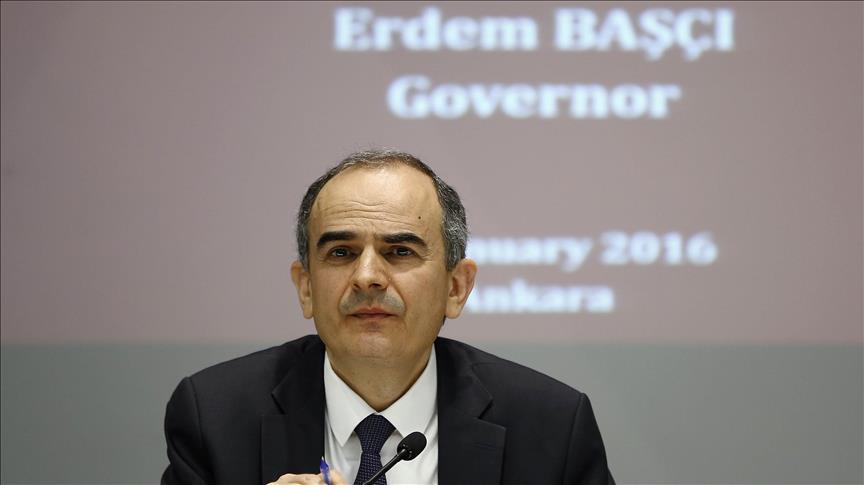
Turkish central bank governor Erdem Basci said on Tuesday that the plan to bring together short-term interest rates -- the overnight and one-week repo rate -- would be delayed.
Speaking at the press conference held to release the Central Bank’s Quarterly Inflation report, Basci said that it was too early to bring together short-term interest rates; the wide "corridor" was and will be useful in periods of high volatility.
The one-week repo rate is currently 7.50 percent, and the overnight lending rate is 10.25 percent -- the distance between them is referred to as the 'corridor.' The Turkish central bank left these rates unchanged in its last monetary policy meeting on Jan. 22. Rates have not gone up for 11 months.
In the inflation report, the bank commented: "Current tight monetary policy reduces the economy’s sensitivity to global shocks, thus supporting financial stability. The CBRT maintains the view that tight monetary policy may be implemented within a narrower interest rate corridor, should the global volatility decline persistently or policy measures that would maintain and improve the gains in external balance and financial stability be implemented effectively."
The bank could take steps to support the Turkish lira if exchange rate volatility continues, the report said.
The bank's principal concern, Basci said, was to bring down inflation.
"The bank maintains a tight monetary policy stance to achieve the price stability objective," the governor said. "The measures implemented recently to support the FX liquidity, core liabilities, and long-term borrowing have enhanced the resilience of the economy."
Basci said that the inflation rate will fluctuate between 6.1 percent and 8.9 percent through end of 2016. ''The mid-point will be 7.5 percent in 2016 and 6 percent in 2017," he added.
In 2015, the annual inflation rate rose to 8.81 percent in December, far higher than the bank's target, the Turkish Statistical Institute reported on Jan. 4. Basci said this was due to rising prices for unprocessed foods. The government's food commission is to investigate certain food price rises deemed excessive, including that of red meat and bread.
The government has planned actions in its Medium-term Economic Program to stabilize inflation. The goverment aims to reduce inflation to 7.5 percent in 2016, to 6 percent in the next year and to 5 percent in 2018.
Deputy Prime Minister Mehmet Simsek, in charge of the economy, on Jan. 4 pledged to “maintain solid steps in the fight against the rising inflation rate in 2016.”
In his speech, Basci said that the bank would send a letter on collaborating with the government to fight inflation on Tuesday.
In the Quarterly Inflation Report released on Tuesday, the central bank said its "medium-term fiscal policy stance is based on the Medium-Term Program projections covering the 2016-2018 period. Conditional on this outlook, inflation is expected to improve gradually and reach the 5-percent target in the medium term."
Factors cited in the report as driving inflation higher were the minimum-wage-hike -- the government has increased the minimum wage to 1,300 Turkish liras ($429.31) per month from 950 Turkish liras ($313.73) per month -- administered price changes, and pressure from the underlying trend of inflation.
But lower oil prices helped with downward pressure on inflation, the report said.
The report noted that commercial loans continued to grow at a faster pace than consumer loans in the fourth quarter of 2015, following the same pattern since early 2014 -- loan growth has been controlled by the bank's macro-prudential (credit control) policies.
"These developments in loan growth and loan composition are expected to contribute to the rebalancing process and financial stability as well as to limit the effects of the recent cost pressures on inflation," the report said.
The report noted that, according to the GDP data of the third quarter of 2015, economic activity proved more robust compared with the outlook presented in the October Inflation Report, and the GDP grew steadily by 1.3 and 4 percent on quarterly and annual bases, respectively.
"On the spending front, final domestic demand increased modestly in the third quarter, while external demand contributed positively to the GDP after three quarters," the report said.
"In fact, exports towards the European Union countries have recently recorded a remarkable acceleration," the report said.
Thus the improvement in the current account, around 4.5 percent of GDP last year, is expected to continue.
"Uncertainties surrounding global monetary policies and concerns over global growth cause financial markets to remain volatile. Thus, portfolio flows to emerging market economies and risk indicators follow a highly volatile pattern. Exchange rates also display a quite fluctuating course. The CBRT assesses that the policy tools laid out in the road map announced in August 2015 strengthen the resilience of the economy against global shocks," the report continued.
The wide corridor will be maintained until there is less concern about global volatility and exchange rates, the report said.