ANKARA
Anadolu Agency does not verify these stories and does not vouch for their accuracy.
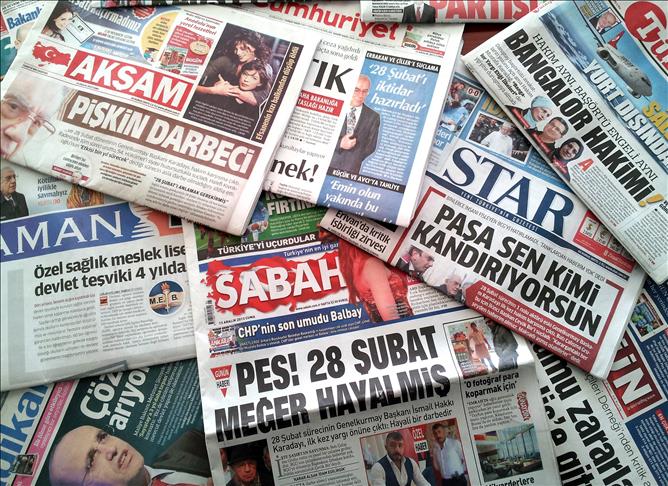
Turkish dailies on Friday, December 13, 2013 mainly cover the trial of Turkish former Chief of Staff General Ismail Hakki Karadayi for perpetrating the February 28 coup and the execution of Mollah Abdel Quader by the Bangladeshi government.
- General Ismail Hakki Karadayi claims that he has nothing to do with the coup of February 28 in Turkey -
Turkish General Ismail Hakki Karadayi was tried on Thursday. He was the Chief of Staff when the Turkish Army overthrew the government in 1997 following a National Security Council (MGK) session held on February 28, 1997. Karadayi rejects that he was one of the key participants in the process.
The Daily SABAH headlined the trial of General Karadayi and wrote “28 Feb was but a dream.” The daily wrote that Karadayi claimed that the army never attempted to overthrow the government.
General Karadayi rejected the coup plans, the preparation of plans and all other steps alleged to be a part of the coup in the Western Studies Group (BCG) as well as rejecting orders for marching tanks in capital Ankara, said the daily.
Daily STAR headlined the case writing “Who do you think you are fooling Pasha?” The number one participant of 28 February process General Karadayi claimed that he was not aware of the coup plans and the black list prepared by the Western Studies Group, wrote the Daily.
Daily ZAMAN put the headline “Karadayi accuses the Vice Chief of Staff Cevik Bir and former PM of the term Erbakan for Western Studies Group”.
Daily AKSAM also put the case on its front page and headlined “Pushy Coup Maker.”
“… and the Chief of Staff of February 28 term Karadayi is tried but the General forgot the whole process and accused the government of that time. He also claimed that the February 28 process was never a coup which his successor General Kivrikoglu defined as a process which would have an impact lasting for a millennium,” wrote the daily.
On the other hand, daily CUMHURIYET quoted Karadayi and put the headline “28 February was prepared by the ruling government”.
The Daily wrote that Karadayi protected his fellows and accused the politicians of the term of PM Necmettin Erbakan and Deputy PM Tansu Ciller. Quoting Karadayi the daily also said the February 28 process was a “fabrication.”
The February 28 coup also called Post-modern coup, refers to the decisions issued by the Turkish military leadership in a National Security Council meeting on 28 February 1997 which initiated the 28 February process that precipitated the resignation of Prime Minister Necmettin Erbakan of the Welfare Party and the end of his coalition government.
As the government was forced out without dissolving the parliament or suspending the constitution, the event has been labelled a "postmodern coup" by the Turkish admiral Salim Dervisoglu, a label that has stuck. The process after the coup is alleged to have been organized by the Batı Calisma Grubu (West Study Group), a clandestine group within the military.
The follow-up of the 28 February process led to an era of intense violation of religious freedoms in Turkey, e.g. closing of religious foundations, imam-hatip schools and headscarf ban at universities.
- Mollah executed -
Another issue covered largely by Turkish press was the execution of Abdel Quader Mollah. Assistant secretary of Jamaat-e-Islami, Abdul Quader Mollah (65), was executed on Thursday night at Dhaka Central Jail. Mollah was convicted by Bangladesh's International Crimes Tribunal (ICT) of atrocities he allegedly committed during the 1971 independence war from Pakistan. He was scheduled to be hanged midnight on Tuesday but an appeal judge granted him a last minute stay of execution when his lawyers demanded a review of his death sentence. Bangladesh's Supreme Court rejected the appeal for review earlier on Thursday.
Daily STAR headlined the execution of Mollah at the top of its front page “Shame of Execution.” All international efforts to stop the execution remained inconclusive, wrote the daily.
The Daily also wrote that Turkish PM Erdogan called the Bangladeshi PM to review the decision.
Daily RADIKAL also gave a place for the case on its front page and wrote that “42 year accusation ended with execution.”
The International War Crimes Court in Bangladesh was established in 2010 to judge those who had cooperated and sided with Pakistan during the 1971 liberation war of Bangladesh. Mollah was imprisoned for life on February 5, 2013 for six different crimes, including the ordering of 344 unarmed civilians' death.
englishnews@aa.com.tr