Eylul Askin Akcay and Neriman Senanur Torun
14 September 2026•Update: 14 September 2026
- Training covers first aid, personal security, mines, survival techniques, disinformation, protection against FPV drones
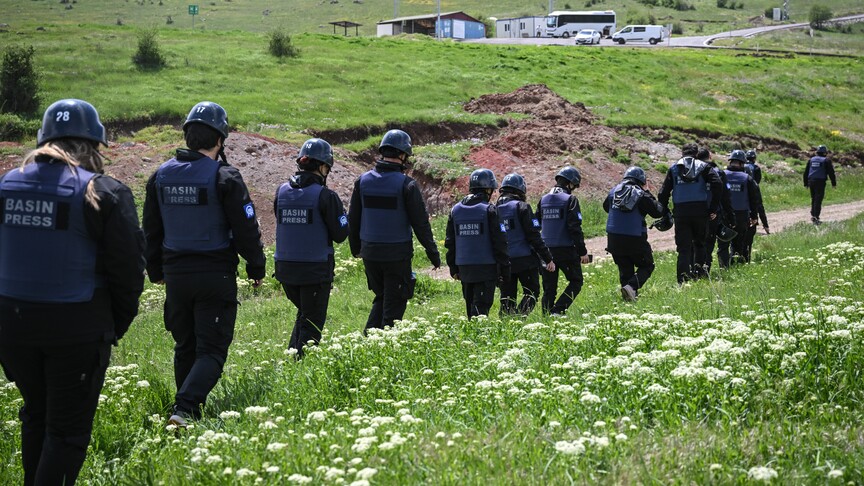
Anadolu on Monday launched the 30th edition of its War Journalism Training Program, aimed at equipping journalists working in war zones, disaster areas, and other emergencies with the skills needed to report safely under challenging conditions.
The 12-day program is being organized in cooperation with Türkiye’s Police Academy and the Turkish Cooperation and Coordination Agency (TIKA).
A total of 25 journalists are taking part, including nine Anadolu staffers and 16 journalists from Laos, Malaysia, Vietnam, Cambodia, the Philippines, Indonesia, and Papua New Guinea.
Speaking at the opening ceremony in Ankara, Anadolu Deputy Director General for Administrative and Financial Affairs Oguz Enis Peru said 654 local and international media professionals have completed the previous 29 editions of the program.
Peru said the training covers subjects ranging from war theory and terminology and the law of armed conflict to first aid, advanced driving techniques, ballistics, explosives, mines, personal security, and survival in water.
Participants will also receive training on technology and information security in emergencies, protection against disinformation and first-person-view (FPV) drones, war psychology, and natural disaster reporting.
"We attach great importance to strengthening the professional competence and field safety of our journalists working in different parts of the world," Peru said.
He added that a course on Asian geopolitics has been included for the first time this year, reflecting the participation of journalists from Southeast Asia and the Pacific.
TIKA deputy head Bugra Aydin said the program has become an internationally respected initiative and commemorated journalists who lost their lives while reporting on Israel's attacks on the Gaza Strip.
"Truth is often hidden behind an impartial and steadfast conscience under difficult circumstances," Aydin said. "The courage and professional dedication you have demonstrated by participating in this training deserve every appreciation."
Police Academy Vice President Fatih Inal described the initiative as a unique certified war journalism training program, saying instructors would share their field experience and technological capabilities with participants.
Inal said he hoped participants would never have to use the skills they acquire in an actual war zone, noting that the training is being held amid ongoing conflicts in various parts of the world.
He dedicated this year's program to journalists and innocent civilians killed in wars, particularly journalists killed in Gaza.
"I want to dedicate this program especially to innocent, defenseless women and children, as well as the journalists who lost their lives in Gaza while practicing fair and honest journalism," he said.
Inal also stressed that war correspondence is not limited to armed conflicts, noting that journalists face similarly challenging conditions while covering earthquakes, floods, wildfires, and other disasters.