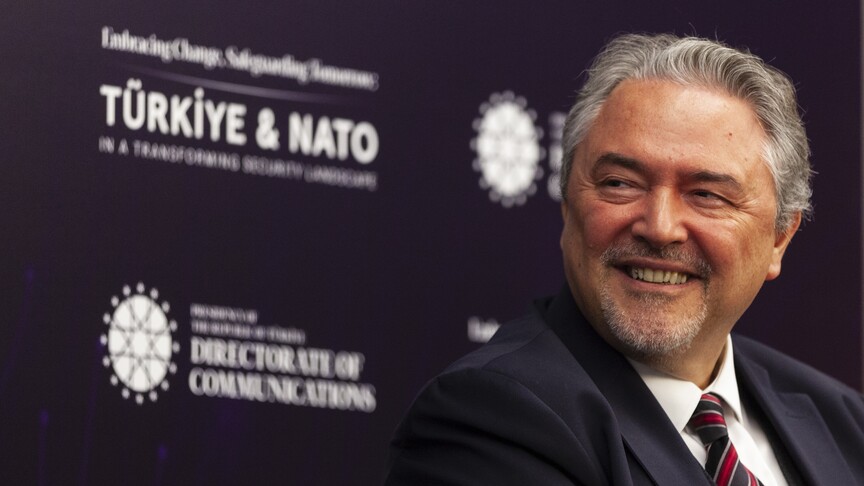
The primary expectation from the upcoming NATO summit in Ankara is a clear demonstration of unity and solidarity among allies, said Türkiye's Permanent Representative to NATO Ambassador Basat Ozturk.
"Türkiye's as well as all allies' collective objective and expectation is to clearly reaffirm unity, solidarity and cohesion among allies. This is the number one expectation," Ozturk told Anadolu at NATO headquarters in Brussels.
He said extensive preparations have been made for the 36th NATO Summit of Heads of State and Government, to be hosted by Türkiye in Ankara on July 7-8, and that the logistical and infrastructure work would set a new benchmark for future NATO summits.
Ozturk stressed the importance of allied leaders arriving in Ankara with a shared determination to succeed together.
He said that unity, solidarity and cohesion should be reflected not only in political statements but also in the successful outcome of the meeting, adding that such political will already exists among allies.
"Undoubtedly, the fact that US President (Donald) Trump will attend the summit and has stated that he is doing so out of respect for our President (Recep Tayyip Erdogan) is very important. This situation shows everyone the weight of our president and that our country will host the summit very effectively," he said.
'Türkiye has a special place within NATO'
Commenting on NATO’s decision-making structures, Ozturk highlighted the significance of the Alliance’s Article 5 on collective defense.
Ozturk said NATO's Article 5 on collective defense remained the alliance's defining feature and distinguished it from other international organizations through its integrated military command structure and decades of institutional experience.
“There is a significant difference between being a NATO ally and not being one,” he said, adding that its integrated military command structure and long-established mechanisms developed over more than 75 years distinguished it from any other regional or international organization.
He said decisions within NATO's North Atlantic Council are made through consultation and consensus, adding that no decision is imposed on any ally.
"Türkiye has a very distinct and special place within NATO," Ozturk said, citing the country's long-standing membership, operational experience and military capabilities.
He also highlighted Türkiye’s progress in its defense industry, including its participation in NATO exercises.
Referring to the “Steadfast Dart 2026” exercise in the North and Baltic Seas, he noted the participation of the Turkish Naval Task Group, frigates, logistics vessels, TCG Anadolu, as well as Bayraktar TB3 armed drones and ZAHA amphibious assault vehicles.
He said the exercise demonstrated Türkiye’s ability to conduct joint operations in full interoperability with NATO, even under harsh winter conditions, contributing to the Alliance’s 360-degree security approach.
Ozturk added that Türkiye’s defense industry capacity, including nearly 4,000 companies, its top-10 global defense export ranking, and a workforce of more than 100,000 engineers and technical personnel, is closely followed and appreciated by NATO allies.
‘NATO 3.0’
Addressing the concept of “NATO 3.0,” Ozturk said the Alliance’s early Cold War phase, described as "NATO 1.0," was based on collective defense and Article 5.
"After the Cold War, a period of relative peace and stability began. During this time, as you know, NATO shifted its focus toward out-of-area operations and missions. That was the prevailing trend of the era. Some of our allies, particularly in Europe, set aside the heavy military equipment inherited from the Cold War period. They also abolished compulsory military service and downsized their armed forces," he added.
However, Ozturk said, Türkiye had not experienced such a "comfort period" because of its geographical location and security environment, remaining in a constant state of readiness.
Referring to longstanding US calls for greater burden-sharing, Ozturk said the "NATO 3.0" vision seeks greater responsibility from European allies as US contributions shift.
"For allies that are ready, there is actually no problem," he said, adding that burden-sharing should be balanced among all allies.
Ozturk also said that creating a separate EU security and defense mechanism was not the solution.
He said the EU could complement NATO allies in areas where it has comparative advantages, but stressed that such support must remain inclusive for all willing allies.
The Turkish permanent representative to NATO said that several restrictions imposed by some EU member states have hindered deeper defense cooperation, calling for remaining barriers to be removed.
“If a common success is to be achieved in the defense industry, this is necessary,” he said, adding that transatlantic cooperation in defense procurement and joint projects is essential.
Ozturk stressed the significance of the NATO Defence Industry Forum to be held during the NATO summit in Ankara, where new joint projects, agreements and contracts are expected to be announced.
He added that if the EU takes the necessary steps, all European allies will become stronger and Europe will also be more secure.