Serife Cetin and Enes Canli
28 September 2026•Update: 28 September 2026
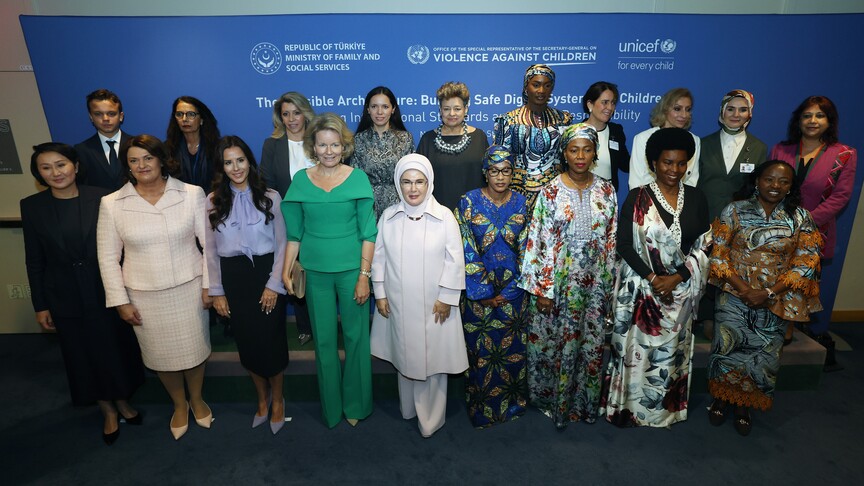
Queen Mathilde of Belgium and the spouses of several world leaders called for stronger international standards to protect children from online risks during a UN panel organized by Türkiye's Ministry of Family and Social Services in New York.
The panel, The Invisible Architecture: Building Safe Digital Systems for Children - Advancing International Standards and Shared Responsibility, was held at the UN headquarters on the sidelines of the 81st UN General Assembly's high-level week.
The event was organized under the auspices of Turkish first lady Emine Erdogan, in cooperation with UNICEF and the Office of the UN Special Representative of the Secretary-General on Violence against Children. It was attended by Turkish Family and Social Services Minister Mahinur Ozdemir Goktas.
Opening the panel, Queen Mathilde warned that rapid advances in artificial intelligence were creating new risks for children.
"Children cannot be the subjects of a global technology experiment or guinea pigs for business models based on data collection and attention," she said.
She stressed that child safety must become a central objective of AI governance, going beyond parental controls, content moderation and data protection.
Preparing children for physical and digital worlds
Serbian first lady Tamara Vucic thanked Emine Erdogan for bringing participants together, emphasizing that children must be prepared for both the physical and digital worlds through education and responsible technology use.
Gambian first lady Fatoumatta Bah Barrow called on governments to enforce stronger laws and urged tech companies to introduce stricter safeguards, warning that online threats can easily cross national borders.
Kenyan first lady Rachel Ruto said children's personal data, locations, photographs and online activities must not be treated as commodities, urging countries to take collective action.
Sierra Leone's first lady Fatima Maada Bio praised Emine Erdogan's leadership and highlighted the need to ensure that technological progress is accompanied by stronger protections against online exploitation, cyberbullying and privacy violations.
Lebanon's teen suicide
Lebanese Prime Minister Nawaf Salam's wife, Sahar Salam, called for greater oversight of AI systems, recalling the suicide of a 15-year-old child in her country who was found to have been chatting with an AI system.
She stressed the need to monitor how such systems respond when children turn to AI during difficult times.
"We cannot expect children to understand the commercial logic of algorithms or assess whether an AI response is psychologically appropriate," she said.
Other participants, including the spouses of leaders from Lithuania, Burundi, Guatemala, Senegal, Romania, Chile and Canada, emphasized the importance of international cooperation, enforceable regulations and greater accountability for technology companies.
UNICEF Child Protection Director Sheema Sen Gupta praised Türkiye's efforts to place children's online safety higher on the global agenda, stressing that protecting children in digital environments is not merely a national priority but a global responsibility.
UN Special Representative on Violence against Children Najat Maalla M'jid also called for stronger accountability, emphasizing that governments, technology companies and the wider digital ecosystem share responsibility for creating safer online environments.