ANKARA
Ukraine's Interior Ministry issued a statement Wednesday, saying security forces did not use firearms in clashes that killed 25 people, amid reports that protests are spreading across the country.
Those killed include nine police officers and one journalist with more than 300 people injured, according to the Health Ministry.
Violence erupted after Tuesday's parliamentary vote to restrict the president's powers was blocked by pro-government MPs.
The government and protesters blame each other for the bloodiest clashes since the country gained independence from the Soviet Union over two decades ago.
Russia's President Vladimir Putin had a phone conversation with Ukrainian President Viktor Yanukovych on Wednesday. A Kremlin spokesperson said Putin "did not have any recommendations" to Yanukovych.
The White House said Tuesday it was appalled by the killings, condemning use of excessive force. EU Security Committee gathered under foreign policy chief Catherine Ashton to discuss possible measures, for which there are increasing calls across the 28-member bloc.
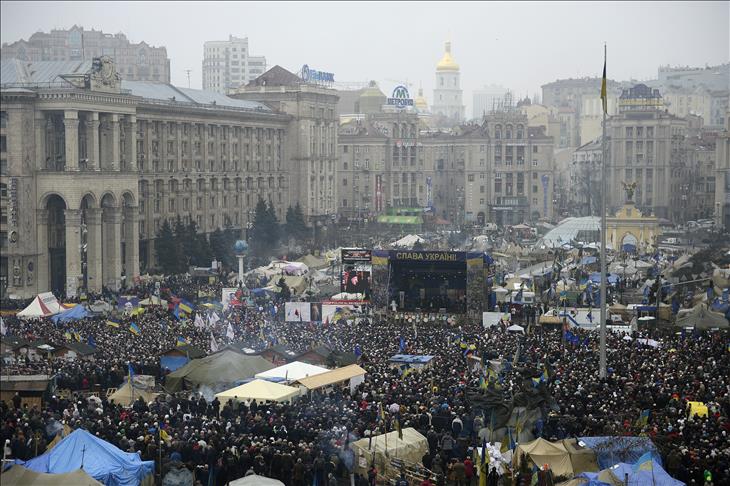
Much of the conflict took place at Independence Square in Kiev, where the protesters have been camped since November, when Ukraine's President Viktor Yanukovych declined a major trade deal with the EU in favor of closer ties with historical ally Russia.
Protesters have taken to the streets in several cities across Ukraine, attempting to set ablaze or occupy government and party buildings, according to AA's correspondent in capital Kiev.
The so-called "Maidan" demonstrators - after the Ukrainian for the Independence Square - have reportedly blocked entry of vehicles into the city of Vinnytsia, only allowing ambulances. In the city of Ivano-Frankivsk, protesters occupied the buildings belonging to the Public Prosecutor's Office, Interior Ministry and the local security department.
Interim Prime Minister Serhiy Arbuzov accused the protesters of "humiliating Ukraine in front of the world," saying that the rallies were not "a demand for democracy, but an attempt to seize power by force and manipulation."
On Tuesday, UN Secretary General Ban Ki-moon expressed shock at the escalation of violence. China joined international calls Wednesday for dialogue efforts between the two sides.
EU foreign ministers are to hold an emergency meeting on Thursday. French President Francois Hollande and Polish Prime Minister Donald Tusk have called for EU sanctions against the Ukrainian government, an appeal echoed by German Chancellor Angela Merkel's party Christian Democrats (CSU).
Russia 'not engaged'
In a televised statement on Wednesday morning, Yanukovych blamed opposition leaders for the violence, saying they "crossed the line" by ignoring democratic principles and encouraging protesters to take up arms.
The president met opposition leaders on Tuesday night for a solution but the talks proved futile.
Kremlin spokesperson Dmitriy Peskov said Russian President Putin "did not and does not" give any advice to his Ukrainian counterpart.
Russia's attitude was to "not engage in what's happening in Kiev," he said.
After opposition-backed parliamentary vote to limit the president's powers was blocked by pro-government MPs, thousands of protesters surrounded the parliamentary building, triggering clashes with security forces.
During the day, the police stormed the camp in the Independence Square using tear gas, rubber-bullets, stun and smoke grenades.
Opposition leader Vitali Klitchko called on 20,000 protesters in the square to remain firm. "We will not leave here. This camp is an island of freedom and we will defend it," he said.
Russia announced Monday it would buy 2 billion dollars' worth of Ukraine debt in bonds, as part of its 15 billion dollar financial aid plus trade incentives which helped sway Yanukovych in November.
His decision to move the country away from the EU by rejecting a landmark trade deal resulted in large-scale rallies reminiscent of the 2004 Orange Revolution, which was against growing Russian influence over Ukraine.
In late January, Yanukovych sought to appease demonstrators by offering positions in the cabinet to opposition leaders, including the post of prime minister. The offer, which was rejected, and a promise of amnesty for protesters failed to end rallies.
englishnews@aa.com.tr