By Olarewaju Kola
MAIDUGURI
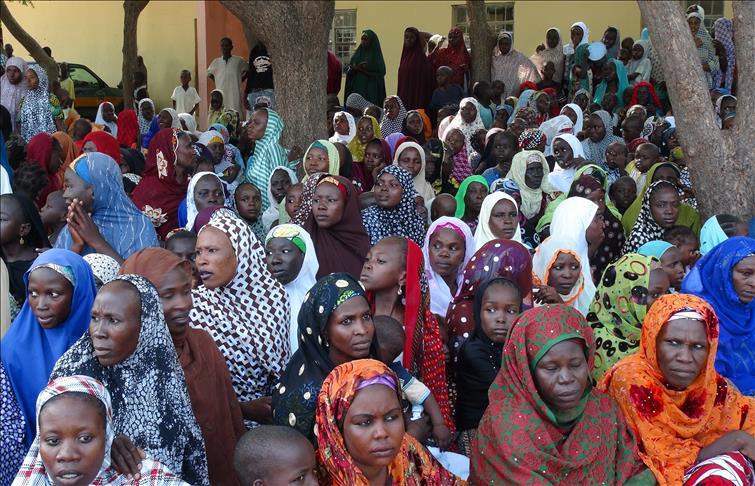
At least 7,000 civilians have fled Nigeria's northeastern town of Bama, which was liberated last week by government troops from Boko Haram militants.
"More than 7,000 Bama residents have moved to Maiduguri," Senator Ali Ndume told a press briefing in Maiduguri, Borno State's provincial capital.
"The state government facilitated their evacuation to Maiduguri, which began over the weekend," he said. "A camp has been set up for them."
Senator Ndume failed to clarify, however, why local residents had fled the town.
A military source, however, attributed the development to "the frightening condition of the local communities."
"The military had yet to mop up the hundreds of corpses littering Bama's streets and wells," he told The Anadolu Agency on condition of anonymity as he was not authorized to speak to the media.
Bama, the second largest town in Borno State, is located some 60km from Maiduguri. It was captured by Boko Haram last September.
Abdulkadir Ibrahim, an information officer for the National Emergency Management Agency (NEMA), confirmed that more than 7,000 Bama residents were staying at a camp set up over the weekend on Maiduguri's outskirts.
He said the agency had delivered relief materials, including canopies, bedding for the camp's clinic, blankets and water.
Ibrahim promised that "more would be delivered" in the week ahead.
Most Bama residents now at the camp are women and young children.
Many are hungry, malnourished and unkempt. Some said they had not had a bath for a month.
"Boko Haram doesn't allow us go out," Yagana, an elderly woman, told AA at a federal government facility, where fleeing residents were camped out.
"They've killed almost all our husbands, especially the agile ones and the youths," she said tearfully.
"They give us food to cook only when they wish," said Yagana, saying there was no market, no light and no hospital.
"We were in Boko Haram's prison," she lamented.
Nigeria is fighting a six-year Boko Haram insurgency that has claimed tens of thousands of lives and displaced over one million people from the northeastern region, where the militants have been the most ruthless.
Last year, Boko Haram went from attacking communities and planting bombs to capturing entire towns.
In mid-2014, the group declared a self-styled "Islamic caliphate" in areas seized in the northeastern Adamawa, Borno and Yobe states.
All but two major local government areas hitherto controlled by the militants have since been liberated by the army in operations that have also involved troops from neighboring Chad, Niger and Cameroon.
Security is expected to be a major issue in determining the outcome of March 28 presidential and parliamentary polls.
Although 14 candidates will vie for presidency, the poll is largely seen as a race between President Goodluck Jonathan and Muhammadu Buhari, a former military ruler running on the ticket of the opposition All Progressives Congress (APC) party.
The APC represents an amalgam of political interests that have come together in a bid to wrest power from Jonathan's PDP, which has ruled the country since its return to democracy in 1999.