Sarah binti Haironnine and Riyaz ul Khaliq
03 September 2026•Update: 03 September 2026
- Combined death toll reaches 1,280 while as 5.624 people remain missing on 2 sides of the Himalayan border
Around 100 Nepali nationals are among 261 foreigners missing on the Chinese side of the border following Himalayan flash floods and mudslides that hit the border region of the two nations, Nepal’s Foreign Ministry said Thursday, as search and rescue operations continued.
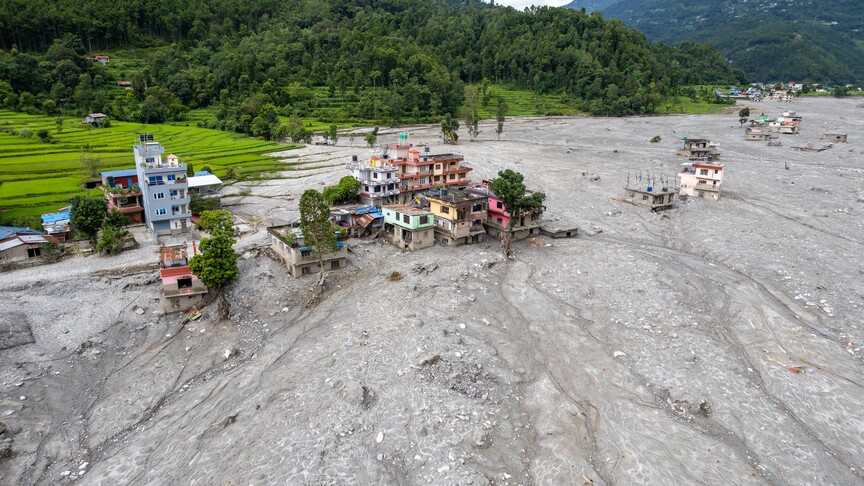
The disaster struck on Aug. 26 when a glacier on Nepal's Mount Langtang Lirung fractured at an altitude of about 5,200 meters (17,060 feet), triggering an ice-rock avalanche that developed into a massive debris flow and swept through valleys along the border.
Floodwaters and mudslides devastated Nepal’s Rasuwa, Nuwakot, Dhading, and Kavre districts, as well as the Kathmandu Valley, while also burying the Gyirong border crossing in China’s southwestern Xizang Autonomous Region, also known as Tibet.
Beijing later said 541 people were missing, including 261 foreigners, on its side of the border.
“About one hundred Nepali nationals are still missing from the Chinese side of the border,” Nepal Foreign Ministry spokesperson Lok B. Chhetri told reporters in Kathmandu on Thursday.
He added that some 1,400 other Nepalis were still in Gyirong, known as Kerung in Nepal, and that Kathmandu is “in coordination with the Chinese side for those who want to return early.”
Nepal has confirmed 1,259 deaths with 5,083 people missing from last week’s flash floods. Authorities in China said 21 people were killed while the search for 541 continues. The combined death toll from both countries stood at 1,280, while 5,624 people remained missing, including 844 foreign nationals. Beijing has noted that almost 100 Chinese nationals are missing on the Nepalese side.
-Nepal's top diplomat briefs envoys in Kathmandu
Nepal's Foreign Minister Shisir Khanal briefed the diplomatic community in Kathmandu on the disaster. The missing foreigners belong to some 39 nations.
Khanal called for continued international solidarity and support as Nepal moves toward recovery, rehabilitation, and reconstruction, according to a statement by the ministry.
He underscored the "disproportionate climate risks faced by vulnerable and mountain countries like Nepal, stressing the urgency of climate action, resilience-building, climate justice, and greater mobilization of resources for adaptation, mitigation, and resilient reconstruction."
Nepal has deployed more than 21,400 security personnel, including over 9,200 soldiers, for search and rescue.
“Our priority remains to continue the ongoing search and rescue operations with a focus on tunnel rescue, locate those who are still missing, and provide continued support to everyone affected,” Chhetri said.
Around 900 personnel deployed at various hydropower stations continue to remain unaccounted for more than eight days after the disaster struck the region. Tunnel and DNA analysis experts, alongside search and rescue teams from China, India, and South Korea, have joined Nepalese authorities to locate the missing and identify the dead.
Nepalese authorities have “started the temporary burial of the bodies recovered after completing necessary forensic procedures,” said Chhetri. “The process is designed to facilitate identification at a later stage and enable families to receive the mortal remains of their loved ones for final rites once identification is established,” he added.
Asked whether the identities of the deceased in Tibet were verified, China's Foreign Ministry spokesman Guo Jiakun said Beijing "will continue communicating and coordinating with relevant parties to properly verify their identities and handle follow-up matters."
Addressing Nepal's call for climate compensation, Guo stated: "Climate change is a global challenge that requires the collective efforts of all parties. We are making active and sound efforts towards the carbon peak and neutrality goals and expected to make the world’s biggest cut in carbon emission intensity."
Guo noted that China "is also severely affected by this cross-border disaster," adding, "We are ready to strengthen cooperation with Nepal and the rest of the international community to jointly prevent and mitigate the negative impact of climate change."