By Ainur Rohmah
JAKARTA
Indonesian search teams have recovered the bodies of the 54 people on board a plane that crashed in the mountains of eastern Papua province.
"All of the victims have been evacuated," Bambang Soelistyo, National Search and Rescue Agency chief, told Anadolu Agency by phone Thursday.
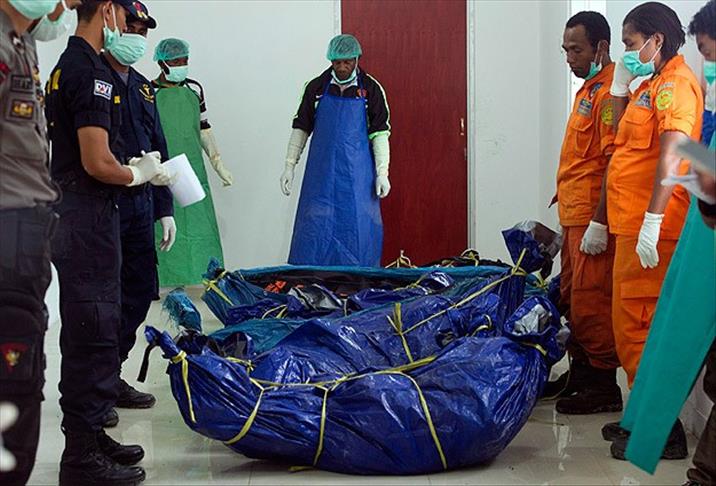
He said that four bodies had been evacuated from the crash site Wednesday, while the remaining 50 were transported Thursday on three flights to a hospital in the provincial capital Jayapura where they will be identified.
The four passengers recovered earlier have been identified as a teacher, a government official, a student and a postal worker who had been transporting around Rp 6.5 billion ($470,000) to be distributed to the poor in the region.
Soelistyo said that teams were also searching for a missing part of the plane's black box after finding the cockpit voice recorder earlier this week.
"I've checked the black box, and apparently [teams] only found the CVR, while FDR [flight data recorder] has not been found. [The black box] is physically in slightly damaged condition,” he added.
“We already submitted the CVR to the National Transportation Safety Committee to be analyzed."
Officials confirmed Tuesday that there had been no survivors from the Trigana Air Service flight that crashed Sunday around 7 miles from an airport in Oksibil -- a remote settlement near the border with Papua New Guinea.
Ground rescuers have been traipsing through thick vegetation in the Bintang Mountains Regency to reach the spot, which is at an altitude of around 2,529 meters (8,300 feet).
Aviation analyst Dudi Sudibyo said Thursday that the plane had experienced turbulence before crashing into the mountain.
"I believe the plane experienced turbulence from strong winds in the mountains," Tribunnews.com quoted him as saying.
Suggesting that the mountainous landscape would have been a main factor in the accident, he added, “the wind was too strong and the plane was not very big."
Dudi refused to blame the incident on human error, insisting that the flight’s pilot had been experienced in flying planes in Papua.
"Maybe before [the accident], he had [previously] experienced turbulence, but not as bad as this time."
Indonesian aviation -- both civilian and military -- has suffered a number of blows to its record. It has resulted in the European Union -- which had barred flights by Indonesian airlines between 2007 and 2009 -- reissuing the ban last June.
In late June, an air force plane crashed in a residential area of North Sumatra province’s capital, killing more than 140 people who were aboard the flight and on the ground.
On Dec. 28, a flight of AirAsia’s Indonesia subsidiary crashed in the Java Sea with 162 people on board.