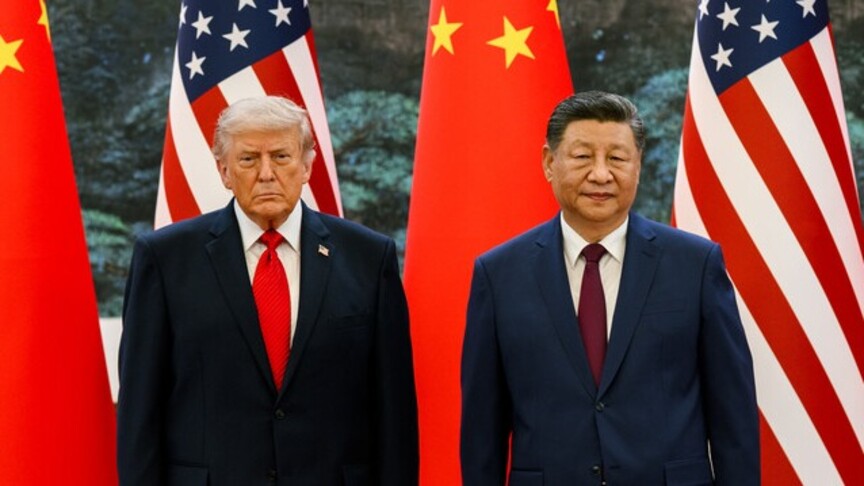
- Extension in trade truce beyond November, tech and artificial intelligence likely to remain focus of talks between leaders of world’s two biggest economies
Chinese President Xi Jinping will visit the United States this week, Beijing said Monday, with Xi and US President Donald Trump expected to discuss world peace amid the war in Iran.
“At the invitation of President of the United States of America Donald J. Trump, President Xi Jinping will pay a state visit to the United States from September 23 to 25,” the Foreign Ministry said in a statement.
It will mark Xi's first state visit to the US since September 2015, when he visited at the invitation of then President Barack Obama.
Later, Xi met Trump during his first term in 2017.
He visited the US in 2023 and met then President Joe Biden on the sidelines of the Asia-Pacific Economic Cooperation (APEC) Leaders' summit, but not at the level of a state visit.
The upcoming visit between Wednesday and Friday comes after Trump paid a state visit to China in May.
“The exchange of visits by the two presidents within the span of a half a year will mark a milestone of historic significance,” Foreign Ministry spokesman Guo Jiakun told reporters in Beijing.
President Xi “will have an in-depth exchange of views with President Trump on major issues concerning bilateral ties and world peace and development,” Guo said.
Xi has paid five visits to the US since becoming president in 2013.
“Head of state diplomacy plays an irreplaceable role in providing strategic guidance to China-US relations. China will work with the US to enrich the dimensions of the China-US constructive relationship of strategic stability, strengthen dialogue and cooperation and properly manage differences and further contribute to world peace, stability and prosperity,” said Guo.
Xi is likely to be received by Trump on the tarmac at Joint Base Andrews in Maryland, adjacent to Washington, DC, according to US media reports.
The Chinese president is expected to be accompanied by top business executives including from electric vehicle maker BYD and smart manufacturing giant Xiaomi.
‘Build on’ Beijing summit
The talks in Washington will build on agreements reached during Trump’s state visit to China in May and a trade and economic deal struck when the two leaders met in Busan, South Korea on Oct. 30 last year.
During Trump’s May visit, the two leaders agreed that the US and China should pursue a “constructive relationship of strategic stability” based on fairness and reciprocity.
They also established US-China boards on trade and investment to manage non-sensitive trade and discuss investment issues.
China agreed to address US concerns over supplies of rare earths and other critical minerals, including restrictions on equipment and technology used to produce and process them. Beijing also committed to purchase at least $17 billion annually in US agricultural products from 2026 through 2028, in addition to soybean purchases agreed the previous year.
The two leaders also agreed that Iran should not acquire a nuclear weapon and called for the Strait of Hormuz to be reopened without any country or organization charging tolls. They also reaffirmed a shared goal of denuclearizing North Korea.
Busan trade deal
At their Oct. 30 meeting in Busan, Trump and Xi reached a broader trade arrangement covering tariffs, rare earths, semiconductors, fentanyl and agricultural purchases.
According to the White House, China agreed to suspend new export controls on rare earths and issue general licenses covering rare earths, gallium, germanium, antimony and graphite. It also agreed to suspend retaliatory tariffs imposed since March 2025 and resume purchases of US soybeans and other agricultural products.
The US in turn cut fentanyl-related tariffs on Chinese imports by 10 percentage points and agreed to keep higher reciprocal tariffs suspended until Nov. 10, 2026. A 10% reciprocal tariff remained in place during the suspension.
Washington also extended certain Section 301 tariff exclusions and suspended some additional export-control measures for one year.
The existing tariff suspension is therefore due to expire in November, giving trade policy added significance to this week’s talks.
The White House did not specify an agenda for the talks but said Trump and Xi would hold discussions during the state visit. The meeting comes as the two countries continue to manage disputes over trade, tariffs, technology and critical minerals following agreements reached during Trump’s visit to China in May and the leaders’ Busan meeting last October.
The two sides have also been engaged on broader strategic and security issues, including Iran and North Korea.
Ahead of the Xi-Trump summit, their chief trade negotiators discussed possible cooperation on artificial intelligence, which is likely to remain in focus when the two leaders meet.