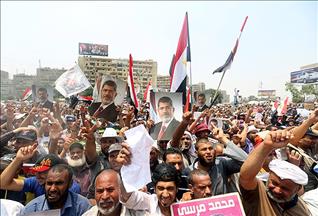
Syrian opposition thinks that the military coup by the Egyptian army that unseated Egypt's first democratically elected president Mohamed Morsi as well as the following incidents will have an impact on the Syrian revolution.
Speaking to AA, Syrian opposition members believe that the military intervention in the Egyptian government would affect the Syrian refugees taking shelter in Egypt, the Syrian armed opposition and the civilian people in various ways.
National Coalition of Syrian Revolution and Opposition Forces (SNC) member Anas al Abdeh extended his gratitude to the Egyptian people supporting the Syrian revolution from the very beginning and sheltering tens of thousands of Syrian refugees.
"We hope that the protests of some Syrian citizens in Egypt will not affect the others. The Syrian Coalition will exert efforts to solve the problems by contacting the Egyptian authorities," he said.
Not foreseeing any negative impact on the Syrian revolution by the recent incident in Egypt, Al Abdeh noted that "The fact that all eyes have turned to Egypt may be regarded as in favour of the Syrian opposition in a sense."
President of the Syrian National Council and member of the National Coalition Of Syrian Revolution and Opposition Forces George Sabra stressed that the Assad regime was striving to benefit from the political split in Egypt.
He claimed that the Syrian regime would take advantage of the incidents in Egypt to argue that the Arab Spring had no benefits for the region except for instability.
SNC member Bassam Yusouf also touched on the uncertainties in the new attitude of the interim administration of Egypt.
Head of Aleppo Parliament's Law Committee Yasin Hilal expressed his fear upon the new leaders put into power in Egypt and described what happened in Egypt as a "coup on democracy", saying "The new Egyptian leaders will negatively affect us as they are opposed to the Syrian revolution."
During the rule of Morsi, Egypt broke off its diplomatic relations with Syria's Assad regime.
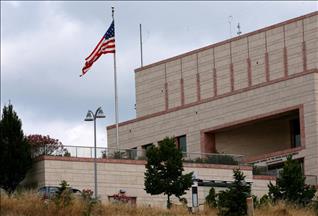
Closed shortly after the military coup in Egypt, Syrian Embassy in Cairo was reopened, blocking the border crossing of the Syrian refugees into the Egyptian territory with the justification of their lack of visas despite any present visa requirement between the two countries.
According to the latest figures announced by the United Nations High Commissioner for Refugees, 20,531 Syrian refugees live in Egypt.