
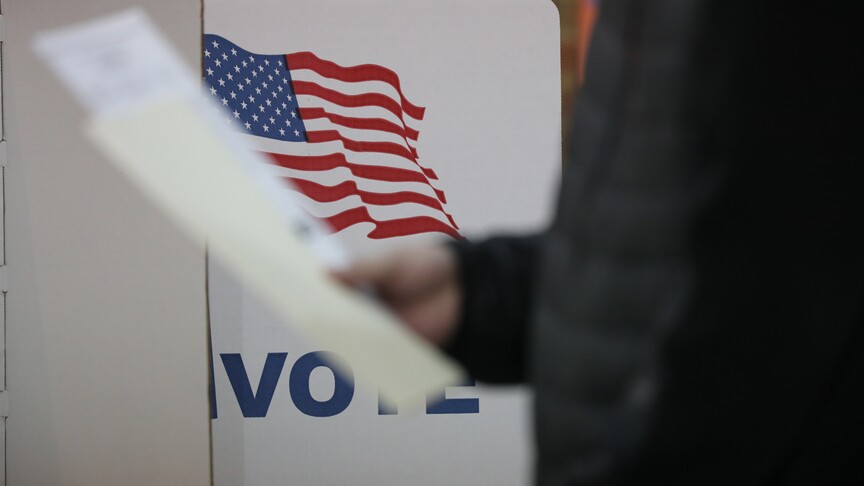
Voters in the US states of Michigan, Missouri, Kansas, Washington, and Virginia are heading to the polls on Aug. 4 for highly anticipated primary elections.
Primaries are crucial elections where voters select which candidates will represent political parties in the November general election.
The results will directly impact the balance of power in the US Congress. Currently, Republicans hold a 53 to 45 majority in the US Senate and a narrow 218 to 214 majority in the US House of Representatives.
To capture control of the US Senate in the 2026 general elections, Democrats must achieve a net pickup of four seats, whereas Republicans cannot afford to lose more than two seats if they are to retain their majority in the chamber.
A similarly tight margin exists in the US House of Representatives, where Democrats require a net gain of three districts to secure a majority, leaving Republicans with a margin of error of no more than two districts to keep control.
The incoming Congress, scheduled to take office in January 2027, will govern during the final two years of the second presidential term of US President Donald Trump.
The political landscape looks challenging for the Republican Party.
A Brookings Institution analysis indicated that public approval for Trump hit new lows in early 2026, driven by dissatisfaction with several issues, including the war with Iran.
Additionally, a July 2026 Emerson College poll showed Democrats leading by 11 points on the generic congressional ballot.
In Michigan's open primary, where voters can participate in either party's contest, the race for the US Senate seat vacated by retiring Democratic incumbent Gary Peters is highly competitive.
The Democratic primary has narrowed to a contest between Rep. Haley Stevens and public health advocate Abdul El-Sayed.
State Sen. Mallory McMorrow suspended her campaign on July 5, but her name remains on the ballot.
Establishment figures have backed Stevens. Her endorsements include Sen. Gary Peters, Michigan Gov. Gretchen Whitmer, and former Sen. Debbie Stabenow. Conversely, El-Sayed has progressive support, endorsed by senators Bernie Sanders and Elizabeth Warren and Reps. Alexandria Ocasio-Cortez and Rashida Tlaib.
Campaigning on a message that favors funding local US communities rather than backing foreign conflicts, El-Sayed, a medical professional of Egyptian heritage, has taken a firm stance against the military actions of Israel in Gaza, labeling them a genocide. Because of these positions, advocacy organizations supportive of Israel, including the American Israel Public Affairs Committee (AIPAC), have directed substantial financial resources toward opposing his candidacy.
Polling shows a volatile race. Early July polling put Stevens ahead, but a later Emerson College survey showed El-Sayed leading by 15 points, highlighted by a generational split where younger voters strongly favored El-Sayed, while voters more than 60 years old favored Stevens.
However, electability surveys suggest Republican candidate Mike Rogers would lead El-Sayed in a general election matchup, becoming the first Republican to do so in the state since Spencer Abraham’s win in 1994.
In the Republican Senate primary, former Rep. Rogers is running unopposed. Rogers has secured key backing, including Trump and Senate Majority Leader John Thune.
Meanwhile, in the Republican primary for Michigan governor, Rep. John James faces businessman Perry Johnson.
James, who aims to be the state's first Black governor, secured an endorsement from Trump.
This prompted rivals Mike Cox and Aric Nesbitt to suspend their campaigns. For Democrats, Secretary of State Jocelyn Benson is the front-runner and endorsed by former Transportation Secretary Pete Buttigieg.
Missouri has no Senate race this cycle, focusing instead on redrawn US House seats.
In the Fifth Congressional District, Republican lawmakers split Kansas City along Troost Avenue, a historically significant dividing line, making the seat harder for longtime Democratic Rep. Emanuel Cleaver.
The Cook Political Report rates the redrawn district as leaning Republican by nine points. Cleaver is unopposed in his primary, while six Republicans compete to challenge him.
In the Fifth District, state Sen. Rick Brattin is the front-runner and endorsed by Missouri Gov. Mike Kehoe and the Missouri Right to Life organization.
In Kansas, a state Trump won by double digits in 2024 but which has a strong tradition of ticket-splitting, voters are deciding key federal and state races.
Incumbent Republican Sen. Roger Marshall faces token primary opposition. His prominent endorsements include Trump, the Senate Conservatives Fund, and supported by AIPAC.
Eleven candidates are running in the Democratic primary, where pastor Adam Hamilton leads in prediction-market tracking.
Voters are also deciding on a constitutional amendment to switch Supreme Court selection to direct partisan elections.
The race for Kansas governor is open as Democratic Gov. Laura Kelly is term-limited. In the Democratic primary, state Sen. Ethan Corson is running against Cindy Holscher and Curt Skoog. Corson is endorsed by outgoing governor Kelly. June polling showed Holscher leading with 37% to Corson's 10%, with 46% undecided.
In the Republican primary, Senate President Ty Masterson faces Secretary of State Scott Schwab. Masterson has secured endorsements from Trump, who announced his endorsement in May and held a telephone rally for him later.
Masterson has also been endorsed by Sen. Roger Marshall, the Kansans for Life political action committee, and the Kansas State Council of Fire Fighters. Trump's endorsement prompted former Gov. Jeff Colyer to withdraw.
Washington operates a top-two primary system where the two highest vote-getters advance to the general election.
The marquee contest is in the Third Congressional District, a critical swing seat.
Incumbent Democrat Marie Gluesenkamp Perez, who co-owns an auto repair shop and maintains a bipartisan reputation, faces a challenge from Brent Hennrich.
The leading Republican challenger is state Senate Republican Leader John Braun, endorsed by Trump, along with US House Speaker Mike Johnson and House Majority Leader Steve Scalise. Gluesenkamp Perez responded that the endorsement would make Braun "beholden" to Trump.
Virginia is holding primaries under its 2021 congressional map. Democratic state legislators had attempted a mid-decade redistricting plan to gain seats, but the Supreme Court of Virginia struck down the effort in a 4 to 3 decision on May 8.
The US Supreme Court subsequently rejected an emergency appeal, forcing several Democratic candidates to suspend their campaigns.
In the US Senate primary, incumbent Democrat Mark Warner faces minor opposition as he seeks a fourth term.
Three Republicans are competing to face him and Trump has notably not endorsed any candidate in the Republican field.
The primary focus in Virginia is on two highly competitive US House seats.
In the First Congressional District, incumbent Republican Rob Wittman is endorsed by Trump.
He faces seven Democratic challengers, with Henrico County prosecutor Shannon Taylor leading the field. Taylor has received endorsements from Virginia Gov. Abigail Spanberger and Sen. Tim Kaine.
In the Second Congressional District, incumbent Republican Jen Kiggans, a former Navy helicopter pilot, has also been endorsed by Trump. Her likely Democratic opponent is Elaine Luria.
The midterm election will take place on Nov. 3.
news_share_descriptionsubscription_contact