Seyma Erkul Dayanc
04 November 2026•Update: 04 November 2026
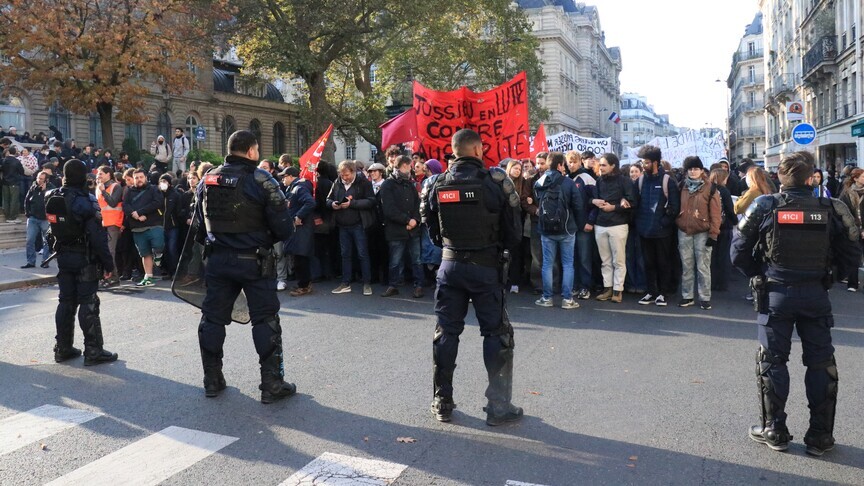
Between 500,000 and 700,000 people are expected to join nationwide demonstrations in France on Thursday, with authorities classifying the planned mobilization as "high-risk," broadcaster BFMTV reported Wednesday.
A territorial intelligence report dated Nov. 3 warned that the protests could mark a "new threshold" in violence, particularly in city centers.
The report linked the growing mobilization to repeated calls by labor unions, later joined by young people involved in recent high school protests.
Interior Minister Laurent Nunez instructed regional prefects to take measures to prevent unrest and respond to potential disturbances.
Security forces will be deployed in a "powerful," "responsive" and "agile" operation that will include the use of drones.
Authorities have also imposed restrictions on carrying weapons, protective equipment and pyrotechnic devices.
Police will conduct checks along transport routes, including at railway stations, while officers have been authorized to intervene systematically in cases of attacks against people or property.
Nunez also recommended that prefects avoid demonstration routes passing through city centers.
During a news conference late Wednesday, Nunez announced that the police deployment Thursday would be “exactly the same as that of Oct. 31," with 70,000 gendarmes and police officers expected to be deployed in the country.
He noted that specialized units would also be mobilized, including the elite tactical and law enforcement units of RAID, GIGN and BRI, as well as canine and mounted police units.
Nunez underscored that the "primary mission" of the law enforcement would be ensuring that the marches take place peacefully and can reach their conclusion without any disturbances.
“If there are any intentions to commit acts of violence, the response will be extremely firm. We will not tolerate any disturbances and there will be arrests,” he added.
National Police department heads had been instructed to raise staffing levels to 75%, while specialized equipment including drones and water cannon vehicles were requested to reinforce security arrangements, BFMTC learned from a police source.
Meanwhile, the route from Bastille to Concorde proposed by trade unions for the Nov. 5 mobilization was banned by the Paris police prefecture. Authorities proposed an alternative route “between Place de la Republique and Place de la Nation."
Student protests fuel nationwide mobilization
The planned demonstrations follow days of student protests and school blockades across France.
Thousands of high school and university students gathered Tuesday in Lyon, Marseille, Paris, Bordeaux and Rennes despite demonstration bans in some areas.
Student and youth organizations have called for the protests to continue, while labor unions and the Yellow Vest movement are preparing for Thursday's nationwide strikes and demonstrations.
Labor Minister Jean-Pierre Farandou told lawmakers that he hoped to make announcements around the mobilization aimed at restarting wage growth in France.