By Shazia Yousuf
SRINAGAR, Indian-held Kashmir
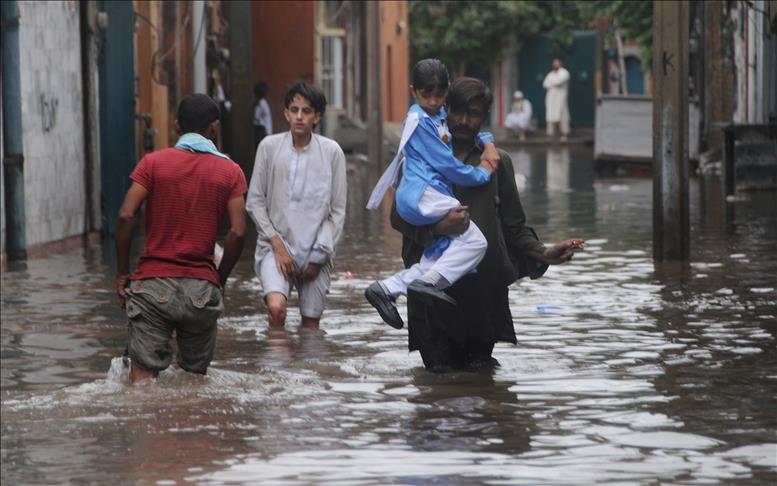
On the evening of September 7, an announcement from a local mosque broke the stillness in Ateeqa Bano’s home. The message was cracked and barely audible but everyone grasped its meaning.
The Jhelum river, which meanders through Srinagar city in Indian-held Kashmir, was overflowing, drowning dozens of areas and was now pouring into Ateeqa’s neighbourhood in Batamaloo, in the west of the city. They needed to leave immediately.
Ateeqa, 45, quickly became anxious about saving select items she was not willing to let the floods sweep away. In her cupboard was a pashmina shawl recently bought for her 24-year old Saima, as well gold necklaces, earrings, copper utensils and packets of almonds collected over the years for Saima’s marriage.
She had weaved carpets and spun pashmina under candle light, while her husband Niyaz Ahmad Din sold cosmetics, in order to furnish their home and prepare for their daughter’s wedding.
“I don’t know how many times I have imagined Saima as a bride; draped in that shawl, she leaves my house with her groom,” she says.
The family was still emptying the cupboard into a tin trunk and moving it to the fourth-floor attic when the waters reached their house. Only when the trunk and its contents were secured did Ateeqa tie the keys around her neck and leave with her family in a rescue boat.
“Some young boys carried me and my daughters on shoulders to take us to a higher building. Our clothes were drenched and headscarves gone, but the keys were the first thing I looked for, when the boys dropped us at a mosque,” Ateeqa remembers.
For thousands of Kashmiri families, the recent floods -- the worst in a hundred years -- forced decisions over which of their belongings were most important to salvage from their homes.
“While my mother was saving my gold necklaces, I was packing my certificates and noting down all the contacts of the people I know. I wanted to save the opportunities to earn,” said Ateeqa’s daughter, Saima Niyaz, who works as a physiotherapist at a private clinic in Srinagar.
Manzoor Ahmad Shah, a 45-year old autorickshaw driver, made the same decision. Noticing that his old mud home was trembling because of the oncoming deluge, he quickly took his wife and four children to safety. He then dragged his autorickshaw, against chest-deep waters, towards a drier patch. Only then did he run for safety himself.
The family now lives in a tent outside a Sufi shrine in Batamaloo. Manzoor’s wife Fareeda Akhtar cries for her burka – the veil she wore every time she stepped out of her house. His 18-year-old son Danish regrets the loss of the diary he had been maintaining with fancy stickers, sparkle pens and his poetry he was too shy to share with others. Manzoor does not care much and insists he made the right choice.
“I tell them those are little things and couldn’t have been my priority at that time,” said Manzoor. “Had something happened to my auto, it would have cut both of my arms and made me handicapped.”
Not everyone could save their means of income. Sixty-year old Mohammad Rafiq Dar and his brother Skakeel Ahmed Dar, 55, who both work as masons, managed to escape from their crumbling home. It was weak because, as their father told them, it was part of a number of hastily constructed houses built on the rubble of houses destroyed by 1965 war between Pakistan and India.
After taking their families to safety, they returned to their home to retrieve their tools but arrived only in time to see the building crumble.
“God saved us miraculously but without our tools we don’t think we will survive too long,” says Mohammad Rafiq, while scrutinizing the muddy debris for any sign of his tool bag.
“If only our tools were saved, we would have made some money. We haven’t earned a penny since the day our house collapsed,” he says.
The brothers spend most of their time by their old home, sorting through the debris. Their relatives, they say, give them all the care and solace they need but the two families are still unsettled by their lack of options.
“How long can one stay as guest? Guests are supposed to leave and go to their homes. Homeless people are not guests,” Mohammad Rafiq sighs.
The same sentiments are echoed by Farida Bano, a homeless 40-year-old mother to three young daughters. She spent almost two weeks at her sister-in-law’s house before quietly leaving one morning.
“I was constantly thinking about how I forced myself on them and how unwanted I must be in that house,” says Farida.
When a group of local boys asked her what needed saving she chose her children’s school bags. They helped her keep a promise to educate her daughters, her personal response to those who had insulted her for not giving birth to a son.
Only one of the daughters was able to save her bag before the house collapsed.
“Every time they see her bag, they cry,” Farida says, breaking down. “If only I had few more hands and eyes, I wouldn’t have let my daughters’ education drown like that.”
www.aa.com.tr/en