By Benjamin Garvey
HONG KONG
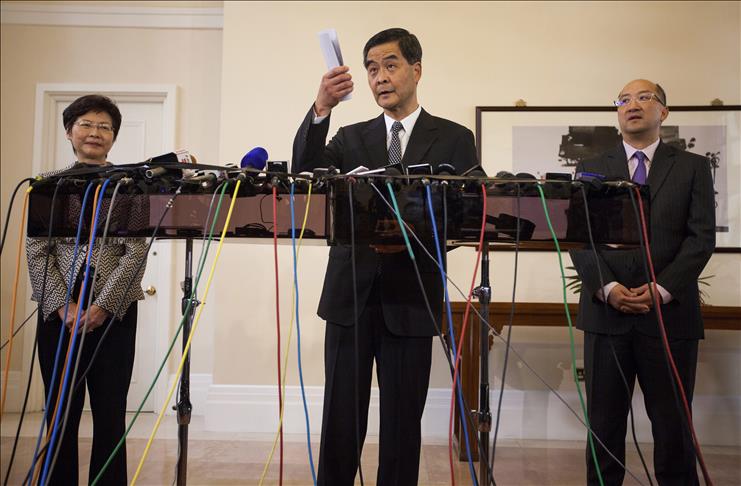
Hong Kong's Chief Executive Leung Chung-ying expressed hope Thursday to meet with representatives of protesting students as early as next week at his first meeting with reporters in weeks.
Leung recommended a university boss chair the meeting between the government and the Hong Kong Federation of Students.
Reiterating that the government can't allow public nomination of candidates for the position of chief executive, he said, “Not all western democracies have civic nomination either.”
The protesters have been demonstrating against Beijing's decision to first approve candidates for Hong Kong’s next chief executive elections in 2017.
Leung said he hoped to make protesting students understand that Beijing's decision on the election could not be changed and he wanted to explore ways both sides could work together within the limits of the Basic Law, the territory's mini-constitution, and Beijing's decision on the election.
The government had suspended talks with the Federation of Students last week, criticizing protesters' pledge to remain on the streets until their demands were met. When announcing the shelving of the talks, Chief Secretary Carrie Lam had said the basis for constructive dialogue had been undermined by protesters' actions.
Earlier Thursday, scuffles again broke out between protesters and police at one of the main protest sites.
The disturbances followed an announcement that police will carry out an investigation into an alleged assault by plainclothes officers on a pro-democracy protester.
In a video clip broadcast by local television station TVB, six men could be seen leading Ken Tsang to an isolated spot before kicking and stomping on him as he lay on the ground.
Tsang, a member of the pro-democracy Civic Party, later appeared covered in bruises in images that quickly went around the world.
The violence has deepened public sympathy for the protest, which mainly consists of university and high school students, just as it did when police used tear gas and pepper spray more than two weeks ago. Then, tens of thousands of locals turned out in support of the students.
Amnesty International said in a statement the officers involved must face justice.
The assault came as hundreds of police in riot gear cleared protesters around Admiralty early Wednesday morning in some of the most violent clashes since the mass movement was launched 18 days ago.
Live television footage showed police wrestling protesters to the ground and then arresting them. Officers also tore down barricades that had been erected over the previous two weeks.
As the barriers were taken down, the protesters erected fresh ones behind their lines. However, this has resulted in the total area of the protests shrinking by around a fifth since police started removing the makeshift barricades Monday.
The movement is seen as the biggest challenge to Beijing's authority over the semi-autonomous Chinese territory.
www.aa.com.tr/en