By Benjamin Garvey
HONG KONG
Around five hours after Hong Kong protesters were beaten from a major protest site, they returned in larger numbers early Saturday, determined to see a chief executive they now see as encouraging attacks on their protest removed, and free and fair elections allowed in the territory.
An Anadolu Agency correspondent at the scene said that despite the attacks some protesters had remained, and after what they referred to as "the gangsters" who had attacked them had gone they returned to their positions in growing numbers early morning Hong Kong time.
One protester told the AA that at times he saw 20 people attack just one demonstrator at the Mong kok site - a satellite of the major protest site.
"Our protest was very peaceful. We just sit here to demand universal suffrage in 2017 elections. The gangsters attacked us," said the man who did not wish to be identified.
He added that at times police would intervene, seemingly arresting the assailants, only to release them a few minutes later.
"Last night they [the authorities] said they would enter dialogue, and tonight they have come out against us. We want Hong Kong authorities to police according to the rule of law."
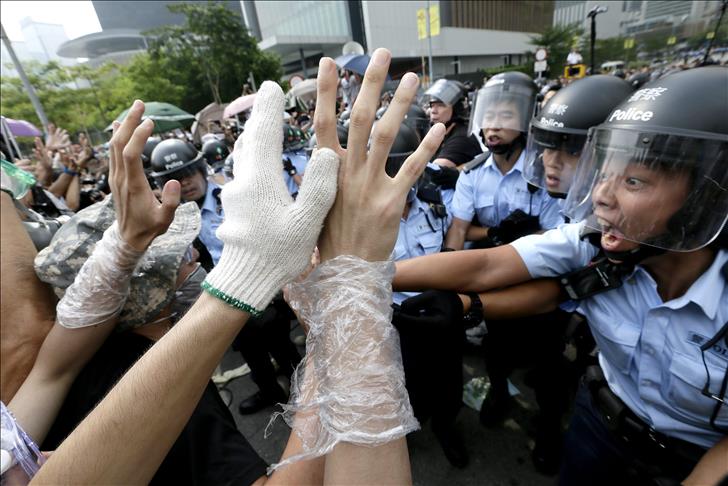
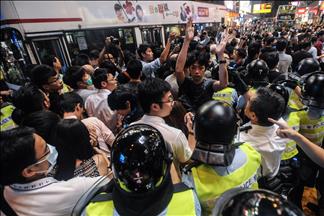
The clashes broke out in various districts of Hong Kong on Friday evening as pro-Beijing groups were seen to intimidate pro-democracy protestors and tear apart their camps.
In the crowded district of Mong Kok, police were unable to stop several hundred supporters of Beijing’s rule from smashing up protesters’ tents.
Police had struggled to clear the protest sites following earlier incidents, but security lines broke shortly after 5 p.m. as scuffles intensified as Beijing supporters surrounded the camp. A student lost consciousness during the attacks, according to the South China Morning Post.
Pro-democracy groups – including the Hong Kong Federation of Students, Occupy Central with Love and Peace – released a press release at 6:50 p.m., saying: “if the government does not immediately prevent the organized attacks on supporters of the Occupy movement, the students will call off dialogue on political reform with the government.”
Onlookers expressed their sadness to the AA at the intimidation used.
“I am a civil servant. I support the students but I can’t do anything,” a by-stander who did not wish to be named told the AA.
Earlier, Occupy Central supporters had begun streaming into protest sites, where a sixth day of demonstrations started after tensions had eased overnight with Hong Kong's chief executive Leung Chun-ying appointing Carrie Lam, the chief secretary, to negotiate with the protesting students on behalf of the government.
That concession by Leung helped defuse some of the hostilities between the two sides and the night passed peacefully.
But at the briefing, Leung also said he would not step down, which is one aim of the protesters' bigger goal -- for China's central government to allow the territory to choose its own leader by universal suffrage.
Hong Kongers go to the polls in 2017 to choose their next chief executive - an election many have accused China of trying to control.
The non-violent movement is seen as the biggest challenge to Chinese rule in Hong Kong since Beijing resumed sovereignty in 1997.
Some observers worry that if the protests persist and the Hong Kong police again fail to disperse the demonstrators, the Chinese military -- known as the People’s Liberation Army -- could be ordered to intervene.
That scenario revives memories of the killing of student protesters in Tiananmen Square, in the heart of Beijing, in June 1989. The 1989 movement, initiated by students to push for a democratic China, ended when the military shot dead hundreds, perhaps more than 1,000.
www.aa.com.tr/en