HONG KONG
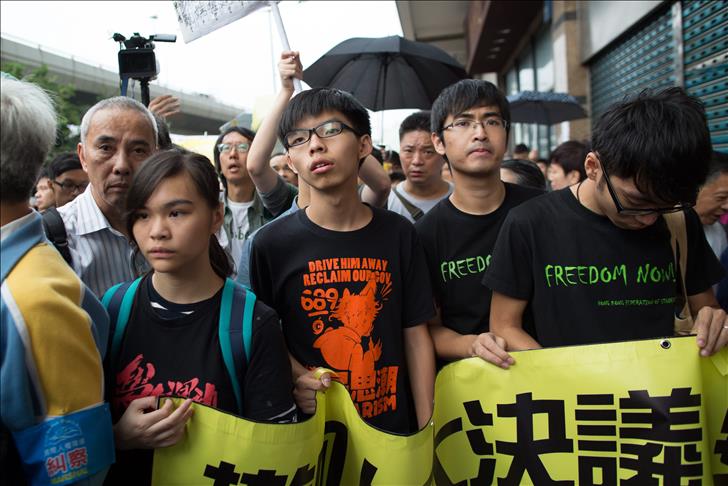
The founders of Hong Kong's Occupy Central protest group said Tuesday they will ‘surrender’ to police to face any legal action over the two-month demonstrations, local media said.
Benny Tai, Reverend Chu Yiu-ming and Dr Chan Kin-man said in an open letter to Hong Kong residents that they would hand themselves in to police at 15.00 local time (09.00 Turkish time) Wednesday.
The trio said they were prepared to face the legal consequences of challenging an unjust political system. The police have not named any of the three as being subject to arrest.
In the letter, they said: “Surrendering to the police is not a sign of cowardice. It shows our courage to honor our commitment. It’s not a failure but a complaint against the government’s indifference.”
They also called for students to leave protest sites, the South China Morning Post reported.
Some student demonstrators – who have formed the backbone of the protests, known as the Umbrella movement – have been involved in violent clashes with police in Mong Kok and the Federation of Students had called for an escalation of the protests.
Speaking at a press conference, Tai, a Hong Kong University law professor, said: “We three urge students to retreat to put down deep roots in the community and transform the movement to extend the spirit of the Umbrella movement.
"A government that uses police batons to maintain its authority is a government that is beyond reason. For the sake of our original intention of love and peace, we ask the students to retreat.”
Chu wept as he called for students to take a “longer path for democracy.”
The activists denied that their surrender was a sign the protests had failed, even though China has not changed its decision to vet candidates for the 2017 chief executive elections.
Tai also refuted the suggestion that the Occupy organizers were abandoning the students.
The declaration did not come as a shock to other protesters, who look to student organizations for leadership.
People Power lawmaker Albert Chan said: "This is a student-led political movement. It should be continued to be led by the students. If some pan-democrats want to start another movement, they can do it on their own initiative."
Labour Party Chairman Lee Cheuk-yan said his party would not withdraw from the protests. "I think it is time to discuss the movement's direction rather than handing ourselves in," he said.
The Occupy Central announcement comes after three members of student group Scholarism said they had begun an indefinite hunger strike as efforts to escalate the protest and disrupt the government were forcefully defeated by police.
The hunger strikers said they would starve themselves to press for dialogue on political reform. Chief Executive Leung Chun-ying remarked that the students should take care of their health.
Following last week's clearance of the Mong Kok protest site, the High Court Tuesday dismissed protesters’ challenges to a bail condition that bans them from entering a large area of Mong Kok that was imposed following their arrests last week.
The protest movement is the biggest challenge to the Chinese Communist Party's grip on power since the bloody 1989 crackdown on pro-democracy student protests in and around Tiananmen Square in Beijing.
Meanwhile, the U.K. parliament is to hold an emergency debate Tuesday on China’s refusal to allow a committee of lawmakers to visit the former British colony.
Sir Richard Ottaway, the chairman of the foreign affairs committee, said Beijing’s refusal was an "affront to this House and to men and women of the free world," the BBC reported.
Under the 1984 Joint Declaration between the U.K. and China, which approved the transfer of sovereignty under the "one country, two systems" principle, Hong Kong was promised greater freedom to run its own affairs than other parts of China.
www.aa.com.tr/en