- Around 150,000 tents remain outside Gaza, while Israeli restrictions, machinery shortages and funding gaps hamper humanitarian response, OCHA spokesperson tells Anadolu
- ‘It’s hard to explain to a family … that they can't get a new tent because the Israeli authorities think they're going to make weapons out of it,’ Jens Laerke says
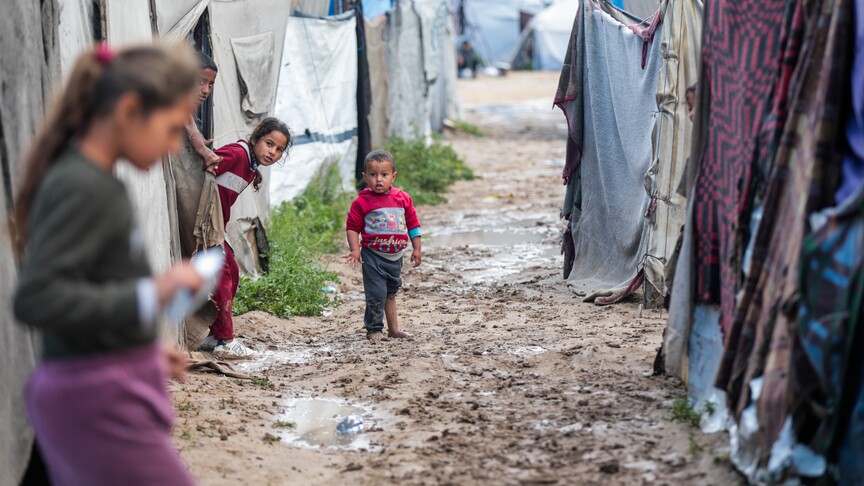
A "nightmare" has unfolded for more than 200,000 Palestinians who may have been affected by heavy rains in Gaza, where over 40,000 family shelters have been damaged, with a UN official warning that further rainfall could worsen the humanitarian crisis as restrictions on aid supplies hamper relief efforts.
"This past weekend has really been a nightmare for hundreds of thousands of people in Gaza," Jens Laerke, spokesperson for the UN Office for the Coordination of Humanitarian Affairs (OCHA), told Anadolu in Geneva.
"The tragedy is that this is only the beginning," he warned, pointing to further rainfall, flooding and the risk of drinking water becoming contaminated with sewage in the coming weeks and months.
An infant reportedly drowned in floodwater, while three children and two women were killed when a sandy hill collapsed onto tents near Al Berka Reservoir, according to OCHA.
Laerke said residents and aid organizations continued searching for possible additional victims.
The UN children's agency UNICEF warned Monday that an estimated 950,000 displaced Palestinians live in areas exposed to flooding, including 400,000 in locations at extremely high risk, nearly half of them children.
According to the agency, around 1.7 million displaced people remain in tents, makeshift shelters or damaged buildings vulnerable to flooding, cold weather and collapse.
OCHA's latest update said damage had been reported to more than 40,000 family shelters, over 900 latrines and nine health facilities.
Despite the scale of the emergency, assistance had reached about 750 households, or roughly 4,500 people, including through the distribution of tents, blankets, mattresses, hygiene kits and other essential supplies.
For displaced families, the flooding has compounded an already desperate situation.
"Now, the predicament that they find themselves in today is that they do not have a home. The few possessions that they have may have been damaged or simply washed away," Laerke said.
'We knew what was coming'
Laerke stressed that the flooding was not unforeseen.
After experiencing similar conditions during the previous two winters of the war, humanitarian organizations had spent months warning Israeli authorities about the need to bring additional tents, equipment and emergency supplies into Gaza.
"We knew what was coming," he said. "Months ago, we started raising the alarm and advocating with the Israeli authorities that we needed much more tents to get in, and we needed to pre-position much more aid."
Yet approximately 150,000 tents already purchased for displaced Palestinians remain outside the territory, most of them stored in Egypt, according to OCHA.
"Now we have been in this tug of war with the (Israeli) authorities, and I would say up to now we have not been on the winning side," Laerke said.
He also said Israeli military restrictions had left Palestinians confined to less than half of Gaza's territory, preventing humanitarian agencies from moving families to higher ground where safer shelter could be established.
OCHA's latest update similarly warned that Israeli restrictions on Palestinian access beyond the so-called "yellow line" have left most of Gaza's land inaccessible, severely limiting options for relocating people from flooded areas and unsafe buildings.
Asked about Israeli restrictions on items classified as “dual use,” Laerke questioned the rationale for preventing essential shelter supplies from reaching displaced families.
"It's hard to explain to a family living in a tent, a family with many kids, their tent has been washed away, that they can't get a new tent because the Israeli authorities think they're going to make weapons out of it," he said.
“That doesn't make sense to many people outside of the Israeli circles.”
Why machinery matters as much as tents
Beyond emergency shelters, Laerke identified heavy machinery as one of the most urgent requirements for preventing further flooding.
According to OCHA, humanitarian partners deployed limited available machinery to 25 displacement sites, helping drain floodwater, clear drainage channels and level the ground for an estimated 3,700 families.
Other teams cleared blocked sewer lines, manholes and stormwater basins at 60 locations, benefiting about 30,000 families.
However, another 245 shelter sites and 23 road locations required urgent machinery interventions, mostly in Gaza and North Gaza.
Laerke explained that water pumps are essential for removing floodwater from low-lying areas where displaced families are sheltering.
"If we are not allowed to … get the pumps in, that's not going to happen," he said.
Even existing pumps cannot operate without spare parts and engine oil, he explained, adding that earthmoving equipment is needed to prepare safer ground for families forced to relocate.
UNICEF also warned recently that no wastewater treatment plant in Gaza was operational. In Gaza City, rainwater mixed with sewage threatened to overflow from the Sheikh Radwan stormwater basin, where only two of six pumps remained functional.
The agency said it had been seeking Israeli approval for "more than a year" to bring in equipment needed to repair the facility.
Funding running out as supplies remain stranded
While restrictions on humanitarian access remain a major obstacle, Laerke said financial pressures are increasingly threatening relief operations.
OCHA's $4 billion humanitarian appeal for the occupied Palestinian territory, covering Gaza and the West Bank, is only 35% funded as the year approaches its end.
"Money is running out, and the aid that we have been able to procure is stocked up outside of Gaza and not allowed in in the quantities that are needed," Laerke lamented.
He emphasized that humanitarian organizations already have operational structures in Gaza, but their capacity to respond is constrained by limited access to supplies and equipment.
"It's very frustrating to work in this humanitarian operation, and it has been frustrating since the beginning," he said.
"We do not understand that the aid that is so obviously needed for people's survival is not being allowed in, or when it is allowed in, only in drips and drops, and not in the quantities that is clearly needed."
Laerke acknowledged contributions from international donors but stressed that the funding shortfall threatens operations throughout the winter and into 2027.
"This is going to take a long time before we get the aid operation up to the level where it needs to be and has needed to be for a very long time."