By Anees Barghouthy
JERUSAELM
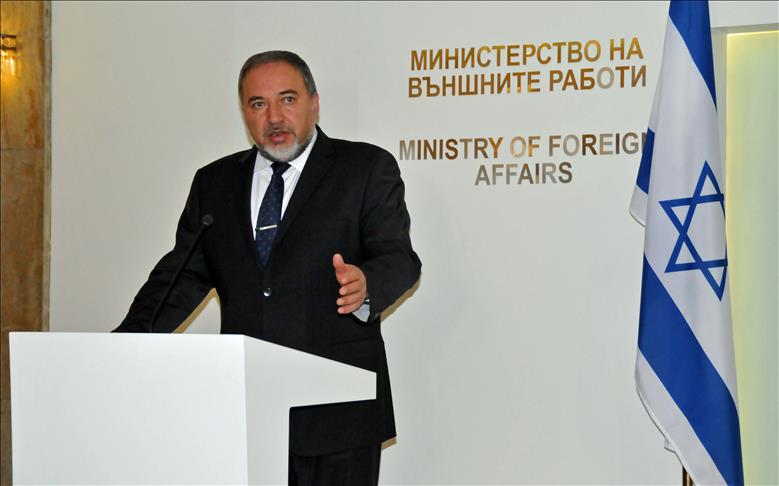
Israeli Foreign Minister Avigdor Lieberman lashed out at Palestinian Authority President Mahmoud Abbas over the latter's speech in the United Nations General Assembly and said the Palestinian leader is not "a partner for peace."
Just before leaving to New York to attend the U.N. meetings, Lieberman told the Israeli army radio that as long as Abbas is the president of the Palestinian Authority, there will be no resolution to the Israeli-Palestinian conflict.
“He is not a partner in anything, and especially for a diplomatic resolution with Israeli,” Lieberman said.
He went on to say that Abbas is not only a source of annoying for Israel, but rather for the entire world. "Even Arab countries are tired of this man," he said.
“The world is not concerned about the Palestinian issue anymore. We need a new diplomatic horizon and a new trusted partner who can deliver the goods,” Lieberman said.
"Abbas should be grateful to Israel because of its security support given to ensure the security and safety of the Palestinian Authority and Abbas himself," he added.
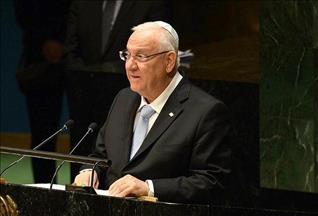
In his speech to the U.N. General Assembly, Abbas called for a resolution on a timetable for ending the Israeli occupation of the Palestinian territories and the establishment of an independent Palestinian state on the 1967 borders.
"Israel refuses to end its occupation of the State of Palestine since 1967, but rather seeks its continuation and entrenchment, and rejects the Palestinian state and refuses to find a just solution to the plight of the Palestine refugees," Abbas told the U.N. meeting.
"The future proposed by the Israeli government for the Palestinian people is at best isolated ghettos for Palestinians on fragmented lands, without borders and without sovereignty over its airspace, water and natural resources, which will be under the subjugation of the racist settlers and army of occupation, and at worst will be a most abhorrent form of Apartheid."
The roots of the Israel-Palestine conflict date back to 1917, when the British government, in the now-famous "Balfour Declaration," called for "the establishment in Palestine of a national home for the Jewish people."
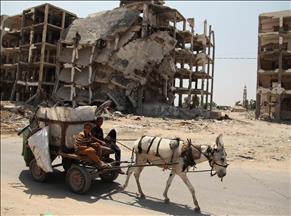
In 1948, some 700,000 Palestinians fled their homes – or were forcibly expelled by Jewish forces – after the creation of the new state of Israel, while hundreds of Palestinian villages and towns were razed to the ground.
Israel then occupied East Jerusalem and the West Bank during the 1967 Middle East War. It later annexed the holy city in 1980, claiming it as the capital of the self-proclaimed Jewish state – a move never recognized by the international community.
Palestinians, for their part, continue to demand the establishment of an independent Palestinian state in the Gaza Strip and West Bank, with East Jerusalem – currently occupied by Israel – as its capital.
By Anees Barghouthy
englishnews@aa.com.tr
www.aa.com.tr/en