TOKYO
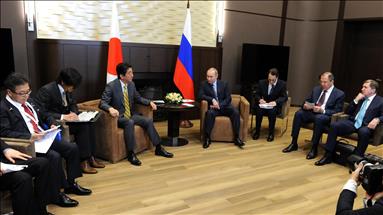
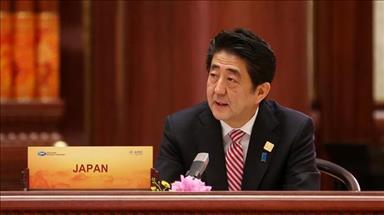
Japanese Prime Minister Shinzo Abe and Chinese President Xi Jinping agreed to work toward better bilateral ties for regional stability during talks Wednesday on the sidelines of an international conference in Indonesia.
It marked the first meeting between the leaders of the rival Asian countries since November, when they spoke at a Beijing summit after a two-year suspension in high-level ties over an island dispute.
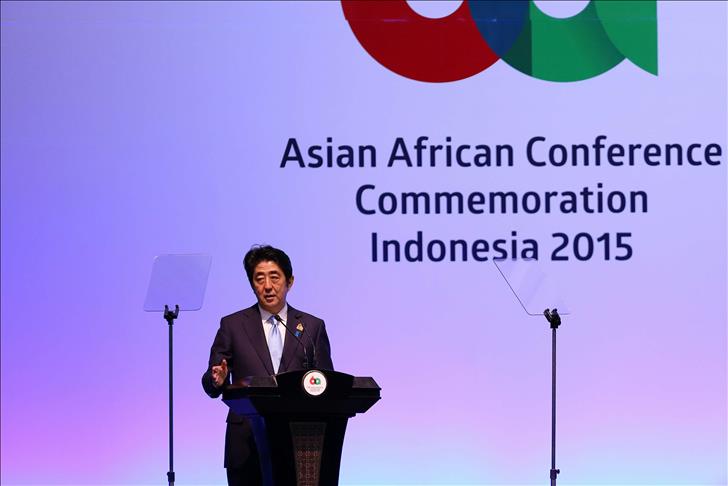
"We agreed on the need to promote strategic relations of mutual benefit to contribute to stability and prosperity of the region and the world," Abe told reporters after the 25-minute talks during the Asian-African Summit in Jakarta.
He said relations between the countries had been "moving toward improvement" over the past months, adding that he and Xi would make joint efforts to hold talks during future international meetings, Kyodo News reported.
Xi expressed similar sentiments, telling reporters, "China-Japan relations have improved somewhat due to joint efforts by the people of both countries."
Prior to November’s meeting, there had been no high-level dialogue between the countries since September 2012, when the Japanese government purchased three of the disputed Senkaku islands in the East China Sea. The islands, known as the Diaoyu islands by China, are claimed by both countries.
In additional to disagreements over territorial claims, relations have been tense due to historic issues -- which Abe touched on in his earlier address Wednesday at the Jakarta summit by expressing Japan's "deep remorse" over World War II.
He said he upholds a landmark statement by former Prime Minister Tomiichi Murayama, who issued in 1995 a "heartfelt apology" to the people of countries affected by Japanese "colonial rule and aggression." He added, however, that he did not find it necessary to repeat the phrasing in a statement he is set to issue this August for the 70th anniversary of the war's end.
"Japan, with feelings of deep remorse over the past war, made a pledge to remain a nation always adhering to those very principles throughout, no matter what the circumstances," Kyodo quoted him as saying.
However, in what appeared to be a reference to Chinese efforts in disputed parts of the East and South China seas, Abe warned: "We should never allow to go unchecked the use of force by the mightier to twist the weaker around."
South Korea has voiced "deep regret" over the lack of an apology from Abe.
"The government expresses deep regret over the omission of key expressions of apology and repentance over [Japan's] colonial rule and aggressions," Seoul's foreign ministry said in a statement.
Local news agency Yonhap cited the statement as expressing South Korea’s hopes that Abe would clarify his intention to honor Japan's past apologies during upcoming opportunities, such as his address at the U.S. Congress next week and his August statement.
Abe left for Indonesia on Tuesday after sending an offering to a controversial shrine for Japan’s war dead before more than 100 lawmakers visited the site the next day -- moves that drew criticism from China and South Korea. Among the war dead honored at the Yasukuni shrine are 14 war criminals convicted by the Allies in the trials that followed World War II.
Japan’s neighbors view visits by officials to Yasukuni, including one by Abe in Dec. 2013, as a sign of Tokyo failing to atone for its past imperialist aggression. Conservative politicians in the country have been accused of repeatedly downgrading previous statements of apology.
Abe himself has previously defended visiting sites like Yasukuni as a way of promoting peace by ensuring the past is not forgotten.
This year's Asia-Africa Conference, which is being attended by 106 countries, will last until April 24.