Legitimacies fiddle in Egypt as Sisi becomes president
The former army chief was declared president with some 97 percent of the valid votes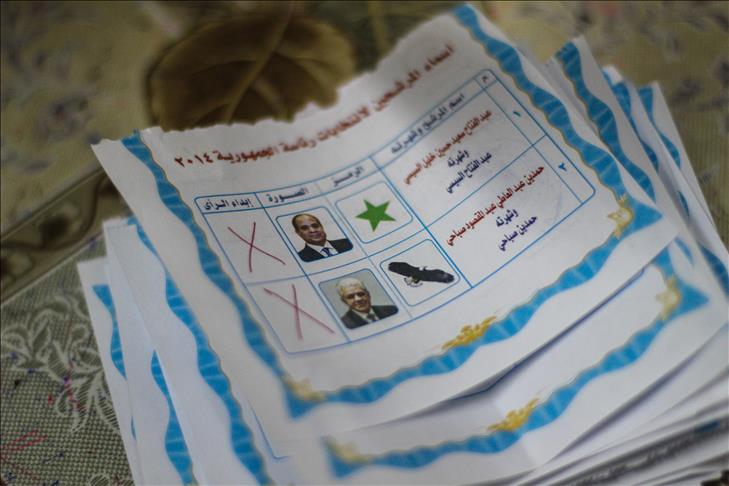
CAIRO
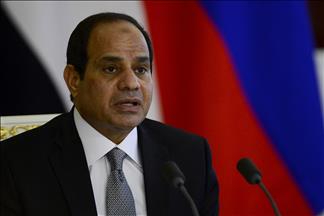
Egypt's presidential election may have ushered in a new legitimacy – namely, the legitimacy granted to former army chief Abdel-Fatah al-Sisi through the ballot box.
But this same legitimacy is stirring up a hornet's nest, particularly given the fact that it cancels the legitimacy of ousted president Mohamed Morsi, according to Morsi's opponents, while supporters still vehemently insist on this legitimacy, hard won in 2012 polls.
"The presidential election and its results have already pulled the carpet of legitimacy from under Morsi's feet," Gamal Abdel-Gawad, director of the government-run think tank the Al-Ahram Center for Political and Strategic Studies, told Anadolu Agency.
"Electing a new president in a vote that did not witness any major irregularities ushers in new legitimacy other than that of Morsi," he said.
Al-Sisi was declared Egypt's president on Tuesday after commanding some 23.7 million valid votes in last week's election.
Commission head Judge Anwar al-Asi said the former army chief had won nearly 97 percent of the total valid votes.
He put the voter turnout at 47.45 percent.
While conceding defeat last week, presidential contender Hamdeen Sabahi had cast serious doubts on the turnout figures.
The vote was the second milestone of a transitional roadmap imposed by the army following its ouster of Morsi, Egypt's first freely elected president, last July.
Abdel-Gawad said the legitimacy of the new president would grow as he finds success where others had failed.
Turnout Crisis
But some argue that the unexpectedly low voter turnout seen during the presidential vote already undermines the new president's electoral legitimacy.
"The low voter turnout, compared with the turnout in the 2012 election, will usher in a legitimacy crisis for the new president," Political science professor Hassan Nafaa told AA.
Around 52 percent of Egypt's roughly 51 million registered voters had cast ballots in the 2012 presidential polls that brought Morsi to power.
Still, Nafaa says the election turned Morsi's page forever.
He urged Morsi supporters to "realize the new political."
Observers link the low turnout to the media's failure to convince the public of the importance of participation; boycotts by youth groups and Morsi supporters; and the near-certainty of an al-Sisi win.
Others also point to the poor performance of the army-backed interim government and boredom emanating from the fact that Egyptians went to polls five times during the past three years.
But the low turnout has further emboldened Morsi supporters.
"The Egyptian people have not withdrawn Morsi's legitimacy," Amr Farouk, a member of the pro-Morsi National Alliance for the Defense of Legitimacy, told AA.
He said legitimacy could only be bestowed in a transparent and democratic atmosphere, which, he asserted, had been absent from the latest election.
"Only 10 percent of voters cast ballots in the last presidential election," Farouk suggested, falling short of giving a source for such a figure.
"The Egyptian people can't be fooled anymore," he said.
Farouk added that the low turnout had revealed that al-Sisi did not, in fact, have the popular backing he claimed and that he had failed to convince Egyptians of his suitability for highest office.
But constitutional law professor Ragab Abdel-Karim said the new president had acquired de facto legitimacy, even if he had come after a "coup" against Morsi.
"Al-Sisi's presidency after the presidential election is a fait accompli," he told AA.
"There is the legitimacy of the reality on the ground now; the thing according to which Egyptians chose their new president," added Abdel-Karim.
He expected wide international recognition of al-Sisi's new legitimacy.
www.aa.com.tr/en