Here’s a rundown of all the news you need to start your Friday, including US President Donald Trump saying Israel will be "scaling back" attacks on Lebanon after appealing to Israeli Prime Minister Benjamin Netanyahu; Iranian President Masoud Pezeshkian warning that continued Israeli attacks on Lebanon would render ceasefire negotiations with the US "meaningless"; and Trump saying that oil would start flowing "with or without the help of Iran."
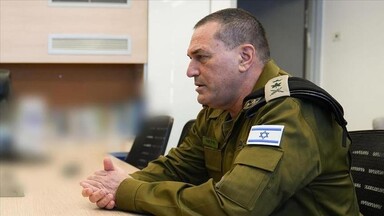
US President Donald Trump said Thursday that he asked Israeli Prime Minister Benjamin Netanyahu to reduce strikes on Lebanon and was assured that Israel would be "scaling back" operations.
"I spoke with Bibi and he’s going to low-key it. I just think we have to be sort of a little more low-key,” Trump said during a brief telephone interview with NBC News.
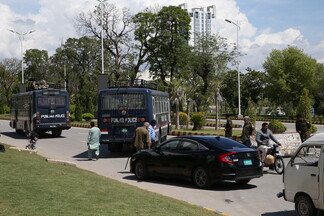
The president announced a two-week ceasefire on Tuesday with Iran after more than one month of war that rapidly spread across the region. Delegations from the US and Iran are slated to convene Saturday for negotiations in Islamabad, Pakistan, that seek to broker a definitive end to the conflict.
Trump said he is “very optimistic” that a peace deal will be struck.
Iranian President Masoud Pezeshkian warned Thursday that continued Israeli attacks on Lebanon would render ceasefire negotiations with the United States “meaningless,” as parliament speaker Mohammad Bagher Qalibaf said Lebanon is an "inseparable part" of the agreement.
“Continued attacks will make negotiations meaningless; our hands will remain on the trigger, and Iran will never abandon its Lebanese brothers and sisters,” Pezeshkian wrote on the US social media company X.
Qalibaf, in a separate post on X, said Lebanon and what he described as the “Resistance Axis” are integral to the ceasefire framework, citing remarks by Pakistani Prime Minister Shehbaz Sharif.
“Lebanon and the entire Resistance Axis, as Iran's allies, form an inseparable part of the ceasefire,” Qalibaf said.
US President Donald Trump said Thursday that oil would start flowing "with or without the help of Iran."
In remarks on his Truth Social platform, Trump criticized The Wall Street Journal, disputing its characterization of his recent remarks on Iran and defending his administration’s foreign policy.
"The Wall Street Journal, one of the worst and most inaccurate 'Editorial Boards' in the World, stated that I 'declared premature victory in Iran.' Actually, it is a Victory, and there’s nothing 'premature' about it!
"Because of me, Iran will never have a nuclear weapon and, very quickly, you’ll see oil start flowing, with or without the help of Iran and, to me, it makes no difference, either way," he said.
Trump further accused the publication of persistent bias, saying it is “always quick to criticize” but unwilling to acknowledge mistakes.
The Israeli Finance Ministry estimated the cost of 40 days of war on Iran and Lebanon at around $17.5 billion, Israeli Channel 12 reported on Thursday.
Direct military expenditures for the ongoing conflict with Iran and Hezbollah are estimated at around 40 billion shekels ($12.9 billion), the report said.
Civilian costs are projected at around 13-14 billion shekels ($4.2-4.5 billion), bringing the total to roughly 54 billion shekels ($17.5 billion), the channel added.
The figures are preliminary and expected to be updated and do not include future reconstruction costs or losses to gross domestic product caused by the partial shutdown of the economy during the war.
US crude oil prices rebounded 5% on Thursday, trimming steep losses, as reports from Iranian media and renewed disruption in the Strait of Hormuz raised fresh doubts about a US-brokered ceasefire and heightened concerns over global oil supply.
The West Texas Intermediate (WTI) crude futures jumped to $100.1 a barrel as of 13000GMT Thursday, after tumbling more than 16% on Wednesday to $90, their lowest level in more than a month.
The international benchmark brent crude futures also climbed 3.5% to $98 a barrel.
Iraq’s North Oil Company said Thursday that a station in Kirkuk, northern Iraq, had received its first shipment of crude oil from Basra after rehabilitation work was completed, and with its operational capacity expanded, and the oil was later destined for a port in southern Türkiye.
According to remarks carried by the Iraqi News Agency (INA), station manager Sarmad Mohammed said the K1 station began receiving its first crude shipments transported by dozens of tankers from Basra, with unloading operations starting immediately upon arrival.
He said the station currently has a capacity of 90,000 barrels per day, adding that tankers are continuing to arrive and unload on an ongoing basis.
news_share_descriptionsubscription_contact

contact_the_ombudsman
is_there_an_error_in_this_story