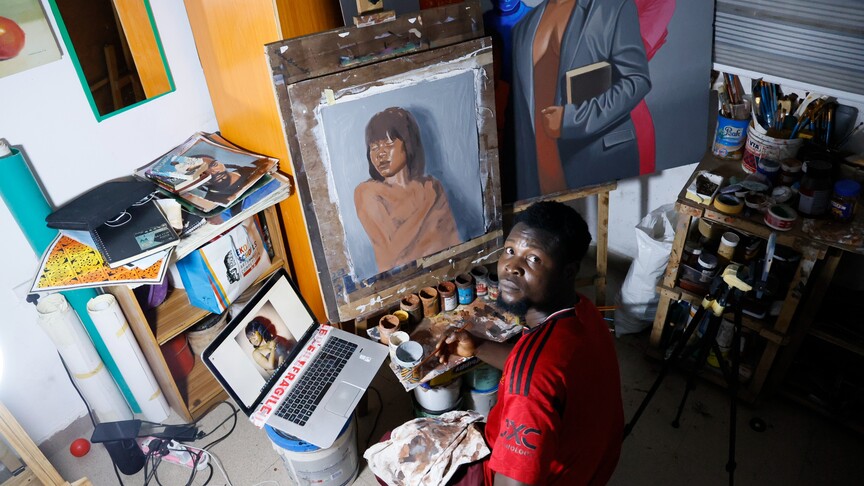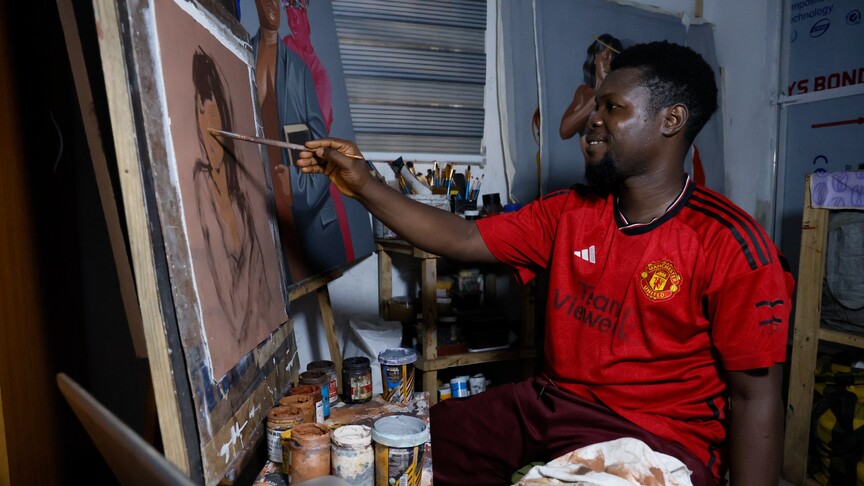

Nigerian visual artist Emmanuel Olatunde is combining his scientific background with his passion for art to create portraits using paints made from natural clay.
Based in Lagos, Olatunde has developed a technique that turns clay, traditionally associated with pottery and sculpture, into a colorful medium for painting on canvas.
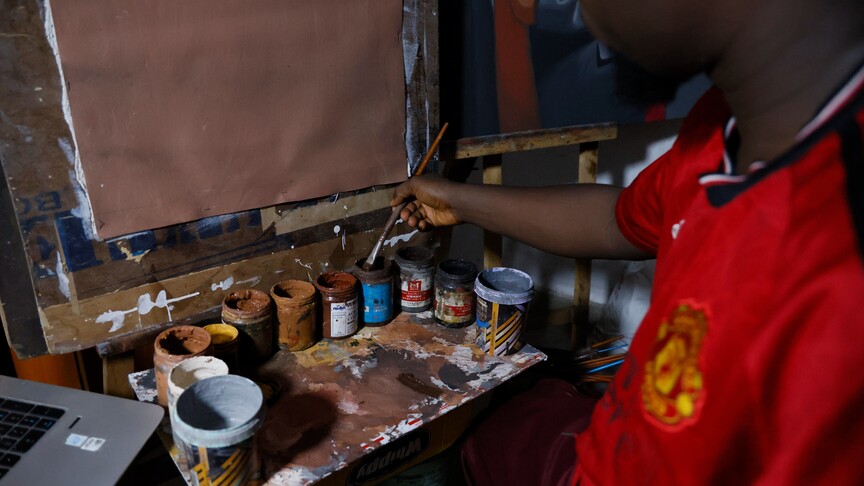
To produce different shades, he uses the clay’s natural colors as well as oxides commonly used in ceramics and various binding agents.
The process is the result of years of research, experimentation and repeated attempts to understand how clay reacts when mixed, applied to canvas and left to dry.
Olatunde told Anadolu that the material’s unpredictability has become an important part of his artistic process.
“Clay can transform into the result you want when it dries. I like that,” he said. “I do not know the answer to everything. What I have is my brush and what I create with it.”
Olatunde’s interest in art began during his childhood in Bauchi, northeastern Nigeria, far from his present home in Lagos.
He said he began drawing after seeing his uncle sketch and trying to imitate him.
His mother later helped him prepare the clay used for his first painting, creating an experience that shaped the direction of his future work.
“My mother mixed the clay for me when I made my first painting,” Olatunde said. “When I saw the result, I was very happy. What I had created truly fascinated me.”
He described that childhood experiment as the starting point of the technique he would later develop by incorporating scientific research into his artwork.
The idea of turning clay into paint became more evident during his school years as his interest in the medium grew.
Olatunde received an art education in Bauchi and began researching the many methods painters used to employ clay.
“I wondered whether I could paint with clay,” he said. “Later, I saw someone painting with sand, and I began researching whether clay could also be used as paint.”
During his research, Olatunde discovered that the color of clay could be altered not only through its natural composition but also through oxidation.
He began using oxides associated with ceramic production to create different colors and continued refining the technique after successfully combining the clay with binding materials.
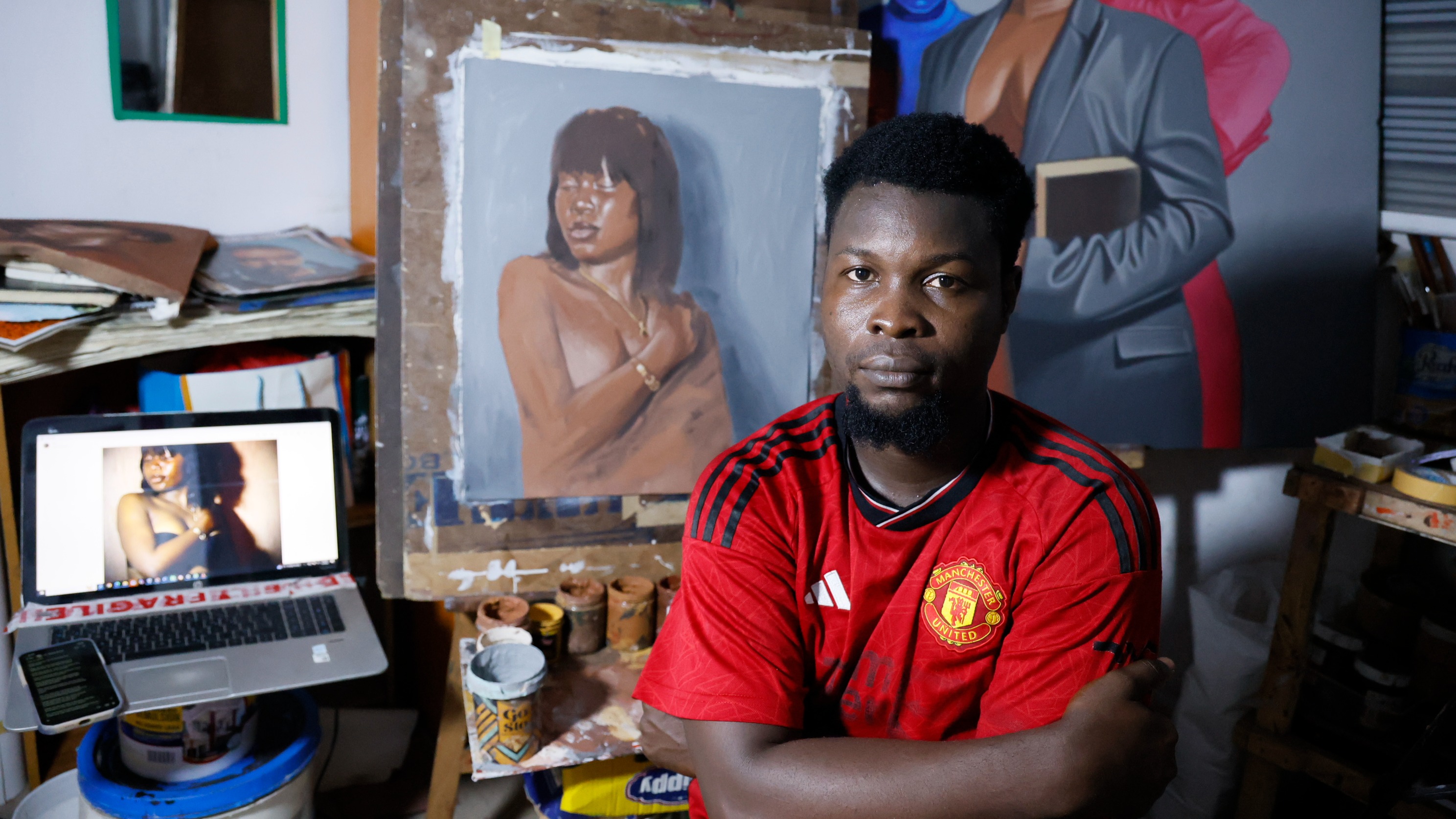
Olatunde said painting with natural clay carries environmental and economic significance in addition to its artistic value.
Clay can be found easily across many parts of Nigeria, making the technique potentially accessible to young people who struggle to afford conventional art supplies.
“Everything is very expensive today,” he said. “For someone who wants to paint but cannot afford to buy paint, clay could be an important option. You can find clay in many places in Nigeria.”
Olatunde wants his work to demonstrate that artistic production does not have to depend on expensive materials.
He believes the technique could provide young artists with new creative opportunities while offering a natural alternative to manufactured paints.
His process also gives local materials a contemporary purpose, transforming soil collected from the environment into pigments capable of producing detailed and expressive portraits.
Clay is among the oldest materials used by humanity for artistic expression and practical production.
By incorporating it into contemporary portraiture, Olatunde connects that long history with modern visual art.
He said his clay paintings retain their color and do not crack over time, underscoring the material’s durability.
“Clay is a material that will always exist,” he said. “There are many works of art made from clay that have survived from the past to the present. I chose this material because I know it is enduring.”
Olatunde said his broader aim is to show how natural clay can be processed through scientific methods and transformed into a viable artistic material.
“I want to inspire other young people,” he added.