By Max Constant
BANGKOK
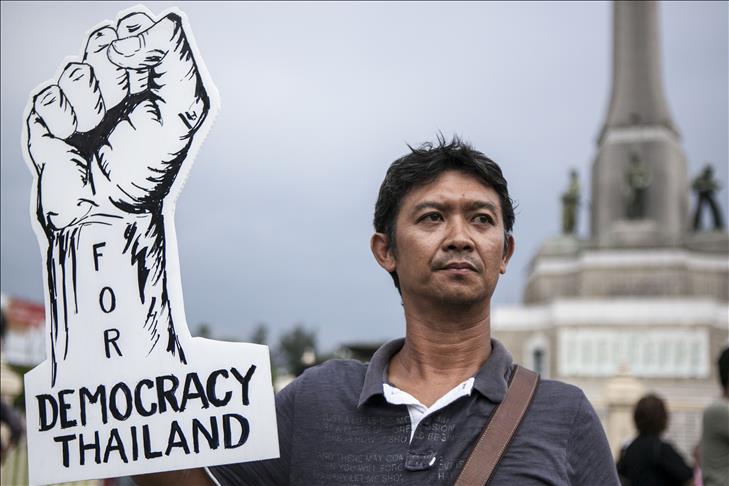
Public protests against Thailand’s military regime marking the one-year anniversary of the May 22 coup were few and far between Friday.
Even simple commemoration gatherings were limited, demonstrating the extent of fear propagated by the junta and its view of any expression of dissent as unacceptable.
“Most people are just afraid and not ready to act, even if they are not happy about the way the military are running the country,” an unnamed diplomat told Anadolu Agency this week.
“It could take a long time for the discontent to boil over and for people to begin to actively protest in mass,” he added.
Among the rare anti-junta gatherings Friday was a protest by seven members of a student group called Dao Din, who deployed a banner with the slogan “We don’t agree with the coup” next to a small monument symbolizing democracy in democracy in the northeastern city of Khon Kaen.
Plainclothes police officers intervened after half an hour, taking away the students.
Meanwhile, 13 members of another student group, the Young People for Social-Democracy, were also briefly detained after demonstrating against the coup in the capital Bangkok.
In another act of defiance, the anti-junta group Resistant Citizen went to the Bangkok criminal court and filed a suit against the military government for tearing up the 2007 constitution -- abolished in the wake of the May 22 coup.
The junta – which banned public gatherings of more than five people after seizing power -- has been dispersing and ordering the cancelation of events organized by critics of its rule.
Last Tuesday, military officers disrupted a small religious ceremony inside the Pathum Wanaram temple in remembrance of four demonstrators and two volunteer nurses who died at the hands of the military five years ago.
On May 19, 2010, the military had conducted a crackdown at the site on Red Shirts -- supporters of the Shinawatra family political clan, led by former PM Thaksin Shinawatra, and opponents of the conservative establishment.
Last year’s coup had overthrown Yingluck Shinawatra – the younger sister of Thaksin, who himself was overthrown in a 2006 and has been living in exile since a conviction for abuse of power in 2008.
The May and June demonstrations that erupted in the immediate aftermath of the coup were dispersed after a massive military deployment.
Hundreds of activists, politicians, academics and civil society representatives were summoned by the junta and detained for several days.
Even minor acts of dissent, such as flashing a “three-finger” salute – a symbolic gesture of resistance first used in the French revolution, but now synonymous with "The Hunger Games" series of films – or publicly reading George Orwell’s book “1984,” have been repressed, with those involved detained.
In a statement released Friday, Human Rights Watch what it called the “sweeping and unaccountable powers” of the junta.
“One year since the military coup, Thailand is a political dictatorship with all power in the hands of one man,” the international rights group’s Asia director Brad Adams said, referring to junta leader-cum-Prime Minister General Prayuth Chan-ocha.
The group acknowledged the lifting of martial law April 1, but deplored that it had been replaced by the enactment of article 44 of the interim charter, which gives extensive powers to the junta.
“The military can secretly detain people without charge or trial,” said the statement. “Military personnel have also been empowered to interrogate detainees in military facilities without providing access to their lawyers or ensuring safeguards against mistreatment.”
Several observers have expressed that the military has abandoned pretenses of being evenhanded, now clearly showing its alignment with conservative forces in society centered on the Royal Palace and the bureaucracy.
“The myth accompanying the coup should now be called out after a year,” political scientist Thitinan Pongsudhirak wrote Friday in the Bangkok Post.
“The military stepped in at that time supposedly as an honest broker to break the [political] impasse… But the military’s position on one side of Thailand’s polarized landscape should not be camouflaged,” he added.
The Thai military has a long history of intervention in politics, with 19 coups – oftentimes followed by the abolition of constitutions - carried out since the absolute monarchy came to an end in 1932.