BEIRUT
By Justin Salhani
Once perceived as an impenetrable stronghold of Shiite militant group Hezbollah, Beirut's southern suburb increasingly looks like a sitting duck for attacks.
"Beirut's southern suburb is Hezbollah's Achilles' heel," Sami Nader, a political analyst and professor at Beirut's St. Joseph University, told Anadolu Agency.
"It's a stronghold, but also a weak point," he said. "It's a residential area so [attacks like those seen recently] come as a major blow to the group."
Beirut's southern suburb is a predominately residential area, inhabited mainly by Lebanese Shiites. It has Christian residents as well, with many foreign laborers – from Syria, Egypt and Palestine – living there.
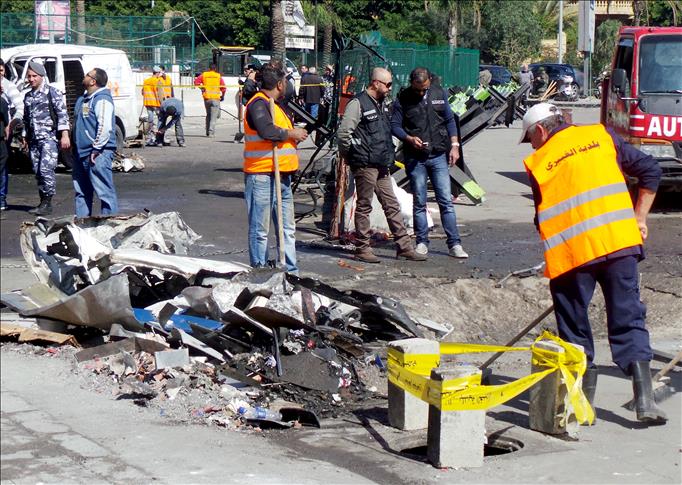
The area has recently witnessed a spate of lethal bomb attacks, the latest of which struck the Bir Hassan neighborhood on Wednesday, killing five and injuring scores.
Analysts believe that the southern suburb's close association with Hezbollah has made it a target for attacks by Sunni militant groups like the Al-Qaeda-linked Abdullah Azzam Brigades, which claimed Wednesday's attack.
"It's a visible center for Hezbollah," said Phillip Smyth, a researcher who specializes in Lebanon and Syria and authors the "Hizballah Cavalcade" blog.
"Going after an Iranian office says a lot," he added, referring to Iran's cultural chancellery in Beirut, which was targeted on Wednesday.
"The first time an attack was well thought out, well planned and well executed was at the Iranian embassy," Smyth asserted.
He said the fact that the Abdullah Azzam Brigades had used a subunit called the "Hussein bin Ali Brigades" meant that it "couldn't have been a harder hit" for Hezbollah.
Hussein and Ali, central figures in Islamic history, are both revered by Shiites.
-Vulnerable-
In the past, the southern suburb was seen by many Lebanese as being protected by Hezbollah's formidable security apparatus.
Now, however, that feeling of security has faded following repeated attacks in the area in recent months.
Analysts say that, regardless of stepped-up security, little can be done to counter the threat of suicide bombers.
"Anyone can walk into these areas," Imad Salamey, associate political science professor at Beirut's Lebanese American University," told AA.
"To fully secure the entire area would require more than a million men," he said. "It's impossible."
Hilal Khashan, a professor of political studies at the American University of Beirut, agrees.
"No one can stop a suicide bomber. It can happen anywhere," he asserted.
But Khashan insisted that the situation wasn't as bad as some might think.
"It's not a 'sitting duck' area; it's not as though security measures aren't being taken," he said.
"The fact that Wednesday's twin explosions weren't in the heart, but rather on the periphery, of the suburbs – in an area more commonly frequented by Palestinian and Syrian workers than Lebanese – shows that getting inside [the area] is more difficult," said Khashan.
Researcher and blogger Smyth agrees.
"One of the recent bombings took place in Choueifat, which is a mixed Druze-Shiite area," he pointed out. "Maybe Hezbollah's security is more effective, so these groups are hitting more peripheral areas."
Some experts believe that Hezbollah's preoccupation with the conflict in neighboring Syria has left the Beirut suburb more vulnerable to attacks.
"Hezbollah has put all its military power and resources into Syria and it has backfired on their strongholds," Mario Abouzeid, a Lebanon expert at the Carnegie Middle East Center in Beirut, told AA.
He said if Hezbollah were to withdraw its fighters from Syria, "this would definitely reflect on the political and security situation all over the country, not just in the suburbs."
Beirut-based political analyst Kamel Wazne, for his part, contests this assertion.
"Terrorism knows no borders," Wazne told AA, insisting that groups like the Abdullah Azzam Brigades were carrying out "an aggressive terror campaign" that would only escalate if Hezbollah left Syria.
St. Joseph University professor Nader believes progress on Lebanon's fraught political stage will contribute to stopping the cycle of violence.
"Forming a government is good, but far from enough," he said, referring to Lebanon's newly appointed cabinet.
"Residents of the [southern] suburb are victims of a play – the same play Hezbollah used against Israel," Nader said.
"This is guerilla action," he added, "and despite all their military apparatuses, they can't stop suicide bombers."
englishnews@aa.com.tr