JUBA
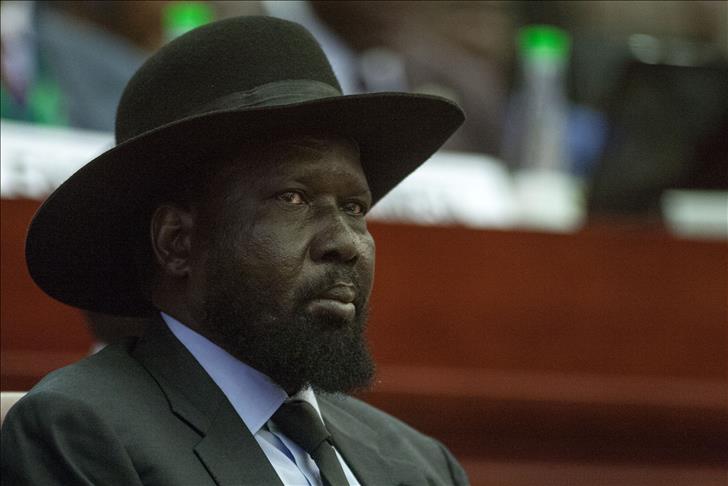
In an effort to restore peace to South Sudan, President Salva Kiir has offered an amnesty to rebel fighters, calling on rebel leader Riek Machar to resume stalled peace talks in Addis Ababa.
"I am still offering amnesty to all who have taken up arms against the government," Kiir said at a ceremony marking the third anniversary of South Sudan's independence.
"We want solutions, not problems," he said.
South Sudan seceded from Sudan in 2011 following two civil wars spanning nearly 40 years.
But the country slid back into chaos late last year when Kiir accused a group of army leaders allied to Machar – who had served as Kiir's vice-president before being sacked – of attempting to overthrow his regime.
Hundreds of thousands of South Sudanese have since been displaced in subsequent fighting, while large swathes of the population remain on the brink of humanitarian catastrophe.
Kiir called on Machar to "put the nation before our own interests" and reach a peaceful settlement to the conflict.
"I still renew my call upon him [Machar] to accept the logic of a peaceful resolution of this conflict. There is nobody who can be so insensitive against the call for peace," he said.
Wednesday's independence anniversary lacked the festive atmosphere that had engulfed the country three years ago when it seceded from its northern neighbor.
In contrast to its first independence anniversary, which was attended by over 13 heads of state, the third anniversary was only attended by a handful of officials.
These included Ugandan President Yoweri Museveni, the Sudanese vice-president, Swaziland Prime Minister Barnabas Sibusiso Dlamini, and Ethiopian Parliament Speaker Abadula Gemeda.
"On July 9, 2011, there was peace and joy among all South Sudanese. You all stood up as one voice; you were free regardless of political and ethnic backgrounds," Kiir recalled.
"When you chose to be free, that spirit was very firm that you would work as one people in unity – but it is fading, we should not make it fail," he asserted.
Kiir added: "Today, our internal crisis in the SPLM should not be allowed to destroy the gains of the social coexistence among communities. We should put them aside. All should exert maximum efforts to stop bleeding our young nation."
Peace call
Kiir called on Machar to resume stalled peace talks in the Ethiopian capital.
"The negotiation was stalled because the other party came with demands. Their demands will not take us anywhere. Let us focus on peace and reconciliation," he said.
"I call upon Riek Machar to stop hostilities," Kiir said. "We committed ourselves in May, but the agreement did not take long. We then made another commitment to stop fighting, and it is very painful that we are here celebrating [independence] and Riek Machar's forces continue attacking."
"Our forces are strictly ordered not to attack, but to remain in their barracks and only react in self-defense," he added.
Kiir also chided the international community for blaming both sides of the conflict.
"All of us are blamed that we are not respecting hostilities when we are not attacking. For how long should my forces remain in their trenches and be attacked? What if I move my forces [offensively] – how would it be?" Kiir asked. "We can fight and development will also still continue."
He added: "I am still committed to peace through the IGAD [Intergovernmental Authority on Development] process for our young country, protection of civilians and development in the country."
-Ugandan troops-
Kiir said that Ugandan forces would remain in South Sudan.
"Ugandan forces were being conditioned by the rebels to go. My position is that South Sudan is a sovereign country and can reach agreements with any country and the Ugandan forces should not be seen as a negative force," he said.
"I will not order Ugandan forces to leave South Sudan until our institutions are safe and fully protected," he said.
The Ugandan military presence in South Sudan has remained a bone of contention in the IGAD-mediated peace talks in Addis Ababa, with Machar's rebels demanding that they be withdrawn before the conclusion of any peace deal.
The government has asserted that Uganda People's Defense Force troops would withdraw once they were replaced by IGAD forces.
Kiir argued that, without Ugandan military intervention, South Sudan would have collapsed as a result of the crisis.
"Without your prompt intervention in December, South Sudan would have lost a lot of lives and a lot of properties. Your immediate intervention on December 18 is the reason why we are here [celebrating independence] today," Kiir told Museveni.
The Ugandan president, for his part, reiterated his country's support for South Sudan.
"I came here to congratulate you on the third anniversary of your independence. People of South Sudan suffered for a long time and for no good reason. We were therefore very happy when you got your independence three years ago," Museveni said.
"Your neighbors to the south, Ugandans are your relatives and will always stand with the people of South Sudan," he added.
By Okech Francis
www.aa.com.tr/en