Efe Ozkan and Seyit Kurt
17 April 2026•Update: 17 April 2026
- Highlights Türkiye’s role in mediation with Ethiopia, calls for unified Somalia to prevent instability
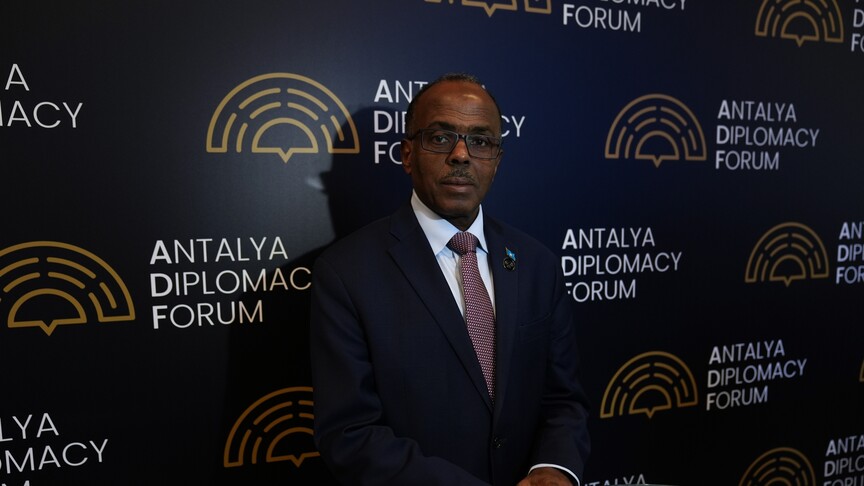
Somalia’s state minister for foreign affairs said Israel’s recognition of a region within Somaliland violates Somalia’s sovereignty and could further destabilize a strategically vital region, in remarks on the sidelines of the Antalya Diplomacy Forum.
In an interview with Anadolu, Ali Mohammad Omar said the move, which he said took place in late December, prompted Somalia to intensify diplomatic efforts to mobilize international support.
“Since then, we have taken a lot of steps diplomatically to garner the support of the international community,” he said, adding that major international organizations and several countries, including Türkiye, have backed Somalia’s position.
Israel move risks fragmentation
Omar reiterated that Mogadishu considers Somaliland part of its territory, arguing that the region itself is "not cohesive" and that only a limited segment is pushing for separation.
“The actions of Israelis are trying to create more difficulty in a region that is already fragmented,” he said, warning that further division could create a vacuum that may be exploited by terrorist groups such as al-Shabaab and ISIS (Daesh).
He said a unified and stable Somalia would be preferable for global security, particularly given the Horn of Africa’s proximity to key maritime routes.
Omar stressed that the corridor linking the Gulf of Aden and the Red Sea is of critical importance to international trade, noting that roughly 30% of global commerce passes through the region.
“The world cannot afford another choke point similar to Hormuz,” he said, warning that instability could threaten navigation and commercial shipping.
He called for cooperation among regional actors, including countries bordering the corridor, to ensure safe passage for global trade.
Türkiye's role in Somalia, regional mediation
The Somali minister also highlighted Türkiye’s longstanding engagement in Somalia, describing Ankara’s outreach since 2011 as a “turning point” that helped shift the relationship from humanitarian assistance to development and investment.
He pointed to recent energy exploration activities and broader economic cooperation as indicators of Somalia’s potential to move beyond aid dependency toward a more self-sustaining economy.
"(Türkiye’s drilling vessel) Cagri Bey, and also the prior seismic ship, all now are pointing Somalia as a potential for investment, he said, adding it will bring “win-win” for both Somalia and Türkiye.
"And this will move Somalia beyond the current trajectory of an aid-dependent, into a more prosperous, resource-dependent state," he added.
Omar further highlighted Türkiye’s mediation efforts between Somalia and Ethiopia, citing a Dec. 11, 2024 agreement reached in Ankara that helped ease tensions.
“Since that agreement, we get very, very close coordination with Ethiopia,” he said, expressing hope that ongoing discussions would enable Ethiopia to gain access to commercial ports in Somalia.
He added that Somalia remains committed to resolving regional challenges through dialogue and cooperation, with support from partners including Türkiye.