By Benjamin Garvey
HONG KONG
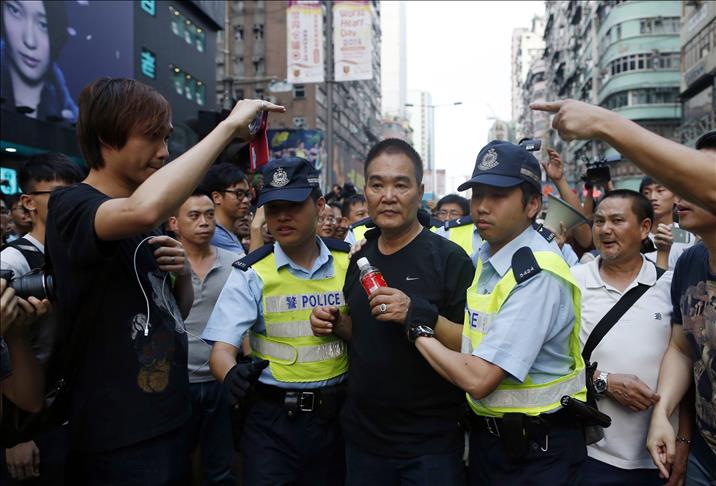
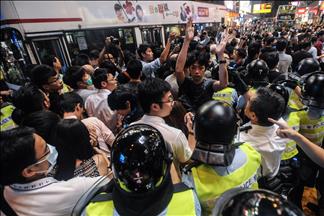
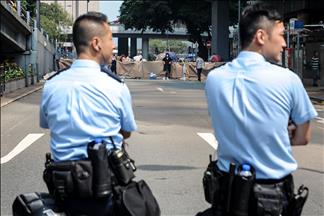
Hours after tens of thousands of people had gathered outside Hong Kong’s main government offices to express opposition to violence against demonstrators, hundreds of police officers turned up at a satellite to the main site early Sunday, armed with batons and riot shields.
Agitators among the crowd of visibly nervous protesters were hauled back as a standoff occurred, but one policeman told an Anadolu Agency correspondent at the scene that the reinforcements had only been called after an officer had been struck by a rock.
"There will be no clearing of the site," the officer -- who gave his name as Steven Tate -- told the AA.
He did not elaborate as to if that referred to Sunday morning, all day Sunday, or even tomorrow.
Around an hour later the police left the site. The protesters had outnumbered the around 300 officers by around 4-1.
Honk Kong Chief Executive Leung Chun-ying had warned Saturday that police would take "all actions necessary" to ensure government offices and schools reopen Monday, although territory-wide tens of thousands of protesters remained on the streets.
The demonstrations had entered their eighth day Sunday as student leader Alex Chow Yong-kang said he hoped to negotiate a compromise with the government whereby street protests would continue -- but with protesters allowing a path to government offices so workers could go to their jobs.
Chow added that if violence did break out, he might ask protesters to disperse.
In an interview with CNN, student leader Joshua Wong called on the government to stop its supporters from attacking protesters.
"We hope that the government will stop this," he said.
The government had to take responsibility for the attacks, Wong responded when asked about preconditions for starting talks between the government and students.
"They [the mob members] are not just normal people who live in Hong Kong," Wong said. "They are being organized."
Wong also called on students and others to leave the Mong Kok protest camp and to move to Admiralty -- the main protest site -- where "they should be more safe."
Police earlier said they had arrested 19 men suspected of attacking protesters during Friday's clashes in Mong Kok -- eight of whom are believed to have backgrounds in triad gangs.
They face charges including unlawful assembly and assault, district commander Kwok Pak-chung was quoted as saying by the South China Morning Post.
An editorial in the People's Daily, an official organ of the Chinese government, warned the "illegal" protests could result in "severely disrupted social order, huge economic losses and possible casualties."
The demonstrators, who see themselves fighting for democracy, protested outside government offices and occupied Hong Kong's major arteries after China said the city could elect its leader in 2017 only after a Beijing-controlled body had screened the candidates.
Andrew Lau, a 70-year-old who runs a rice porridge shop, told the Anadolu Agency Sunday that he neither supported nor opposed the student protesters. He added that all demonstrators should gather at the main protest site in Admiralty so business in Mong Kok and other places would not be inconvenienced.
Hong Kong -- an international financial center -- was a British colony from 1842 to 1997.
In August, Chinese leaders ruled that while Hong Kongers could choose their next chief executive in the 2017 elections, the candidates would have to be approved by Beijing first.
The non-violent movement is seen as the biggest challenge to Chinese rule in Hong Kong since Beijing resumed sovereignty in 1997.
Some observers worry that if the protests persist and the Hong Kong police again fail to disperse the demonstrators, the Chinese military -- known as the People’s Liberation Army -- could be ordered to intervene.
That scenario revives memories of the killing of student protesters in Tiananmen Square, in the heart of Beijing, in June 1989. The 1989 movement, initiated by students to push for a democratic China, ended when the military shot dead hundreds, perhaps more than 1,000.
www.aa.com.tr/en