ANKARA (AA) – September 19, 2012 – International defense security and foreign policy experts have said that the tension between Japan and China over the disputed islands might escalate not only because of the islands' natural resources, but also nationalism was also another factor in the row.
Thousands of protestors gathered on Monday in the Chinese capital of Beijing to protest Japan on the anniversary of Japan's invasion of north-east China in 1931.
While protestors were shouting slogans against Japan, Chinese police closed the street to traffic and pedestrians where Japanese Embassy is located.
As the Chinese lift up their voice against Japan due to their invasion, the real problem between both countries is disputed islands, known as Senkaku in Japan and Diaoyu in China.
Speaking to Anadolu Agency correspondent on Wednesday, international defense security and foreign policy experts on Pacific region worried about the both countries’ future relations.
Ralph Cossa, President of Pacific Forum of Center for Strategic and International Studies (CSIS) said that there were a variety of factors at play.
Stating that Japan had no intention to handing these islands any nation, "It is certainly about access to natural resources, but it is also a matter of pride for both sides. Japan has no intention of handing these islands to the Chinese or Taiwanese while the Chinese see this as part of their centuries of humiliation under the Japanese. They will not accept the current status quo," Cossa said.
Cossa said that it would not be easy to solve the issue.
"Not sure there is a simple solution since Japan will not give them up and refuses to go to the International Court of Justice to solve the dispute since they feel there is no dispute. China and Taiwan are not likely to relinquish their claims even though the islands are in Japanese hands," he said.
Cossa also said that the best think to do in the short term was manage the problem and not allow it to get out of hand.
Cossa expressed that Beijing should be careful in not pushing Japan too hard.
Cossa said that the United States was not a disinterested party in the row.
Having a security treaty with Japan, Cossa said US would get involved with the problem, "While the US does not get involved in the legalities, as long as the islands are administered by Japan, they fall within the security treaty and the US is thus automatically involved," he said.
-"Purchase of islands offers deepens tension"-
Meanwhile, Dr. Ted Glen Carpenter, who is a senior fellow for defense and foreign policy studies at the Cato Institute, said that the islands purchase by Japans offered deepens the tension between both countries.
"It is clear from recent statements and actions that the territorial controversy is becoming an emotional, high-priority matter for both sides. While war remains unlikely, where matters of national pride are involved in addition to the islands’ strategic location and the potential wealth in oil and natural gas in nearby waters," Carpenter said.
Carpenter said that the most constructive way to solve the dispute would be through international, like UN, mediation or arbitration.
-"US might get involved if fighting broke out"-
Carpenter stated that US might get involved with the issue if fighting broke out.
"The dispute is--or at least should be--very worrisome for the United States. The mutual defense treaty with Japan would seem to cover those islands as part of the chain including Okinawa. Washington insists that it is neutral regarding the rival claims, but if the treaty considers the islands to be Japanese territory, the United States would apparently be obligated to come to Japan's aid if fighting broke out," he said.
-"Nationalism on root of problem"-
On the other hand, Bahadir Pehlivanturk, who is an assistance professor doctor at the TOBB Economy and Technology University, stated that not only islands' strategic position and its richness in terms of oil and natural gas were the reason of the row, but also nationalism was being in the root of the problem.
Stating that the government in Tokyo were consist of nationalist people, "However, the nationalism movements were more powerful in China than Japan. If we look at the both countries' statements, we will notice that China’s ones much sharper," said Pehlivanturk.
Pehlivanturk stated that if tension got worse, US would be standing by Japan because of their security treaty with Japan.
"Because of the security cooperation agreement, US is responsible to protect Japan. It the situation between both countries got worse, US will be next to the Japan. However, I do not think that the war is likely," Pehlivanturk said.
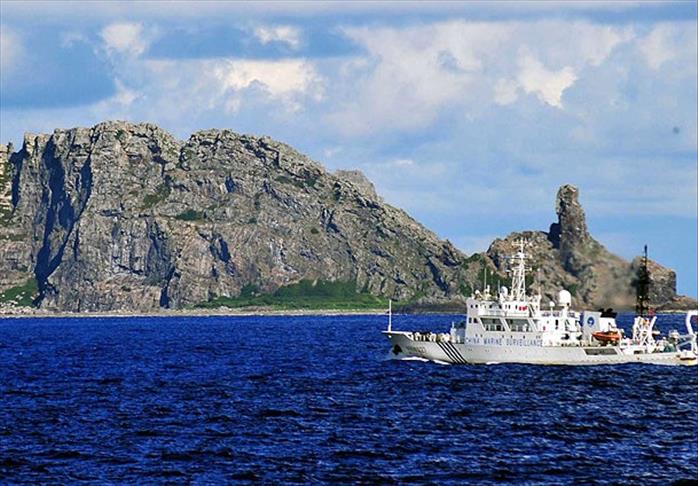
Japan controls the uninhabited but resource-rich islands, which lie south of Okinawa and north of Taiwan, but China also claims them, as does Taiwan.
The disputed islands contain eight uninhabited islands. They lie in the East China Sea between the eastern coast of mainland China and south-west of Japan's Okinawa.
Reporting and writing by Erkan Avci