By Max Constant
BANGKOK
Condemnation of the deportation by Thai authorities of 109 Uighur Turks to China continued unabated Monday after television pictures showed them forcibly being loaded onto planes with their heads covered in black hoods.
The images appeared to contradict the Thai government's affirmation that the deportees – 85 men and 24 women - would be treated correctly.
“It is an inhumane and a cruel act to deport the migrant with hoods over their heads,” Angkhana Neelapaijit, the chair of the Working Group for Peace and justice, told the Bangkok Post.
“Even though Thailand signed the Convention against torture and cruelty, degrading and inhumane treatment, the government failed to comply with it,” she added.
The pictures from Chinese TV channel CCTV show the Uighur seated in an airplane with handcuffs and black hoods over their heads.
Meanwhile, Chinese police officers sat at their sides.
On Sunday, Thai Deputy-Government Spokesman General Weerachon Sukhondhapatipak attempted to defend the Chinese authorities’ behaviour.
“Chinese authorities deserved to be understood” for their handling of the deportees, he told the Bangkok Post.
“It is part of the Chinese authorities’ security measures. They needed to prevent any resistance or attempts to hijack the aircraft,” he claimed.
But even columnists who in the past have come out in support of Thailand's military regime questioned the junta’s handling of the case.
“In retrospect, the deportation of the Uighur men to China was a big mistake by the government of Prime Minister Prayuth Chan-ocha, even with China’s claim that some planned to join jihadist groups in the Middle East,” Veera Prateepchaikul wrote on Monday in the Post.
China's Ministry of Public Security claimed Saturday that the 109 migrants had been on their way to "Syria or Iraq to join jihad."
“By sending the men back to China and deporting the women and children to Turkey, the government has deliberately broken up their families, separating children from fathers, wives from husbands," Prateepchaikul said.
He underlined that the families "may never be able to see one another again.”
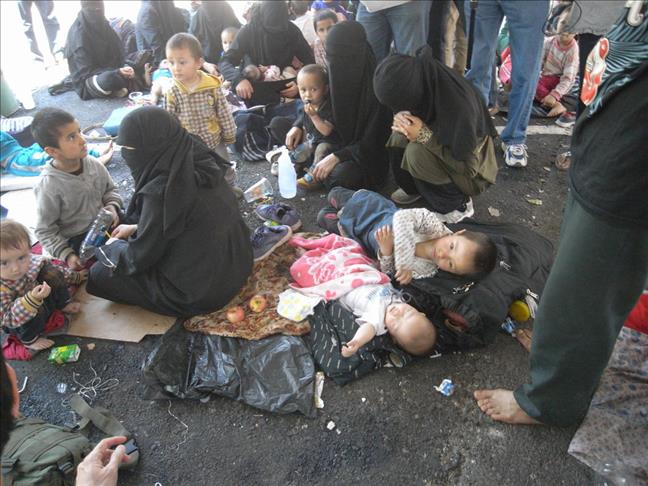
Since the beginning of the month, around 180 Uighur women and children have also been sent - according to their wishes - to Turkey.
The Uighur have been at the center of a diplomatic tug-of-war between Beijing and Ankara, with China identifying the Muslims as from its Xinjiang Uyghur Autonomous Region, while Turkey has welcomed them as its own.
Thai authorities have insisted that a “nationality verification process” had been carried out to decide who went where, but the fact that just one male was sent to Turkey appears to contradict this.
Human Rights Watch's representative for Thailand, Sunai Phasuk, claimed in Saturday's edition of the Bangkok Post that female and young family members were sent to Turkey, while the menfolk - and some women - were shipped to China.
"Soon after the Thai government was lauded for sending over 170 Turkic women and children to the country of their choice, the same government made a U-turn on its policy by sending the Turkic men to a country where they did not want to go,” Phasuk was reported as saying.
Thai immigration police said last week that 60 more Uighur are still detained in Thailand – 52 men, four women and four children.
Since then, eight more - four women and four children - have arrived in Turkey.
Those remaining in Thailand are reported to also be going the same process of “nationality verification.”
The Human Rights Commission of Thailand, a constitution sanctioned body, has called a meeting with government and junta officials, United Nations High Commissioner for Refugees officers, and Human Rights Watch representatives for July 24 to discuss the Uighur issue.
Some analysts have said they see Thailand’s move as being part of a wider embrace of China. Last year, it was one of the few countries that did not criticize Thai generals for their military coup.
Political scientist Pongsudhirak slammed the government for its move Monday.
“Sending the Uighur back to China to accommodate Beijing, while Thailand incurs international opprobrium merely shows the military’s craven willingness to sell out Thailand’s traditionally masterful and clever foreign policy pragmatism on the rough-and-tumble global canvass,” he wrote in the Post.