Diyar Güldoğan
13 October 2026•Update: 13 October 2026
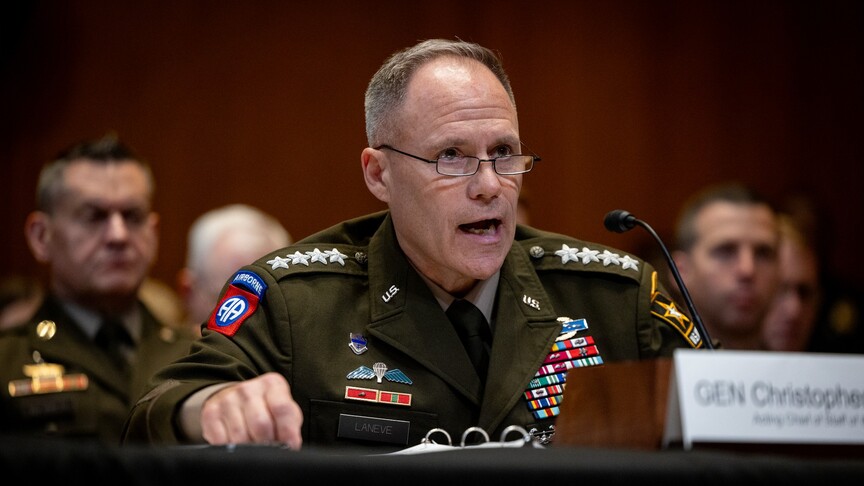
The US Army is introducing new operational warfighting guidance designed to align its doctrine, training, force structure, and technology investments with evolving battlefield threats, Gen. Christopher LaNeve, vice army chief of Staff, said Tuesday.
Speaking at the Association of the United States Army’s Eisenhower Luncheon, LaNeve, who is also serving as acting army chief of staff, outlined the army’s new guidance, How the Army Fights, which was published last week.
The document is intended to establish a common framework for how the army contributes to joint military operations, drawing lessons from conflicts including Russia’s war in Ukraine and fighting in the Middle East.
"Upfront, I’ll just say, How the Army Fights is not a departure from Multi-Domain Operations. The purpose of this document is to provide warfighting guidance that enables every single leader to understand their role in Multi-Domain Operations," he said.
LaNeve said the changing battlefield, characterized by widespread unmanned aerial systems, persistent surveillance, increasingly precise long-range fires, and the growing importance of cyber and space capabilities, requires the army to adapt how it fights.
He outlined four interconnected elements at the heart of the new guidance: convergence, strike, close battle, and endurance.
"Together, these four elements of land power provide the US Army, within the Joint Force, the ability to fight and win our nation’s wars," he said.
The army plans to expand the integration of autonomous and unmanned systems across its formations, including the introduction of military occupational specialties focused on unmanned aerial systems and robotics.
LaNeve also announced that the Futures and Concepts Command had been redesignated the US Army Futures and Autonomous Systems Command, or FASCOM, following the establishment of the Autonomous Warfare Command.
"The army is not turning its back on modernization. We are sprinting towards (it)," he said.
LaNeve called on defense industry partners to support army efforts to field effective technologies at scale, stressing that innovation must be linked directly to battlefield requirements.
The ultimate objective, he said, is to preserve the Army’s position as the world’s leading land power and ensure it remains prepared to respond whenever the nation calls.