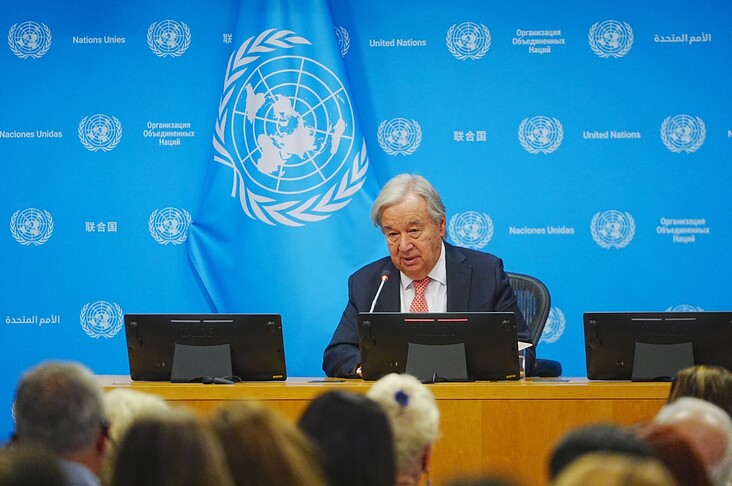
UN Secretary-General Antonio Guterres on Friday urged the Security Council to overhaul the way UN peacekeeping operations are deployed and supported, calling for a renewed focus on political solutions, stronger partnerships with host countries and more adaptable missions.
Addressing a Security Council debate in New York on UN peacekeeping operations, Guterres said the changing nature of armed conflicts had exposed limitations in the way peacekeeping mandates are designed and implemented.
“For nearly 10 years, I have seen what peacekeepers can do when the Security Council stands behind them – and what they endure when it is divided,” Guterres said.
“We do not lack tools. What we lack, all too often, is the political space to use them,” he added.
Guterres said the need to adapt peace operations is at the center of a review requested under the Pact for the Future, arguing that peacekeeping must respond to a significantly different international security environment.
“Peacekeeping is, above all, a political instrument,” he said. “It is deployed to support political solutions – never as a substitute for them.”
He said that for decades, UN peacekeepers were primarily deployed to help parties to civil wars implement comprehensive peace agreements.
But such agreements are now rarer, harder to reach and more fragile, according to the secretary-general.
“Most of our missions now operate where peace remains elusive,” he said.
Guterres said the environment in which peacekeepers operate has changed rapidly.
“Peacekeepers are attacked. Civilians are targeted. International law is violated with a mounting sense of impunity,” he said.
'Peacemaking before peacekeeping'
He outlined five broad priorities for what he described as a “reset” of UN peacekeeping.
The first priority, he said, should be putting peacemaking first.
“Let me be clear: peacekeeping operations should be deployed only when a peace agreement, or at least a robust ceasefire, is in place,” Guterres said.
He acknowledged that peacekeepers can help preserve peace but argued that they cannot create lasting peace in the absence of a political settlement.
“We cannot keep peace where there is no peace to keep,” he said.
Guterres identified a new partnership with host states as his second priority.
“Peace cannot be imported,” he said. “It must be built from within – by the national actors, who hold the key.”
He called for host governments to be consulted when mandates are established and renewed, while also ensuring that other parties to conflicts and civil society are heard.
His third priority was to ensure that peacekeeping mandates are designed for the circumstances in which missions actually operate.
“Protection built into missions’ mandates from the outset – in how they are planned, mandated and resourced – so that when civilians are threatened, peacekeepers can act decisively,” he said.
Guterres' fourth priority was to empower peacekeeping missions with greater operational flexibility and adequate resources.
The UN chief identified stronger cooperation among the UN, regional organizations and host countries as his fifth priority.
“No organization can address today’s conflicts alone,” he said.
Guterres also drew a distinction between peacekeeping and peace enforcement.
He reiterated that UN peacekeeping operations should be deployed only where a peace agreement or robust ceasefire exists.
“When circumstances require, we need peace enforcing, not peacekeeping,” he said.
Guterres concluded by emphasizing that the effectiveness of UN peacekeeping ultimately depends on political unity among Security Council members.
“Unity is built – through effort, engagement and compromise,” he said.
“That is, first and foremost, the work of this Council.”
He said no mandate, budget or technology could replace political unity among council members.