
Anadolu Ajansı © 2026


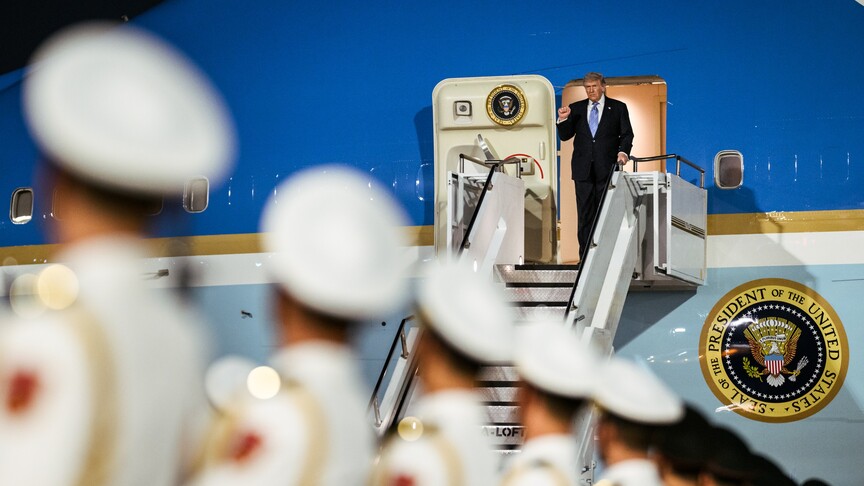
US President Donald Trump heads to Asia next week for talks with Southeast Asian leaders and Chinese President Xi Jinping, with trade disputes unresolved and a possible meeting involving Russia still under discussion.
Trump is expected in Manila on Nov. 17 before traveling to Shenzhen for the Nov. 18-19 Asia-Pacific Economic Cooperation (APEC) summit.
The Philippine stop offers opportunities for defense cooperation and commercial agreements.
In China, Trump is expected to meet Xi following an extension of their trade truce, although disputes over critical minerals, advanced technology and Taiwan remain unresolved.
A proposed encounter involving Russian President Vladimir Putin could expand discussions to nuclear weapons and the wars in Ukraine and Iran. Whether that meeting happens, and what the three leaders would discuss, remain unsettled.
What is planned in Manila?
Philippine officials have confirmed that Trump will meet President Ferdinand Marcos Jr. and attend an ASEAN-US summit in Manila.
The Philippines is a US treaty ally, and confrontations between Chinese and Philippine vessels in the South China Sea have heightened the importance of their defense relationship.
Defense Secretary Gilberto Teodoro has hinted that new US assistance could be announced during the visit, involving equipment and capabilities rather than cash grants, according to Philippine broadcaster ABS-CBN News.
Trade and technology are also US priorities, according to Victor Cha, president of the Geopolitics and Foreign Policy Department at the Center for Strategic and International Studies.
At a Nov. 9 press briefing, Cha said Washington hoped to encourage Southeast Asian countries to adopt American artificial intelligence technology, potentially using development assistance as an incentive.
"It really is commercial diplomacy, as the administration likes to talk about it, at its finest," he said, adding that this could be the most important stop of the trip.
He cautioned that this was an administration aspiration, rather than an arrangement already accepted by regional governments.
What is expected from the Xi meeting?
The expected talks in Shenzhen would be Trump and Xi's third meeting this year, following encounters in Beijing in May and Washington in September.
Trump’s May trip was the first visit to China by a sitting US president since his own visit in 2017.
A detailed agenda for Shenzhen has not been announced, but recent exchanges between senior officials suggest that implementing existing trade commitments remains a priority for Washington.
During a Nov. 6 call with Chinese Vice Premier He Lifeng, Treasury Secretary Scott Bessent and US Trade Representative Jamieson Greer pressed Beijing to fulfill commitments involving agricultural purchases, rare earths and other critical minerals.
Cha said the administration appeared to be lowering expectations for a major breakthrough in Shenzhen, presenting the encounter as a shorter meeting to maintain the existing truce.
More substantive discussions could follow at December’s G20 summit in Florida, he said.
What has the US-China trade truce settled?
The truce suspends some measures imposed during the trade dispute rather than removing all barriers between the two economies.
China announced Monday that several suspensions would continue until Jan. 10, 2027.
These include an additional 24% tariff on US imports, while a 10% duty remains in place.
Beijing also extended suspensions covering selected export controls and port fees.
The extension follows September’s Washington summit, where the two sides also discussed $60 billion in reciprocal tariff reductions that have yet to be finalized.
Critical minerals exports are particularly important because restrictions can disrupt manufacturing far beyond China and the US.
China accounted for 91% of global refined output of magnet rare earths in 2024, according to the International Energy Agency. These materials are used in powerful magnets essential to electric vehicles, wind turbines, electronics and military equipment.
The latest extension keeps selected Chinese export-control measures suspended. It does not remove every restriction on rare earths.
How do AI chips and Taiwan complicate relations?
While China dominates rare-earth processing, Washington controls access to advanced American semiconductor technology.
US restrictions aim to limit China's access to computing power with potential military applications, while American chipmakers seek access to the Chinese market.
Trump has allowed sales of Nvidia's H200 chips to China under conditions, drawing congressional scrutiny over the balance between commercial interests and national security, according to the Congressional Research Service.
That debate has intensified following reports involving former Nvidia chief Jensen Huang and a suspected Chinese intelligence agent.
US lawmakers from both parties are pushing for tighter restrictions on China’s access to advanced AI chips.
Taiwan presents a separate security dispute.
Beijing claims the self-governing island as its territory and opposes US arms sales and official exchanges. Washington maintains unofficial relations with Taipei and provides defense equipment under the Taiwan Relations Act.
Beijing treats Taiwan as a core sovereignty issue and has urged Washington to oppose Taiwanese independence.
During his May visit to Beijing, Trump said he was holding a proposed $14 billion Taiwan arms package "in abeyance," describing it as a negotiating chip, according to the Congressional Research Service.
Secretary of State Marco Rubio subsequently told Congress that US policy had not changed and that Washington did not consult Beijing on Taiwan arms sales.
Could Trump, Xi and Putin meet?
One of the most closely watched possibilities is a meeting bringing Trump, Xi and Putin together.
“Work is under way on organizing such a meeting,” Kremlin spokesman Dmitry Peskov told the Financial Times earlier this month.
Trump has also publicly said he expects talks with Xi and Putin, identifying the Iran war and denuclearization as possible subjects.
After Rubio spoke with Chinese Foreign Minister Wang Yi on Nov. 11, the State Department said they discussed leader-level conversations on peace and denuclearization, including a potential trilateral meeting with Russia.
China's account described the call as positive and constructive but did not mention a trilateral meeting or denuclearization.
For Moscow, a meeting with the US and Chinese presidents could strengthen its diplomatic standing and provide an opportunity to advance its position on Ukraine.
For Trump, it could offer a setting to pursue negotiations on two wars and demonstrate continued diplomatic influence after Republican losses in the US midterm elections.
Alicja Bachulska, a European Council on Foreign Relations policy fellow, warned that the proposed format could carry diplomatic costs for Beijing.
Writing for the Lowy Institute, she argued that even a largely symbolic encounter could damage China’s relations with Europe by reinforcing concerns that European governments were being bypassed in discussions about the Russia-Ukraine war.
Nuclear talks face another obstacle. New START, which limited US and Russian strategic nuclear forces, expired Feb. 5 without a successor agreement.
Washington wants China involved in arms control negotiations, while Beijing argues that its much smaller arsenal should not be treated on the same terms.
China's Foreign Ministry said Oct. 16 that asking it to join trilateral nuclear disarmament negotiations at this stage was "neither fair, reasonable nor realistic."
news_share_descriptionsubscription_contact

contact_the_ombudsman
is_there_an_error_in_this_story