WASHINGTON
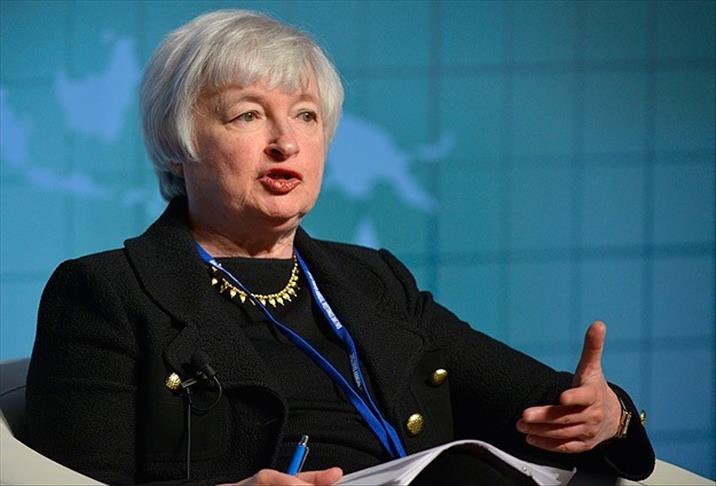
Federal Reserve Board Chairwoman Janet Yellen said Tuesday that while U.S. labor market situation has improved, domestic spending and production have increased at a solid rate, federal funds rate won't rise for at least the next couple of FOMC meetings.
Yellen testified at Senate Banking, Housing and Urban Affairs Committee about the Federal Reserve Board’s semiannual report on monetary policy and the U.S. economic outlook for the year.
She said that since last July, the employment situation in the U.S. has been improving along many dimensions.
"The unemployment rate now stands at 5.7 percent, down from just over 6 percent last summer and from 10 percent at its peak in late 2009," she said. "The average pace of monthly job gains picked up from about 240,000 per month during the first half of last year to 280,000 per month during the second half, and employment rose 260,000 in January."
While the labor market situation has improved, domestic spending and production have been increasing at a solid rate, chief economist said.
"Real gross domestic product is now estimated to have increased at a 3-3/4 percent annual rate during the second half of last year," Yellen added.
However, she noted, GDP growth is not anticipated to be sustained at that pace, but still it is expected to be strong enough to result in a further gradual decline in the unemployment rate.
The Fed chairman also said she is worried about housing, as housing construction continues to lag and activity remains well below levels the Committee (Federal Open Market Committee, or FOMC) judged.
Yellen also underlined that declining oil prices would likely be a significant overall plus for the U.S. economy while at the same time it would result in negative effects on energy producers and would probably result in job losses in this sector.
On the other hand, she said uncertainties in foreign economies could pose a risk to American economic outlook, but they don't exclusively reflect downside risks.
"In response to unforeseen developments, the Committee will adjust the target range for the federal funds rate to best promote the achievement of maximum employment and 2 percent inflation," she said.
Regardless of this positive economic environment, she called on Congress to be patient about the normalization of monetary policy.
"It can be patient in beginning to normalize policy," she said. "The Committee considers it unlikely that economic conditions will warrant an increase in the target range for the federal funds rate for at least the next couple of FOMC meetings."
Noting that U.S. inflation continues to run below the Committee's 2 percent objective, she said, "The Committee is reasonably confident that inflation will move back over the medium term toward our 2 percent objective."
She added, however, if economic conditions continue to improve, the Committee will begin considering an increase in the target range for the federal funds rate on a meeting-by-meeting basis.
Last September, the FOMC issued its statement on Policy Normalization Principles and Plans which provides information about the Committee's likely approach to raising short-term interest rates.
Yellen said the primary means of raising the federal funds rate will be to increase the rate of interest paid on excess reserves.
The Committee will also use an overnight reverse repurchase agreement facility and other supplementary tools as needed to help control the federal funds rate, she added.
www.aa.com.tr/en