Europe's drought crisis is no longer a seasonal phenomenon limited mainly to the Mediterranean, but has evolved into a continent-wide climate challenge, experts told Anadolu.
Increasingly frequent dry periods, declining river flows, depleted soils and rising temperatures are exposing Europe's growing vulnerability to water stress.
Laura Iozzelli, a policy advisor at climate change think tank E3G, said drought in Europe has undergone a fundamental shift in recent years.
"Drought in Europe is no longer an occasional shock that is mainly confined to the Mediterranean. It has become a recurring threat," Iozzelli told Anadolu.
She pointed to data from the European Environment Agency (EEA), noting that in May 2025 nearly 39% of the 38-nation EEA area was affected by drought conditions.
"Several parts of Europe are experiencing dry conditions, with low rainfall, dry soils, and reduced river flows," she said.
The most severe impacts are emerging where prolonged heat combines with a lack of precipitation, intensifying pressure on farming, ecosystems and water supplies.
"Southern Europe remains the most hit region," Iozzelli said, adding that around 30% of the population in southern Europe lives under permanent water stress, while this rises to around 70% during seasonal summer stress.
She said agriculture, tourism and public water supply are increasingly competing for the same shrinking resources.
"Cyprus and Greece are the most acute cases, but the EU's drought observatory shows alert-level conditions this summer extending well beyond the south, into France, Germany, Austria, Hungary, Romania, Poland, Ukraine and the Baltic states. Eastern and central Europe are also increasingly affected," Iozzelli said.
Guido Rianna, a scientist at the Euro-Mediterranean Center on Climate Change, told Anadolu that current drought conditions reflect a combination of long-term rainfall deficits and rising temperatures.
"The Copernicus European Drought Observatory shows that a broad central and northern band of Europe, from east to west, currently falls into one of the three drought classes," Rianna said.
He said the most critical areas are currently concentrated in eastern Europe, where extensive zones have reached alert-level conditions.
"In mid June, alert conditions persisted in Ukraine, Belarus, Poland and the Baltic region and worsened in Hungary, Romania, France, Germany, Austria and the United Kingdom," Rianna said.
According to him, the drought did not develop suddenly but was driven by accumulated precipitation shortages over several months.
"To this reduction in the resource made available by rainfall we must add a sharp increase in evapotranspirative demand associated with the recent European heat waves," Rianna said.
He highlighted that June 2026 was the warmest June on record for western Europe, while Europe as a whole recorded its second warmest June.
"Critically, that heat wave developed over soils that were already drying, following an equally anomalous heatwave in May," Rianna said.
Recent developments across Europe illustrate how drought pressure is spreading beyond traditionally vulnerable southern regions.
The Netherlands officially raised its national drought response level after weeks of persistent dry conditions, with authorities warning that river inflows had fallen to their lowest level since 1976.
Italy's northern Piedmont region has sought additional water supplies from neighboring regions as drought placed increasing pressure on agriculture and drinking water resources.
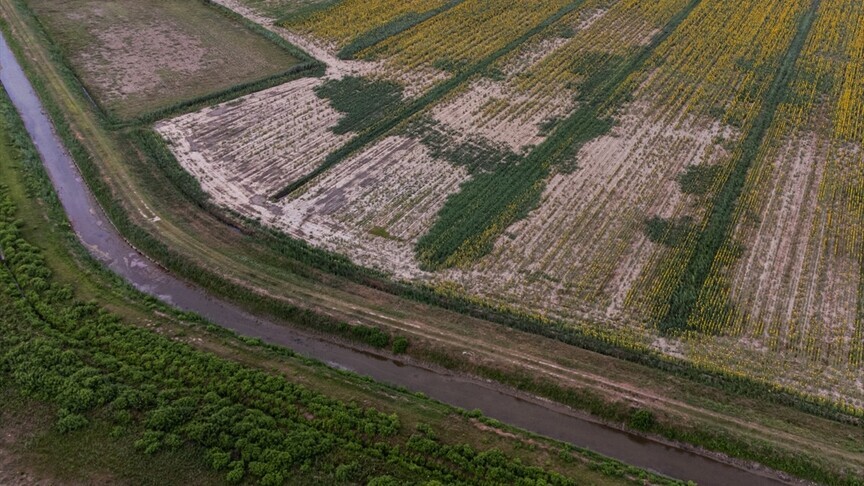
The Po River, Italy's longest river, has seen severe reductions in flow, threatening agricultural production and increasing risks such as seawater intrusion in the Po Delta.
Greece, meanwhile, has declared drought emergencies in multiple regions as declining rainfall, shrinking reserves and rising tourism demand put additional strain on water resources.
Popular islands have experienced dramatic seasonal increases in water consumption, intensifying concerns about long-term water security.
France has also faced one of its most extensive drought episodes in recent years, with almost all mainland departments placed under drought monitoring and dozens reaching the highest crisis level.
Germany's southern city of Munich introduced emergency water restrictions after daily consumption surged above normal levels during prolonged dry conditions.
Meanwhile, nearly half of Czechia has been experiencing extreme soil drought conditions, according to drought monitoring experts.
Asked whether diminishing water resources could become a driver of climate-related migration within Europe, Iozzelli said the process is already measurable, although it is slower and less visible than traditional displacement crises.
"This is unfortunately an already observable and measurable phenomenon," she said.
Iozzelli cited Italy as an example, saying drought exposure has been shown to influence internal migration patterns, with more than 560,000 additional inter-provincial moves linked to high-exposure areas over the past two decades.
A global study published in Nature Climate Change covering 72 countries also found similar patterns, particularly in arid and hyper-arid regions of southern Europe.
Rianna said drought alone does not automatically trigger migration, but persistent water stress can gradually change economic conditions.
According to the expert, the likely European scenario would not resemble large migration events but rather a gradual demographic decline in vulnerable rural areas.
Experts said Europe already has a broad water policy framework but faces difficulties in implementation, enforcement and financing.
"The issue is not so much a lack of legislation, but rather how well existing measures are implemented, integrated, and financed," Iozzelli said, adding that policymakers need to move from reacting to crises toward anticipating them.
"We are at a critical turning point and need to fully recognize the seriousness of the crisis we are facing," she said.
Rianna also stressed that Europe must focus on how water resources are managed rather than only on future climate scenarios.
"The framework is there," he said. However, Rianna added that efficiency without abstraction limits does not save water.
According to him, the implementation gap remains the biggest challenge after two decades of the Water Framework Directive.
The economic impact of drought is already increasing, experts warned.
Iozzelli said extreme weather events across the European Union caused at least €43 billion ($49 billion) in short-term economic losses in 2025.
The EEA has warned losses could rise significantly in coming years if climate risks are not addressed.
Rianna cited Joint Research Centre projections estimating current annual drought losses in the EU at around €9 billion, potentially increasing toward €45 billion annually under 3C of warming.
"Agriculture carries the largest share," he warned.
news_share_descriptionsubscription_contact