Italy’s parliamentary approval to deploy 22 security personnel to Tunisia as part of a maritime support and training mission has triggered a debate over sovereignty and foreign security presence in the North African country.
Italy’s Chamber of Deputies approved in early June the government’s plan to send about 22 members of the Guardia di Finanza, one of the country’s law enforcement agencies, along with land equipment and vehicles, to Tunisia as part of the mission.
Former Tunisian lawmaker Majdi Karbai, who lives in Italy, said the Italian decision should be seen within a broader effort to reshape border management tools on the southern shore of the Mediterranean.
“The matter is no longer just technical bilateral cooperation, but a clear expansion of a European security logic inside Tunisia’s sovereign space,” Karbai told Anadolu.
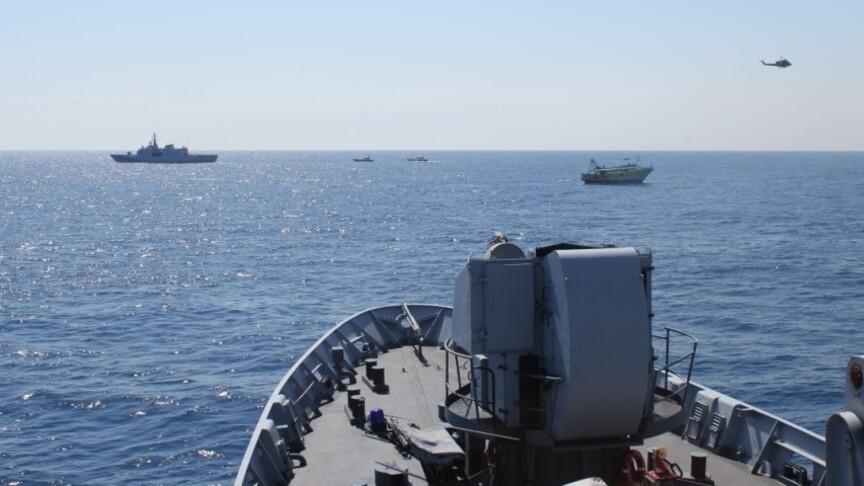
According to the official document presented to the Italian parliament, the mission aims to provide assistance, support, qualification and training to Tunisia’s maritime guard.
The mission focuses on strengthening Tunisia’s capacity to manage and monitor maritime borders and combat irregular migration.
Tunisia has faced growing European pressure to exercise more control over its shores and prevent boats carrying irregular migrants from departing.
While observers have called for greater transparency over the agreement between Tunisia and Italy, they have rejected the deployment of foreign forces in the country, amid official Tunisian silence over the Italian parliament’s decision.
“It must be recalled that any foreign security presence on national territory, even if it takes place within the framework of cooperation agreements, remains a sensitive matter linked to sovereignty and the principle of democratic oversight,” lawmaker Karbai said.
“These arrangements are concluded in the form of memoranda of understanding or executive cooperation that are not always subject to parliamentary debate or sufficient transparency before public opinion, which creates a political and institutional vacuum around the nature of these missions and their actual limits,” he added.
“The justification for these steps is usually presented under the title of combating irregular migration or combating smuggling, but the reality is that European policies in the Mediterranean have moved from the logic of cooperation to the logic of managing borders from outside, meaning transferring part of the functions of monitoring and security intervention to transit countries,” Karbai said.
He said this places Tunisia before what he called “the external securitization of European borders,” where “countries such as Tunisia turn into field spaces for implementing European migration policies.”
“Even when some crossing indicators decline during certain periods, this does not necessarily mean a retreat of the security approach, but exactly the opposite: preventive and preemptive presence is strengthened, including training, monitoring and information exchange,” he said.
“The goal is to control migration movement from its source before it reaches the sea, and this reflects a structural shift in European policy, not a temporary response to numbers,” he added.
Mustafa Abdel Kabir, head of the Tunisian Observatory for Human Rights, said the Tunisian-Italian memorandum of understanding signed in July 2023 has not been fully published for the Tunisian public.
“The agreement includes clauses such as efforts to combat irregular migration and provide advanced training to the Tunisian navy at the security and military levels,” Abdel Kabir told Anadolu.
“It’s a partnership agreement between Tunisia and Italy, and behind that, the European Union,” he said.
“Among the clauses we fear is the issue of using Tunisian space, whether air, sea or land, in combating irregular migration, because this will create problems that we reject because they are linked to sovereignty,” he said.
“The emergence of the Italian decision and its approval by parliament to allow Italian regular forces to enter and work jointly on Tunisian territory or in Tunisian territorial waters with the national security forces and maritime guard is something we do not accept,” Abdel Kabir said.
“This may have been included in the memorandum of understanding, and we do not accept it, because in the end, we are no longer just border guards, they will be guarding their borders from our borders,” he said.
“We reject guarding their borders from our borders. We support combating irregular migration, maintaining security at sea and joint cooperation in what benefits irregular migration by turning it into regular migration,” he added.
“The Tunisian Observatory for Human Rights completely rejects the presence of foreign parties in our territorial waters or on Tunisian territory under any circumstances, and I believe the Tunisian authorities are well aware of that,” Abdel Kabir said.
Mahmoud Ben Mabrouk, secretary-general of the Al-Massar party, which supports Tunisian President Kais Saied, said Tunisia is not part of the Italian decision.
“This is a decision that has nothing to do with Tunisia, because Tunisia is a state with national sovereignty and rejects any foreign interference in its space,” Ben Mabrouk told Anadolu.
“If the Italian parliament approved that, then it is a measure that does not go beyond the Italian sphere, and this is Italy’s right within the framework of protecting its borders. But talk about deploying them in Tunisia contradicts national sovereignty,” he said.
“Tunisia rejects any interference or assault on its sovereignty, and the Italian parliament cannot approve matters inside Tunisian territory. We reject this, and it has no legal dimension,” he said.
Asked about Italy’s concerns over irregular migration flows, Ben Mabrouk said: "It has the right to protect its borders.”
“North African countries, including Tunisia, Algeria and Libya, can strictly protect their borders because of the scale of the current flow,” he said.
Asked whether agreements signed between Tunisia and Italy on combating irregular migration allow for security cooperation, Ben Mabrouk said:
“Whatever the agreements and international relations may be, intervention by any state is rejected, and there are agreements that must be approved by both countries.”
“If we are talking about the Italian parliament approving a law concerning Tunisia, it must be presented to the Tunisian parliament and the Tunisian Foreign Ministry within the framework of diplomatic relations between the two countries,” he said.
“Italy must send the proposal to Tunisia, if it is true that it will send security personnel into Tunisian space, which Tunisia does not accept,” he added.
“The proposal must be subject to prior Tunisian approval, but approving it unilaterally is contrary to any international norm and to any Tunisian-Italian agreements,” he said.
The European Commission announced in September 2023 that it had allocated 127 million euros in aid to Tunisia under a memorandum of understanding covering several areas, including efforts to limit the movement of irregular migrants to Europe.
There are no official overall estimates for the number of irregular migrants in Tunisia. However, Khaled Jrad, head of the Irregular Migration Committee at the Interior Ministry, said in January 2025 that about 20,000 migrants were in the eastern areas of Al-Amra and Jebeniana, without providing figures for the rest of the country.
*Writing by Lina Altawell in Istanbul
news_share_descriptionsubscription_contact