
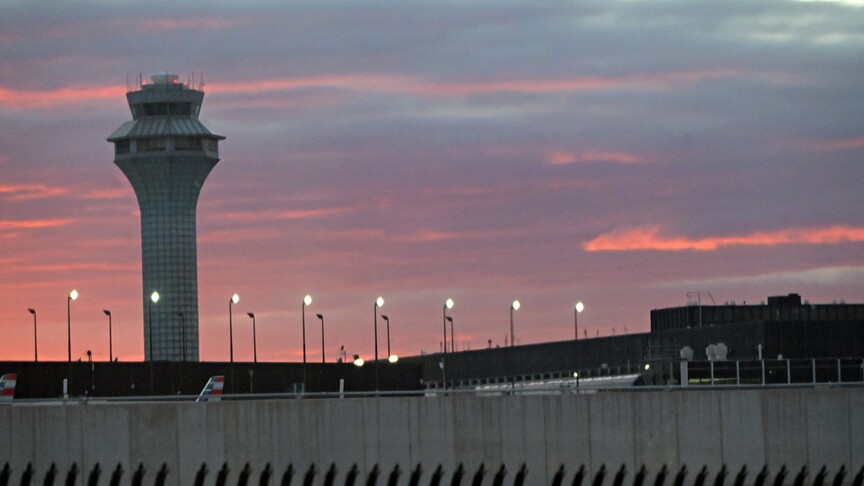
US airlines are expected to be back to full schedules Monday, three days after a communications failure forced the country's aviation agency to halt departures nationwide for more than four hours.
The Federal Aviation Administration (FAA), the government agency that runs the country’s air traffic control system, issued a nationwide ground stop after a communications failure hit the centers that guide planes across US skies on Friday.
The order was lifted that evening, but the disruption lasted all weekend.
Thousands of flights were canceled, and travelers slept in airports or struggled to rebook, with Thanksgiving, one of the busiest travel periods of the year, less than two weeks away.
President Donald Trump did not speak about the disruption at first. On Sunday, he blamed the Biden administration, saying it had made an old and broken system worse and urged Congress to approve additional funding for its modernization.
The fallout is also reaching Congress. Transportation Secretary Sean Duffy said he would send lawmakers a new funding request Monday to modernize the system. Meanwhile, investigators are still working out exactly what went wrong.
Here is what is known so far.
1 - What happened?
Problems emerged Friday afternoon when air traffic controllers began experiencing intermittent disruptions to radar systems and communications with aircraft.
The FAA, the federal agency responsible for overseeing civil aviation in the US, issued a nationwide ground stop at 3.54 pm Eastern time (2054GMT) as a safety precaution.
A ground stop prevents aircraft from taking off until authorities determine that flights can operate safely. It does not require planes already in the air to stop flying immediately.
About 3,500 aircraft were airborne when the order was issued. All landed safely, according to the FAA, which said some radar and radio systems remained operational throughout the disruption.
Emergency medical, military and law enforcement flights were also able to continue operating.
The agency lifted the ground stop at 8:15 p.m. after identifying and isolating the source of the communications problem and confirming that the network was stable.
About 1.5 million passengers were scheduled to fly from US airports Friday evening, according to aviation data firm Cirium.
2 - What caused the technical failure?
The FAA has had problems for years. It has faced repeated equipment failures, communication breakdowns and a shortage of controllers while it replaces aging systems.
Duffy, whose department oversees the FAA, first blamed old equipment. “Our switches, our routers actually got overloaded with data,” he said. He added that the FAA shut the system down and that radar and communications were never fully lost.
On Saturday, Duffy gave more detail. He said L3Harris, a long-time FAA contractor, was doing routine maintenance at at least one remote location, replacing copper wire with fiber. Fiber-optic cable is the modern replacement for older copper lines. He said the routers, the devices that direct data across a network, there were made in 2001.
The FAA’s acting chief technology officer, Rebecca Guy, said engineers looking for the cause found two locations sending a very high volume of connection requests, about a thousand every four to five seconds. Once both were switched off, the network stabilized.
Investigators are still trying to work out whether a person or a piece of equipment was at fault.
Duffy said investigators were examining whether the disruption resulted from human error or faulty equipment. “Was it user error or install error from L3Harris or did they install a faulty router?” he said.
In a statement Saturday, L3Harris said it was supporting the FAA's investigation and took the disruption and its impact seriously. The company said it had completed more than 70% of the planned transition from copper wires to fiber-optic cables in cooperation with the FAA and telecommunications partners.
A 2024 report by the Government Accountability Office, a congressional watchdog, found that 51 of the FAA's 138 air traffic control systems were considered unsustainable because of problems including outdated technology and shortages of replacement parts.
3 - Was it a cyberattack or artificial intelligence?
Officials say there is no sign of either, but they have not finished looking.
Homeland Security Secretary Markwayne Mullin said there was no indication of a threat to the US. Bloomberg reported that the FBI does not think a cyberattack or criminal activity caused the outage and is looking at a software update as a possible cause, citing a person familiar with the matter.
The timing also raised questions about artificial intelligence. On Nov. 10, just days before the outage, the FAA announced it was expanding its AI-powered SMART system to all 22 air traffic control centers. SMART is a planning tool that predicts traffic conflicts and suggests routes. At first, Mullin said officials had not ruled out the new AI tool.
FAA Administrator Bryan Bedford later said there was “zero evidence of anything AI-related” and blamed a defective piece of equipment. Air Space Intelligence, the company that built SMART, said its technology did not cause the ground stop.
The tool was already controversial before Friday. The controllers’ union has said it played no part in SMART’s design or testing. In October, more than two dozen House lawmakers asked the FAA to pause its use.
4 - Has this happened before?
Shutting down the entire country’s departures is extremely rare. Friday’s ground stop was only the third of its kind in US history.
The first came on Sept. 11, 2001. The FAA issued an unprecedented ground stop for the entire US after the second hijacked plane crashed into the World Trade Center. It was lifted in phases over several days, with most departures resuming on Sept. 13.
The second came on Jan. 11, 2023. The FAA halted domestic departures after the failure of its NOTAM system, which sends pilots safety notices about things like closed runways or broken equipment. Pilots must check these notices before every flight. More than 10,000 flights were delayed within, into or out of the US. That outage was caused by contract workers who deleted critical files by mistake. Both then and now, routine work by outside contractors has been at the center of the investigation.
Smaller, regional breakdowns have become more frequent.
In 2025, controllers lost contact with planes flying into Newark Liberty International Airport near New York, which led to weeks of delays and flight cuts there.
In September this year, a single air traffic facility near Philadelphia lost its main communications line, and its backup cable had been cut by a construction crew. More than 7,000 flights were delayed or canceled, with disruptions reaching Europe.
5 - What happens next?
Airlines spent the weekend moving planes and crews back where they belonged. On Sunday, just over 1,300 of the more than 26,000 scheduled flights were canceled, according to aviation data firm Cirium. That is about 5.2%, compared with an average cancellation rate of 3.4% before Friday.
Speaking to ABC News on Sunday, Duffy said: “We’re going to see things come back to normal today, but probably fully normal tomorrow.”
For passengers, Bedford said everyone would either be rebooked on a flight or get a full refund. But airlines’ promises of hotels and meals generally cover only disruptions within their control, which does not include FAA ground stops.
The FAA is now running a root cause analysis. Bedford said it will determine whether the router “was installed or configured incorrectly, or was simply defective.” Duffy said equipment switchovers at remote sites are done during the day, while those at larger airports happen late at night, and the timing of this work will be reviewed.
news_share_descriptionsubscription_contact

contact_the_ombudsman
is_there_an_error_in_this_story