GAZA CITY
Hanadi had to live for four years with a deep shrapnel-wound scar on her foot due to her inability to leave the blockaded Gaza Strip for treatment.
Finally, the 32-year-old woman received a grant for treatment by Palestinian plastic surgery specialist Salah al-Zaanin who arrived in his hometown to offer his services for war-afflicted Gazans.
Al-Zaanin, who traveled back from Greece in 2011, recently began treating Hanadi's complex scar, which she sustained after an Israeli rocket hit her home in Gaza City during a 2011 confrontation with the Palestinian resistance.
"I am very satisfied with the first operation's results," Hanadi told The Anadolu Agency.
She said she did not hesitate to head to al-Zaanin's clinic in Gaza, after she had failed to travel abroad for treatment due to the repeated closure of the Rafah border crossing with Egypt, Gaza's only outlet to the outside world that is not controlled by Israel.
"I still have to undergo a number of other surgeries until my foot goes back to looking normal so I would finally overcome the embarrassment and self-consciousness I suffered from having to live with that scar," she said.
Equally satisfied with his surgery's results is Ahmed, who has undergone a fat tissue transplant surgery to repair skin damage on his foot from third-degree burns he had suffered during Israel's devastating offensive on the Palestinian coastal enclave last summer.
Like Hanadi, Ahmed had obtained a grant for treatment in Europe, but was repeatedly obstructed from traveling due to Egypt's tightened grip on the Rafah crossing.
"After failing to travel, I managed to obtain a grant for treatment by al-Zaanin who is qualified to perform surgeries which are normally assigned for treatment abroad," Ahmed, 24, said.
Al-Zaanin, who had been running his own clinic in Greece for 12 years, says dozens of people frequent his clinic in Gaza on a weekly basis since he returned home.
"I came back after I heard that many people here in Gaza needed reconstructive surgeries, many of which are complex," al-Zaanin, who holds accreditation by European and Greek as well as Palestinian medical boards, told AA.
He added that Israel's eight-year blockade on the Gaza Strip had obstructed the transfer of medical equipment which he had attempted to procure for his Gaza clinic.
"I tried to bring in some equipment from Arab countries, but they were not available there," al-Zaanin said.
He noted that his clinic began receiving many more patients – men and women alike – following last summer's Israeli offensive.
Treatment funds for many of the patients, Al-Zaanin said, come from grants by NGOs working to support Palestinian victims of Israeli attacks.
But not all of Dr. al-Zaanin's patients seek to heal post-war scars.
"Some female patients come to the clinic for nose jobs, breast enlargement or liposuction surgeries," al-Zaanin said.
"The Gaza Strip is one of the world's cheapest places for cosmetic surgeries," he added.
He noted that Gaza's residents had unbeatable perseverance and love for life, despite their plight.
Home to some 1.9 million Palestinians – most of whom are registered as UN refugees – the Gaza Strip has been subjected to three Israeli military campaigns within the past seven years.
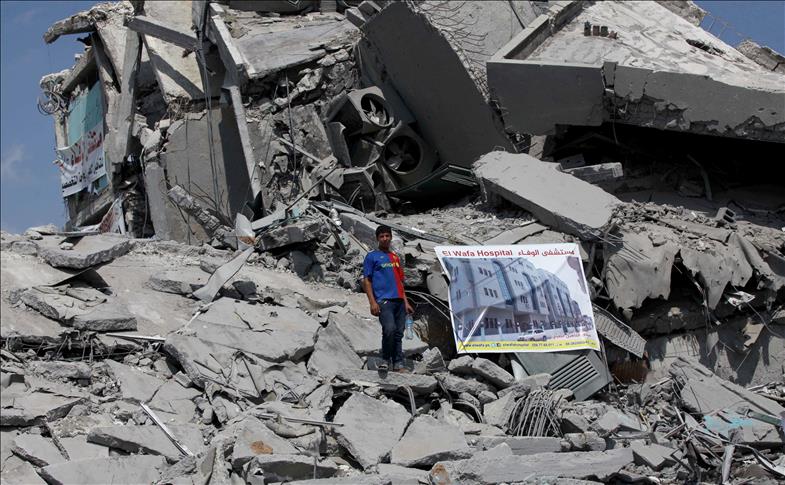
Israel last attacked the Gaza Strip in July and August of 2014 for 51 days during which 2,160 Palestinians were killed and 11,000 others injured.
The offensive was launched with the ostensible aim of halting rocket fire from Gaza, which has been suffering an all-out Israeli blockade since 2007.
The offensive ended on August 26 of the same year after Israel and Palestinian factions signed an indefinite ceasefire through indirect negotiations in Cairo.
Blockaded by Israel – by air, land and sea – since 2007, the Gaza Strip has a total of seven border crossings linking it to the outside world.
Six of these crossings are controlled by Israel, while the seventh – the Rafah crossing – is controlled by Egypt, which keeps it tightly sealed for the most part.
Israel sealed four of its commercial crossings with Gaza in June 2007 after Palestinian resistance movement Hamas wrested control of the strip from the Ramallah-based Palestinian Authority.
As it currently stands, Israeli authorities allow the Kerem Shalom crossing – which links Gaza to both Israel and Egypt – to operate for commercial purposes.
A truce deal signed in Cairo last summer by Israel and Palestinian groups in Gaza called for reopening the strip's border crossings – a move which, if implemented, would effectively end the eight-year blockade of the territory.