The Bab el-Mandeb Strait, one of the world’s key gateways for energy and trade alongside the Strait of Hormuz and the Suez Canal, has moved to the center of an increasingly complex equation since the outbreak of the US-Iran war in late February.
With the Houthis taking control of strategic positions near the strait and threats to shipping and energy infrastructure expanding, Bab el-Mandeb, through which about 12% of global annual trade passes, has become a growing concern for global shipping and energy markets.
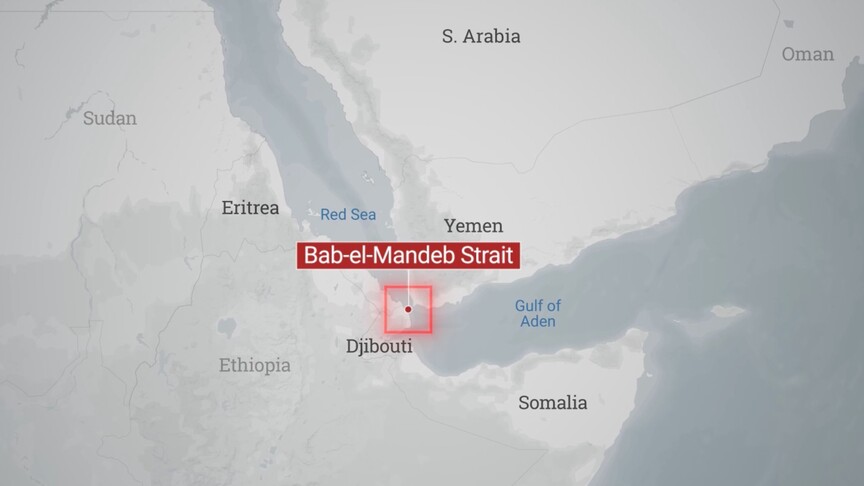
The strait links the Red Sea with the Gulf of Aden and the Indian Ocean and serves as a gateway to the Suez Canal to the north and from there to the Mediterranean, giving it major strategic importance for trade between Asia and Europe.
Concerns have intensified in recent weeks as the Houthis advanced into strategic areas near the strait. Recent analysis has pointed to the Houthi capture of Mokha and nearby islands as significantly increasing the group’s ability to influence maritime traffic through Bab el-Mandeb.
In 2023, following the outbreak of Israel’s war on the Gaza Strip in October, the Houthis began attacking commercial vessels in the Red Sea and Bab el-Mandeb that they said were linked to Israel, prompting major shipping companies to reroute vessels around the Cape of Good Hope.
The disruption directly affected shipping through Egypt’s Suez Canal. Egyptian Foreign Minister Badr Abdelatty recently estimated that his country had lost about $11 billion in canal revenues due to Red Sea disruptions.
On Tuesday, the UN Security Council discussed developments affecting navigation in the Red Sea and Bab el-Mandeb. Saudi Arabia warned during the session of Houthi threats and stressed that protecting maritime routes and freedom of navigation is a shared international responsibility.
Against this backdrop, Anadolu spoke to experts in military affairs, energy and supply chains from Egypt, Britain, Iraq and Algeria, who outlined three possible paths for the crisis: continued escalation, expansion into a broader regional confrontation or a settlement that restores stability to the waterway.
Egyptian military and strategic expert Brig. Gen. Samir Ragheb told Anadolu that “the Houthis have the ability to impose fire control over the Bab el-Mandeb Strait.”
He said the Houthis “have a military presence at strategic positions surrounding the strait, beginning with Mayun Island, passing through Mokha, Hays and southern Al-Hudaydah, and extending to the eastern coast of Dhamar province.”
Ragheb, head of the Arab Center for Strategic Studies, said there had been a military solution whereby “national forces could impose control over the coast, thereby pushing the Houthis away from those areas and ending the threat to the strait.”
“This has not happened yet, but if the national forces regain their capabilities, they will return to control and the threat will end,” he said.
Regarding the nature of the current control, he said: “If we are talking about direct naval control, warships belonging to international coalitions are the most capable. But the situation is not a battle between two naval fleets. Rather, the Houthis are targeting civilian and commercial vessels, creating panic among them and driving insurance prices and costs up threefold, while forcing ships to reroute around the Cape of Good Hope.”
On the prospects for escalation and de-escalation, Ragheb said escalation would become more likely if “one of the active blocs in the scene enters the military confrontation,” in addition to the possibility of the US avoiding direct military involvement.
The repercussions of the crisis extend beyond navigation, as escalation in Bab el-Mandeb has coincided with disruption in the Strait of Hormuz and the loss of alternative routes for oil exports, placing energy markets under simultaneous pressure.
Mamdouh Salameh, a British-based international expert on oil and energy affairs, told Anadolu that the Houthis’ attempts to control Bab el-Mandeb, together with Iran’s closure of the Strait of Hormuz, represent an Iranian attempt to impose its terms on Washington at a time when global oil and gas supplies are declining and major oil-consuming countries have used a large portion of their strategic reserves.
Salameh did not rule out the possibility that the dual disruption in Hormuz and Bab el-Mandeb could push Brent crude above $108, and possibly to $110 or $120 a barrel, levels he said would exceed the global economy’s ability to withstand the shock and drive up the cost of living as well as industrial and food production.
Salameh does not believe there is an alternative to Hormuz and Bab el-Mandeb, particularly because the alternatives themselves are under threat.
He noted that Saudi Arabia sought, after the closure of Hormuz, to make use of its East-West pipeline, which ends at the Red Sea port of Yanbu. However, the pipeline was recently attacked by the Houthis and temporarily shut down, affecting Saudi exports.
Energy expert Asim Jihad told Anadolu that the current problem is that the threat has begun approaching the alternative route itself, particularly following the shutdown of Saudi Arabia’s East-West pipeline, which can normally transport about 5 million barrels of oil per day.
That would deprive oil markets, particularly Asian markets, of part of the supplies on which they heavily depend, said Jihad, a former spokesman for Iraq’s Oil Ministry.
He explained that as flows through Hormuz declined sharply, the importance of alternative routes increased, with oil transit through Bab el-Mandeb rising from about 5.4 million barrels per day in the fourth quarter of 2025 to about 8.1 million barrels per day in the second quarter of 2026.
Bab el-Mandeb and the Red Sea have consequently become an essential part of efforts to compensate for the shortfall through Hormuz, which carried nearly 20 million barrels of oil per day before the Iran war, he said.
Jihad believes that extending the crisis to Bab el-Mandeb or continuing to disrupt alternative routes would mean more than higher oil prices and could produce a dual crisis in oil and gas supplies amid deliberate pressure.
He stressed that the waterways do not need to be physically closed for these consequences to emerge. Simply increasing the perceived risk leads to higher tanker rates and insurance premiums, changes in shipping routes and longer journey times.
Algerian logistics and supply-chain expert Nasreddine Boughachiche, meanwhile, told Anadolu that “the situation in the Red Sea and Bab el-Mandeb stands at a very critical crossroads.”
“Field data and maritime analyses clearly indicate that the situation is moving toward a scenario of escalation and continued instability rather than imminent de-escalation,” he said.
Boughachiche said the Houthis’ recent push to expand their field presence and intensify fire control over Bab el-Mandeb aims to use the strait as a major bargaining chip in any potential regional negotiations.
He noted that preemptive strikes have so far failed to completely neutralize Houthi capabilities, leaving the maritime environment in the region highly risky for a potentially prolonged period.
From this perspective, Boughachiche outlined several possible scenarios.
The first, he said, is “the most realistic scenario at present: continued escalation and deepening uncertainty.”
This scenario would mean continued attacks on vessels or an expansion of the risks to include new routes and projects, prompting more global shipping companies to abandon the direct trade route.
A second scenario, which Boughachiche described as less likely but possible, would be an expansion of the confrontation into a broader regional conflict, leading to the near-total obstruction of the strait at intermittent periods.
The third is de-escalation and a comprehensive settlement. Boughachiche said this currently appears weak and the furthest from implementation because of the complexity of regional issues, particularly those linked to the balances managed by Iran in the region, although he said it could not be ruled out.
news_share_descriptionsubscription_contact

contact_the_ombudsman
is_there_an_error_in_this_story