Anadolu Ajansı © 2026


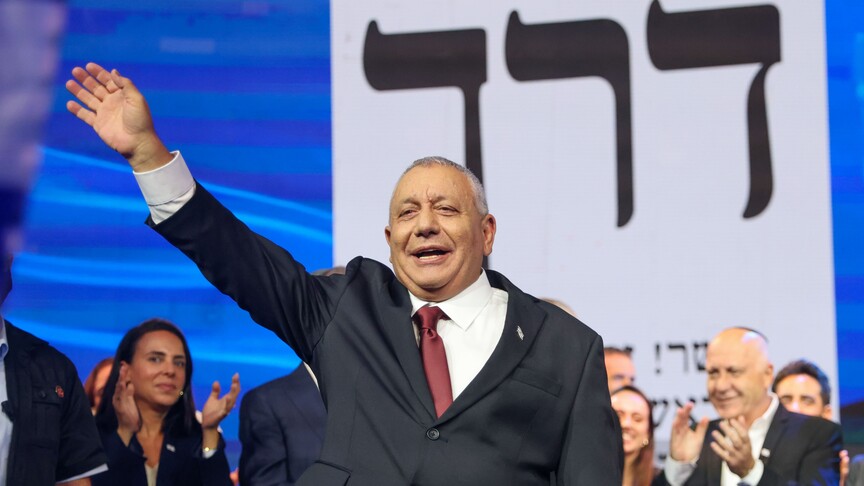
Israeli Prime Minister Benjamin Netanyahu and former army chief Gadi Eisenkot, two prominent figures competing for political leadership, share hardline positions on several aspects of Israel’s security policy and the Palestinian issue but differ over domestic governance, military conscription, and relations with Arab political parties.
Their differences have come into sharper focus following Israel’s Oct. 27 election, which left Netanyahu’s bloc with 53 seats in the 120-member Knesset, short of a majority, while Eisenkot’s bloc secured 48 and Arab-led parties won 19.
President Isaac Herzog tasked Eisenkot with forming a government on Nov. 8 after 67 lawmakers recommended him for the mandate. He has until Dec. 6, with a possible 14-day extension, to secure a parliamentary majority.
Eisenkot's bloc is pursuing negotiations with the ultra-Orthodox United Torah Judaism party while also holding discussions with Netanyahu's Likud. However, no agreement has been reached.
The negotiations have exposed divisions within the opposition bloc, particularly between Yisrael Beytenu leader Avigdor Liberman, who opposes relying on Arab parties, and Democrats leader Yair Golan, who supports their involvement in forming a government.
The following comparison examines their positions and public statements on key issues.
Both Netanyahu and Eisenkot support dismantling Hamas's military capabilities and preventing the group from governing Gaza.
Netanyahu has called for Hamas to disarm before Gaza can be reconstructed and that Israel must retain its occupation over the territory.
Eisenkot, a former Israeli army chief and member of the war Cabinet, shares the same views. In an October 2026 campaign statement, he promised that "within 18 months of taking office as prime minister, Hamas will no longer rule the Gaza Strip."
Later, in an interview with The Times of Israel, he said he would advance US President Donald Trump's post-war Gaza plan, but insisted on Hamas's disarmament.
Although both leaders agree on removing Hamas from power, they differ over the role of international forces and the future civilian administration of Gaza.
Both Netanyahu and Eisenkot consider Iran a major security threat and oppose Tehran acquiring nuclear weapons, but differ over the approach to confronting it.
Netanyahu has adopted a hardline position, advocating military action to prevent Iran from developing nuclear weapons and calling for regime change in Tehran.
At an Israeli military ceremony on Oct. 21, he accused Tehran of resuming efforts to develop nuclear weapons and said regime change was the only way to eliminate the threat.
Eisenkot, a former Israeli army chief, has called for closer coordination with Washington, stronger international inspections and a comprehensive strategy combining diplomatic and military measures.
Their differences have become more apparent following the election. In November, Eisenkot urged Netanyahu to avoid unnecessary military operations during the political transition, warning of potentially serious consequences.
Neither Netanyahu nor Eisenkot supports the establishment of a fully sovereign Palestinian state under the two-state framework, leaving little prospect for Palestinian self-determination under either leader's proposed policies.
Netanyahu has repeatedly rejected Palestinian statehood and insisted that Israel retain control over the territory between the Jordan River and the Mediterranean Sea.
In January 2026, he said: "Israel will maintain security control over the entire area from the Jordan River to the sea."
Eisenkot has also rejected the two-state formula, saying that anyone who thinks on those lines is "delusional."
Both leaders support maintaining Israeli control over the occupied West Bank.
Eisenkot has proposed allowing the Palestinian Authority to administer Palestinian population centers in the occupied West Bank, while Israel retains overriding security control.
He has described the possible future arrangement as "autonomy or a state-minus," adding that it "certainly will not have an army, and will be under overriding Israeli security control."
One of the sharpest differences concerns the relationship between Israel's government and judiciary.
Netanyahu has defended his government's judicial overhaul, which sought to limit certain powers of the Supreme Court and increase the influence of elected officials over judicial appointments.
His government has argued that the changes would restore the balance between the judiciary and elected representatives. Critics say they threaten judicial independence and democratic checks and balances.
Eisenkot has pledged to reverse key elements of the overhaul. He described legislation changing the judicial selection process as "a corrupt law designed so that politicians will select judges according to a partisan key."
He also pledged to reverse measures weakening the attorney general and restore the independence of institutions responsible for investigating judicial misconduct.
On Nov. 10, his parliamentary bloc submitted proposals aimed at reversing key elements of Netanyahu's judicial reforms.
The question of compulsory military service for ultra-Orthodox Jewish men represents another major dividing line.
Netanyahu has relied on ultra-Orthodox parties to maintain his governing coalitions and has supported arrangements protecting religious seminary students from compulsory military service.
Eisenkot advocates broader military, national or civilian service obligations for all Israeli citizens, including ultra-Orthodox men.
He has also criticized ultra-Orthodox leaders who reject military enlistment.
The issue has become a central obstacle in coalition negotiations, as Eisenkot seeks to persuade United Torah Judaism to join his bloc while the party demands guarantees over military-service exemptions for yeshiva students. Shas, the other major ultra-Orthodox party, remains aligned with Netanyahu.
The two politicians differ over how Israel should investigate the security and political failures surrounding the Oct. 7, 2023 attack.
Netanyahu has resisted calls for an independent state commission of inquiry, while arguing that the investigation should have broad public legitimacy.
Eisenkot has called for an independent commission with the authority to examine the conduct of political and military officials.
"We will immediately pass a government decision establishing a formal state commission of inquiry...," he told Israeli media.
The issue is particularly significant because Eisenkot served in Netanyahu's emergency government during the war and later left it, accusing the prime minister of failing to take necessary decisions.
His party introduced proposals for an independent inquiry when the new Knesset convened on Nov. 10.
The role of Arab-led parties in forming a government is among the most immediate political differences between the two leaders.
Netanyahu has opposed relying on Arab parties for parliamentary support, arguing that such cooperation threatens Israel's security and Jewish identity.
He has also called for a unity government comprising Zionist parties under his leadership.
Eisenkot has left open the possibility of parliamentary cooperation with Arab-led parties, provided they accept certain conditions, including recognition of Israel as a Jewish and democratic state and Hamas as a terrorist organization.
However, he has also imposed restrictions on potential coalition partners and has not offered unconditional support for Arab parties joining his government.
Netanyahu has defended his right to remain in office and opposed proposals that would restrict the prime minister's tenure.
Eisenkot has proposed limiting a prime minister's time in office to eight years and preventing anyone facing criminal charges from forming a government.
His bloc submitted legislation on term limits when the new parliament convened on Nov. 10.
The proposals reflect Eisenkot's broader argument that Israel needs stronger institutional accountability and limits on executive power.
news_share_descriptionsubscription_contact

contact_the_ombudsman
is_there_an_error_in_this_story