Laith al-Jnaidi and Serdar Dincel
19 November 2026•Update: 19 November 2026
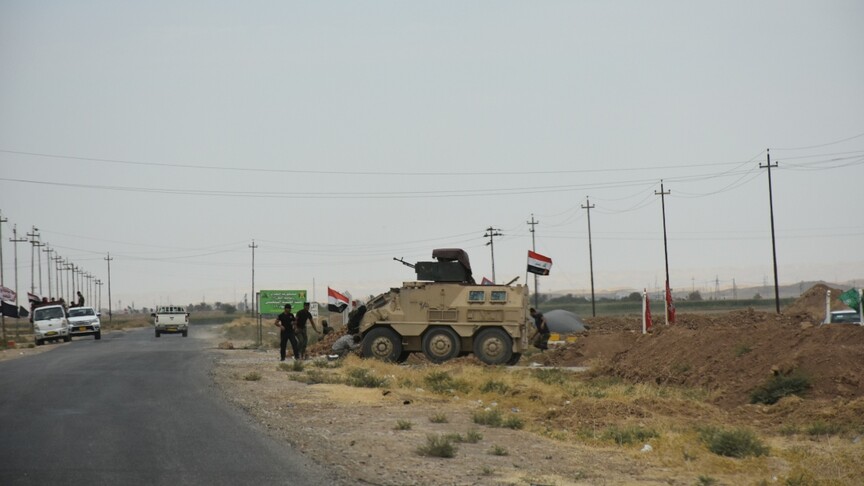
Iraqi joint forces will begin redeploying in the Jurf al-Nasr area of central Iraq's Babil province on Friday, state media reported Thursday, citing a source familiar with the matter.
The unnamed source said the redeployment would begin “tomorrow, Friday,” without specifying its starting time or duration, according to the Iraqi News Agency (INA).
The announcement came a day after a document issued by the office of Prime Minister Ali al-Zaidi, in his capacity as commander-in-chief of the armed forces, showed that he had approved a plan to divide security responsibilities in the area among the army, Federal Police, Popular Mobilization Forces (PMF) and Energy Police.
Under the plan, the army will take responsibility for one sector, while the Federal Police will oversee security in the center of Jurf al-Nasr subdistrict.
The PMF will be responsible for another sector, while an Energy Police battalion will be tasked with “securing and guarding oil transport pipelines in the sector.”
The plan also calls for establishing two checkpoints staffed by Babil and Anbar police and reopening the road linking Al-Musayyib, Al-Bahbahani, the Fadhiliyah intersection and Amiriyah al-Fallujah to traffic.
A counterterrorism battalion will serve as a reserve force under the commander-in-chief to respond to emergencies in the area.
Earlier, PMF chief Faleh al-Fayyad proposed in a Nov. 16 letter assigning the Jurf al-Nasr sector to the PMF's 72nd and 79th brigades and its special forces battalion, while tasking the Energy Police with securing the oil pipeline.
Al-Zaidi subsequently approved the division of responsibilities among the joint forces in a letter dated Nov. 17, explicitly referring to al-Fayyad's proposal.
The arrangements follow a government announcement Monday that al-Zaidi had ordered armed forces to enter Jurf al-Nasr, also known as Jurf al-Sakhar, and set a deadline for Kataib Hezbollah to withdraw from the area.
Government spokesman Haider al-Aboudi did not disclose when the deadline would expire.
The directives came amid investigations into suspected oil smuggling.
Al-Aboudi said an investigative committee had inspected six sites and found what he described as “clear manipulation of pipelines passing through the area” and attempts to conceal evidence, along with two refineries, a tanker and storage tanks.
Kataib Hezbollah denied the smuggling allegations, saying the inspection had found no pipeline violations and that the tanks and facility in the area were used to supply fuel to military vehicles.
Jurf al-Nasr, formerly known as Jurf al-Sakhar, lies in northern Babil province. Iraqi forces and PMF factions recaptured the area from the Daesh/ISIS terrorist group in 2014.
The area has since remained under tight security, with armed factions, particularly Kataib Hezbollah, maintaining influence there. Many displaced residents have yet to return.