OPINION - Hungary's elections: Implications for regional and global politics
With Viktor Orban moving into opposition, Peter Magyar's voters expect a reorientation of Hungary's foreign policy: improved relations with EU and neighboring countries, including Kyiv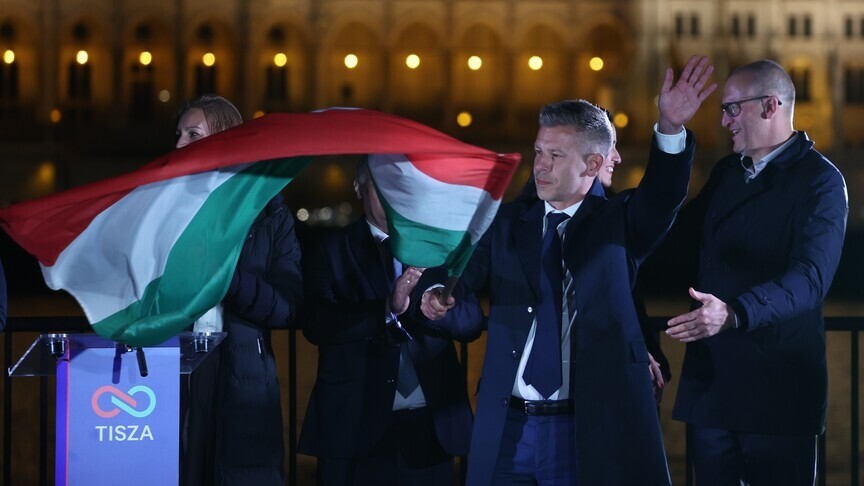
The author is a researcher at the Ludovika University of Public Service.
The Hungarian parliamentary election attracted far greater international attention than would historically be warranted for a small Central European country. A relatively new party, the Tisza (Respect and Freedom Party), secured two-thirds of the seats in parliament with more than half of the votes, while the former governing coalition, Fidesz and the Christian Democratic People's Party, received less than 40%.
This surprise victory came against Hungary's incumbent Prime Minister Viktor Orban: a leader who, winning every election since 2010, had been able to form governments with confidence. The system he built represented not only a domestically undisputable power bloc, but also, as an EU member state, maintained close relations with numerous powers -- including the US (or at least with President Donald Trump), Russia, China, and Türkiye -- while attempting to create a distinctive form of "connectivity" in an increasingly bloc-based world. This domestic and foreign policy power-building, however, led to isolation within the EU and the blocking of a significant portion of EU funding, further weakening already low prospects for economic growth.
Among several factors playing a key role in Tisza Party's landslide electoral victory, the economy was crucial. Following the 2022 election, Hungary was forced to confront the most severe inflationary crisis of the past two decades.
In this situation, recently emerging corruption scandals also provoked greater public outrage. Additional political scandals further weakened the self-proclaimed conservative-Christian narrative of Fidesz.
Orban's ‘central force’
In his speeches prior to the 2010 electoral victory, Viktor Orban outlined the concept of a "central force," which in practice meant the creation of a power bloc uniting religious, urban right-wing intellectuals with workers and significant segments of small-town and rural populations. This system functioned effectively for a decade and a half. Opposition parties were unable to effectively counter Fidesz's dominance in media and resources: neither individually nor in their united effort in 2022 were they capable of defeating it.
This changed in 2024, when, in connection with the clemency scandal, a previously unknown figure, Peter Magyar, emerged via the Hungarian online media platform Partizan. Coming from a traditionally conservative Fidesz background -- and the former husband of a minister of justice -- he delivered an insider critique of the government that was watched live by tens of thousands and brought him national prominence overnight.
While the government's campaign focused primarily on protecting national sovereignty and avoiding entanglement in the war in Ukraine, Peter Magyar was able to frame the election as a referendum on Orban. Although the Tisza Party sits within the European People's Party group in the European Parliament and defines itself as a center-right and pro-European party -- nor is any substantive change in migration policy expected compared to the Orban government -- in reality, it is still an anti-Orban catch-all party that represents broad segments of Hungarian society with differing ideologies.
Site of clashing international interests
With Orban moving into opposition, Magyar's voters expect a reorientation of Hungary's foreign policy: improved relations with the EU and neighboring countries. Compared to Orban's Ukraine-critical foreign policy of recent years, relations with Kyiv are also expected to improve; even if they do not become warm, they will be more constructive.
During the campaign, Tisza sought to frame the election as a choice between Russia and Europe, which appeared credible given the Orban government's ties to Moscow. As a result of the change in government, a much more pragmatic foreign policy aligned more closely with EU objectives can be expected. At the same time, this policy will not be free of conflicts, but the European press is unlikely to be dominated by Hungary's regular European Council vetoes in the future.
Alongside the normalization of relations with the EU's leading powers, it is also important to note that the Hungarian prime minister will no longer back the Patriots for Europe, a far right-wing political group within the EU -- thereby depriving several Western and Central European far-right parties of an important ally -- but will instead belong to the same political family as the leaders of Austria, Germany, Finland, and Poland, among others.
While priority will be given to improving ties within the EU and with neighboring countries, a more pragmatic approach to relations with China, Russia, and the Turkic states is expected, in contrast to Orban's "Eastern Opening" policy launched in the early 2010s.
Thus, relations will be more institution-based, replacing the current personalized approach. From this point of view, the biggest loser of the elections in geopolitical terms is Russia; the power shift in Hungary may cause further diminishing of Russian influence over other European countries as well. A similar shift is expected in US-Hungary relations. As a NATO ally with a strengthened alignment with the West, Budapest will seek good relations with the American administration, albeit without the strong personal ties it previously enjoyed.
Economically, expectations center on renewed growth, which will undoubtedly be challenging given the looming energy crisis, though many hope that billions in EU funds can be unlocked. Nevertheless, mending fences after years of disputes will not be easy; the Hungarian government will need to build trust and will likely follow the example of Poland.
*Opinions expressed in this article are the author's own and do not necessarily reflect the editorial policy of Anadolu.